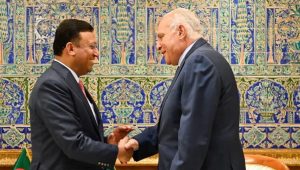
The harassment of Prime Minister’s Information Adviser Dr Zahed Ur Rahman at New Delhi airport is being viewed as a deliberate signal from India that relations with the BNP government may remain strained. The incident has prompted a strong reaction in Dhaka, which has conveyed its displeasure to New Delhi through diplomatic channels.
Bangladesh informed Indian authorities of Zahed’s visit on Friday, more than 60 hours before his arrival. Bangladesh High Commissioner to India M Riaz Hamidullah was also present at the airport to receive the adviser.
Despite the advance notification and diplomatic arrangements, Indian immigration authorities kept him waiting for more than two hours before allowing him entry. During the period, the high commissioner and other officials of the Bangladesh mission made repeated efforts to resolve the issue.
Diplomatic experts argue that the explanation offered by Indian authorities does not fully justify the long delay. They note that New Delhi had prior knowledge of the visit and that any administrative or communication lapse on the Indian side could have been resolved within minutes.
The treatment of the adviser could further complicate bilateral relations, which had remained particularly close during the Awami League’s tenure. The incident happened when hundreds of Awami League leaders and activists are taking shelter in India since 2024, without any valid documents.
“It might be intentional. What we have seen over the past month is that India’s actions do not match its public messaging. There is a lack of coherence between messages and actions,” former ambassador Mahbub Hassan Saleh told TIMES of Bangladesh, warning that such incidents could be detrimental to the development of bilateral ties.
The harassment has triggered a strong reaction in Dhaka, with Bangladesh summoning India’s acting High Commissioner Pawan Badhe on Monday for the second time in six weeks. Foreign Ministry Director General Ishrat Jahan conveyed Bangladesh’s displeasure to the Indian diplomat over the incident.

The episode comes amid growing strains in relations between Dhaka and New Delhi following the political changes in Bangladesh after the August 2024 mass uprising that led to the fall of the Sheikh Hasina-led Awami League government.
What happened at Delhi Airport
Zahed Ur Rahman travelled to New Delhi to attend the senior officials’ meeting of the Indian Ocean Rim Association (IORA), held on June 15-16. He was leading a five-member delegation.
According to diplomatic sources, Bangladesh informed Indian authorities of the visit through a note verbale sent at 12:04pm on Friday, more than 60 hours before his arrival. Accordingly, Bangladesh High Commissioner to India M Riaz Hamidullah, accompanied by another diplomat and a protocol officer, went to the airport on Sunday to receive the adviser.
After disembarking, Dr Zahed was escorted to immigration and submitted his passport, but he was then directed to a waiting area and asked to remain there.
Bangladeshi officials said the adviser was kept waiting for over two hours without being given any clear explanation. Throughout the ordeal, officials of the Bangladesh High Commission, including the High Commissioner, remained in contact with India’s Ministry of External Affairs in an attempt to know what went wrong.




Sources said Hamidullah spoke with the official in charge of the Bangladesh desk at the Indian foreign ministry and initially received a response. However, subsequent calls from the High Commissioner reportedly went unanswered, further deepening Dhaka’s concerns over the handling of the matter.
Eventually, Indian immigration authorities informed Dr Zahed that he had been cleared to enter the country. By then, however, he decided not to proceed with the visit. Despite requests from immigration officials, he declined to enter India and remained at the airport. Arrangements were subsequently made for him and his entourage to return to Dhaka via Colombo on Monday morning.
‘Deliberate’ move
Diplomatic sources said Indian authorities later cited an apparent administrative error for the delay, saying that the PM’s adviser had previously been placed on an Indian watchlist because of his activism against the Hasina government. Although his name had reportedly been removed from a social media-related blacklist, it allegedly remained on an immigration watchlist, triggering an alert upon arrival.
Dr Zahed was travelling to Delhi with ordinary passport and Saarc visa which allows him to travel any member in the Saarc region. He is entitled to diplomatic passport, but he did not apply for such passport, which is considered as privilege and it is individual choice to avail the privilege or not.
Indian authorities, which had two days to clear his name from the immigration watchlist and ensured his smooth entry to India. Eventually, they did it after the harassment of the adviser at the airport, which experts believe “intentional”
Former ambassador Saleh questioned the explanation.
“It is practically impossible to accept such an explanation [made by the Indian authorities]. Even if there had been an administrative issue on the Indian side, it should have been resolved in a very short time. Keeping an adviser with ministerial status waiting for more than two hours gives an impression that it was a deliberate attempt to harass him.”
Impact on bilateral relations
The incident comes against a backdrop of broader tensions between the two neighbours.
Although Indian leaders have repeatedly stated that New Delhi is willing to engage with Bangladesh’s elected government, some analysts argue that relations have yet to improve significantly since the BNP government assumed office in February due to Indian government’s mindset and some controversial actions.
Bangladesh has raised concerns in recent months over border killings and India’s push-in attempt of undocumented individuals across the frontier.
People-to-people contact between the two countries has also slowed, according to observers.
Former ambassador Saleh warned that India’s actions risk fuelling anti-Indian sentiment in Bangladesh. “Such actions will have a negative impact on bilateral relations,” he said.
He added that if tensions continue, Bangladesh may increasingly strengthen ties with other regional powers, including China.
Debate over responsibility
Following the incident, some commentators and journalists questioned whether there had been any communication lapse on the part of the Bangladesh High Commission in New Delhi. Their comments went in favour of India.
A former diplomat, speaking on condition of anonymity, suggested that some criticism of the High Commission may have been motivated either by personal grievances or by attempts to shield Indian authorities from criticism.
What Bangladesh can do
Diplomatic experts say Bangladesh has several options to signal its dissatisfaction while keeping diplomatic channels open.
Some have suggested delaying credential presentation involving India’s newly appointed High Commissioner-designate, while others argue that concerns should be raised directly in upcoming bilateral meetings.
They also said that Indian high commissioner’s meeting with the prime minister should be delayed as long as possible.