


Farida Akhter, Adviser to the Ministry of Fisheries and Livestock, has stated that fisheries resources are not merely subjects of economics or science but are deeply intertwined with religion, culture, and social behaviour.
She emphasised that viewing the sector solely through technical or economic lenses would fail to capture its full significance.
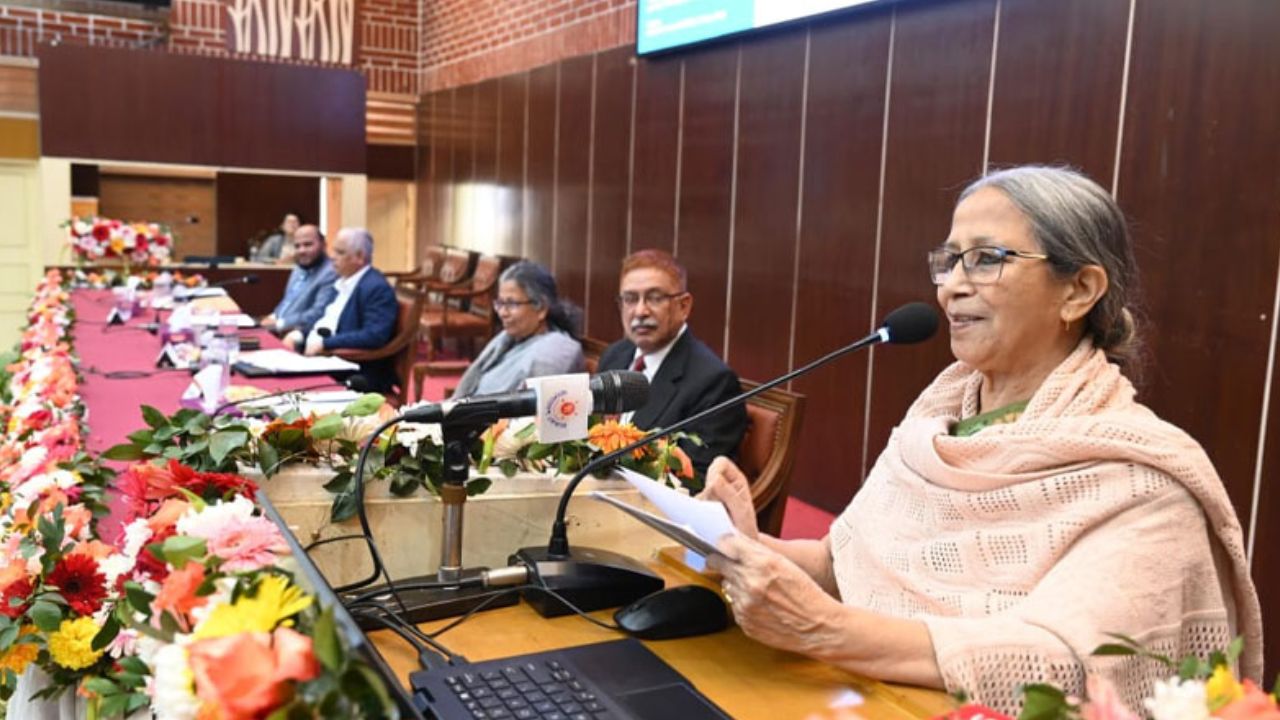
The Adviser was speaking as the chief guest at an inception workshop titled “Research Proposal Review and Planning (2025-26) for Development and Management Project of Natural Fish Spawning Ground of Halda River” on Saturday.
The event, held at the Bangladesh Agricultural Research Council (BARC) auditorium in Dhaka, was organised by the River Centre, Chandpur, under the Bangladesh Fisheries Research Institute (BFRI).

Research for the people Adviser Farida Akhter asserted that because the Halda River is a public resource, research presentations and final reports should be written in language accessible to the general public. While presentations may be in English, she insisted that final reports must be published in Bengali.
She also stressed the importance of including women in socio-economic research, noting that understanding the realities of the Halda requires considering the positions and experiences of local women. Research methodologies must explicitly include female participation.




Addressing threats to the Halda Identifying human activity as the primary threat to the river, the Adviser urged researchers to use clear language rather than hiding behind the term “anthropogenic”. She stated that if the Bhujpur Rubber Dam is found to be harmful, immediate steps should be taken for its removal.
Furthermore, she highlighted that tobacco cultivation along the riverbanks poses a significant threat to fisheries. She expressed hope that the policy prohibiting tobacco cultivation on triple-crop land would provide some protection. The Adviser also called for effective sluice gate management and controlled measures against the invasive “Sucker Fish”.
Project timelines and evaluation Regarding project implementation, the Adviser insisted on meeting deadlines without initially planning for extensions. She proposed a mid-term workshop in late 2026 or early 2027 to evaluate progress.
The workshop was chaired by Anuradha Bhadra, Director General of BFRI. Special guests included Md Imam Uddin Kabir, Chairman of the Bangladesh Fisheries Development Corporation (BFDC) and Additional Secretary, and Md Abdur Rouf, Director General of the Department of Fisheries.
The technical sessions featured experts including Professor Md Moshrefa Ali of BUET, Assistant Professor Mohammad Samsil Arefin of Chittagong University, and Professor SK Ishtiaque Ahmed of Chittagong Veterinary and Animal Sciences University.