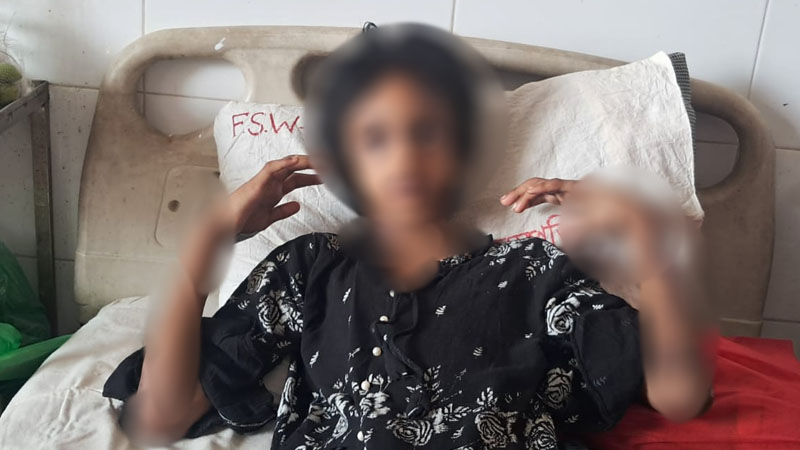
Eleven-year-old Mohna, who lost her mother in a road accident at the age of three, sought a maternal figure in her employer, Bithi. She addressed the woman as “Ma,” yet this affection was met with systematic and “routine” brutality.
Mohna is currently undergoing treatment at Gazipur Shaheed Tajuddin Ahmad Medical College Hospital, where doctors have confirmed that her injuries are the result of consistent, long-term abuse.
Dr Mohammad Khalilur Rahman, head of the surgery department, noted that the child’s body bears scars from various intervals – some from ten days ago, others dating back two months.
The Managing Director and CEO of Biman Bangladesh Airlines, Shafiqur Rahman, his wife Bithi, and two other domestic staff, Rupali Khatun and Sufia Begum, have been sent to jail by a Dhaka court following these harrowing revelations.
While Mohna claimed her “Sir” was often kept unaware of the abuse because she was locked in the washroom whenever he returned home, the humanitarian cost of her eight-month stay in the Uttara residence has been devastating.
Routine brutality behind closed doors
Mohna’s daily life was a cycle of fear and physical pain. She recounted being beaten with sticks and having her hair pulled for minor lapses, such as failing to cut vegetables or look after the household’s baby.




Most disturbingly, she was frequently burned with heated spatulas. “I was always kept in the bathroom and not given food,” the child shared from her hospital bed. “Even when I was hungry, I was too terrified to ask for food”.
Her grandmother, 70-year-old Rezia, expressed her anguish, stating that the accused “did not consider humans as humans,” and described how the child’s back had been “split open” by beatings with sticks.
The child’s former guardian, Israfil, who had cared for her for eight years before her father placed her in the Biman official’s home, called for justice to ensure no other impoverished child suffers such a fate.
Broken promise of a better life
For Mohna’s father, Golam Mostafa, a hotel worker in Konabari, the decision to send his daughter to a wealthy household was driven by a desperate hope for her future.
He was led to believe by a security guard that the employers were “good people” who would eventually arrange for her marriage. Instead, he found himself barred from the house for months and was eventually forced to sign a blank piece of paper when he came to retrieve his daughter on 31 January.
Upon seeing Mohna’s condition, Mostafa was told by Bithi that the injuries were merely a “skin condition” caused by a fall in the bathroom. The family provided him with 5,000 Tk and sent them away.
“I am a poor man. I gave my daughter to a wealthy household thinking they would raise her, but they would have killed her if she had stayed a few more days,” Mostafa lamented.
He has now filed a case under the Prevention of Oppression Against Women and Children Act, seeking the maximum penalty for the torment inflicted upon his daughter.