Vast stretches of farmland in the northern agricultural district of Dinajpur have turned yellow with mustard flowers this season, as cultivation surpasses official targets and sets a new record.
With favourable weather raising hopes of a bumper harvest, agriculture officials estimate the district could produce around 17 million litres of healthy edible oil, significantly contributing to meeting national demand.
According to the Department of Agricultural Extension (DAE) in Dinajpur, the mustard cultivation target for the current season was set at 27,097 hectares, but farmers brought a total of 29,089 hectares under cultivation.
The area is 1,992 hectares more than last year, marking a notable expansion in mustard farming across the district.

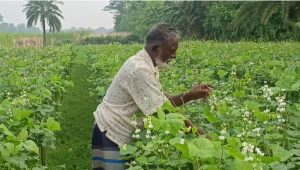
Farmers in Kornai and Nashipur villages of Dinajpur Sadar Upazila said they were growing mustard as an additional crop between harvesting aman paddy and planting boro rice, when land usually remains idle.
They said cultivating mustard on one bigha of land costs around Tk10,000 to Tk12,000, while expected yields range from eight to nine maunds per bigha.



After deducting expenses, farmers expect an additional income of about Tk15,000 per bigha, providing much-needed cash ahead of the boro season.
DAE Deputy Director Md Afzal Hossain said farmers are being encouraged to grow mustard to reduce dependence on imported edible oil.
As part of the initiative, 2,572 farmers across the district’s 13 upazilas received high-yielding seeds and chemical fertilisers free of cost, he said.
Oil mill owners said each maund of mustard seeds, equivalent to 40 kilograms, produces about 16 litres of oil.
Based on that ratio, the estimated production of 48,575 tonnes of mustard in the district could yield a substantial volume of edible oil.
DAE Deputy Director for Research and Training Md Mostafizur Rahman said proper guidance and favourable weather conditions have driven what he described as a “mustard revolution” in Dinajpur.
“Farmers are benefiting financially, while consumers are gaining access to pure mustard oil,” he said.
The success in Dinajpur is now being seen as a model for other districts in the northern region to follow, agriculture officials said.