Inflation in the country — particularly food prices — remains stubbornly high, squeezing consumers despite a series of measures by the interim government and the Bangladesh Bank, including a tight monetary policy that has, in turn, weakened businesses.
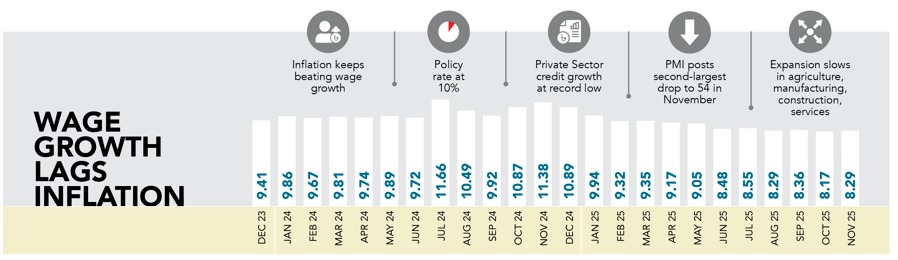
After a brief drop to 8.17% in October, inflation rebounded to 8.29% in November, well above Bangladesh Bank’s target of 7% and the wage growth rate of 8.04%.
Surprising analysts, food inflation ahead of winter rose to 7.36% in November from 7.08%, while non-food inflation edged down, according to the latest release by the Bangladesh Bureau of Statistics (BBS) on Sunday.
Experts blamed the interim government’s weak oversight and inadequate action to curb market manipulation and resolve supply disruptions for the renewed rise in food inflation.
“We have been hearing a lot of talk about checking manipulation, but systematic efforts and effective steps by the government have been lacking,” said economist M Masrur Reaz, chairman and CEO of Policy Exchange Bangladesh (PEB).

Vegetable prices typically cool in winter and there have been no negative news on rice production, he said, adding, “The uptick in food inflation in November could be mostly due to manipulation in the supply chain.”
Former secretary AHM Shafiquzzaman, president of the Consumers Association of Bangladesh, said the government’s weak oversight of the commodities market was also reflected in how edible oil refiners unilaterally increased soybean oil prices last week.
He said he had expected strict action against the refiners for raising the price-controlled essential commodity without government approval, but no such steps were taken.



Analysts are questioning how price trends in global and local markets are diverging. From rice to wheat, global prices have fallen over the past year, while Bangladeshi families continue to spend more on essentials.
Governor Ahsan H Mansur, in several speeches, has blamed the government’s failure to curb rice prices on its delaying rice imports by two months.
The government is importing large quantities of commodities, yet the impact on domestic prices remains limited.
Without strong commodities market oversight and giving entrepreneurs breathing space, it will be difficult to stabilise the situation, Bangladesh Chamber of Industries President Anwar-Ul-Alam Chowdhury told TIMES of Bangladesh.
At a time when entrepreneurs are desperate to reduce interest burdens during a prolonged period of economic strain, Bangladesh Bank Governor Ahsan H Mansur has clearly linked calls to cut the policy rate – currently at 10% – to progress in controlling inflation.
Inflation is not only high, but has remained volatile, demanding a more targeted and stronger fight, said Masrur Reaz, adding, “Until supply issues are fixed, we will not get the benefits of the tight monetary policy.”
Echoing business leaders, Association of Bankers Bangladesh President and Chairman Mashrur Arefin questioned the continuation of the tight monetary policy at a conference earlier this month, saying it alone would not be effective in curbing inflation.
Investment, job creation stall
Amid political uncertainties and weakening confidence, investment and job creation have stalled as private-sector credit growth hovers at a record low of 6%-7%.
The Purchasing Managers’ Index (PMI), which reflects the pace of economic output in the coming months, recorded the second-largest drop this year, falling to 54 in November.
The updates, jointly released on Sunday by the Metropolitan Chamber of Commerce and Industry (MCCI) Dhaka and PEB, show that all key sectors of the economy – agriculture, manufacturing, construction and services – experienced slower expansion in November.
On a scale of 0–100, where readings above 50 indicate expansion, the agricultural PMI dropped to 57.4 in November from 59.6, while the manufacturing PMI fell sharply to 58.3 from 66.1.
Both the construction and services PMIs declined to 51, down from over 56 and 61 respectively, with the services sector facing the steepest slowdown in November.