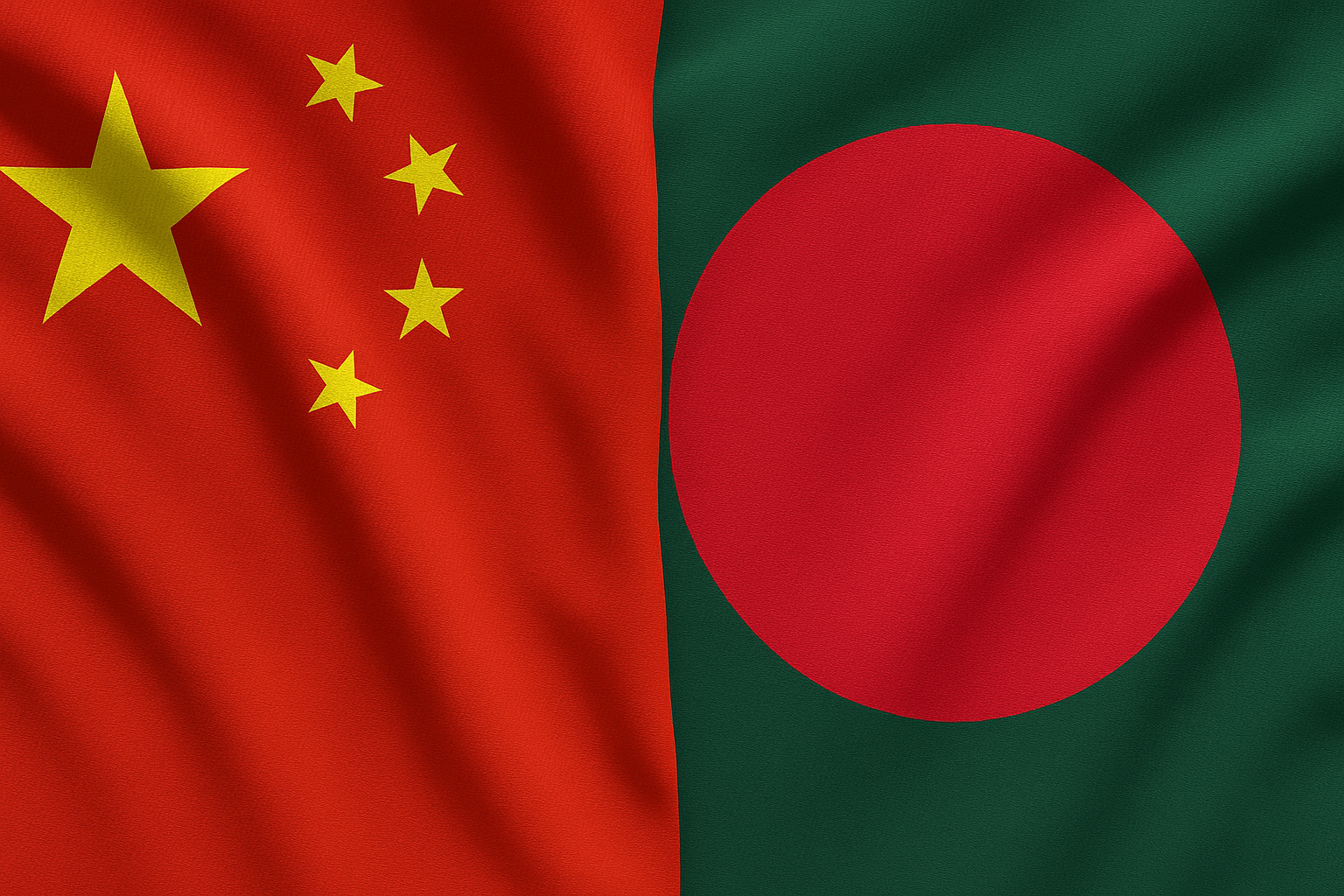

The newly released US National Security Strategy (NSS) 2025 introduces a sharper and more confrontational framework toward China, redefining Washington’s priorities across the Indo-Pacific. For Bangladesh—a country whose development trajectory and strategic orientation have become increasingly intertwined with Beijing—the shift signals mounting geopolitical pressure and a more delicate diplomatic environment in the years ahead.
China has emerged as one of Bangladesh’s most consequential partners across economic, political, and military domains. Over the past decades, Beijing has invested heavily in Bangladesh’s infrastructure landscape, financing ports, bridges, power plants, industrial parks, and major connectivity corridors that anchor Dhaka’s long-term development plans.
The relationship reached a turning point in October 2016 when Chinese President Xi Jinping made a historic visit to Dhaka—the first by a Chinese head of state in three decades. During this visit, the two countries elevated their bilateral ties to a “strategic partnership of cooperation,” a designation Bangladesh holds with no other nation. This strategic partnership has since served as the foundation for deeper political trust, expanded investment flows, and stronger alignment on regional development priorities.

China has also become Bangladesh’s dominant defence supplier, accounting for the vast majority of Dhaka’s military procurement in recent years. From submarines and naval corvettes to fighter aircraft, missile systems, and advanced radars, Chinese platforms now constitute a significant portion of Bangladesh’s modernised defence inventory. These acquisitions not only enhance Bangladesh’s maritime and territorial security but also reinforce Beijing’s role as Dhaka’s most reliable and affordable source of military hardware. This growing defence dependence adds a layer of strategic complexity at a time when US–China rivalry is intensifying across the Indo-Pacific.
Against this backdrop, the NSS 2025 delivers a clear message: China is the United States’ foremost strategic competitor, and its overseas economic and infrastructure activities are viewed with deep suspicion. The document warns that Chinese state-linked enterprises leverage foreign investments to gain control of critical assets—particularly in ports, digital networks, and energy infrastructure. For Bangladesh, where many flagship development projects involve Chinese financing or contractors, this framing translates into heightened Western scrutiny. In practical terms, Dhaka may face pressure from Washington to justify or reconsider Chinese-backed projects, especially those with potential dual-use implications.



The NSS also elevates the Indo-Pacific as the central theatre of global strategic competition, placing India at the heart of Washington’s regional strategy. The US–India partnership, already expanding in defence, technology, and supply-chain cooperation, is now positioned as a cornerstone for countering Chinese influence. This tilt complicates Bangladesh’s diplomatic navigation. Dhaka has long sought to maintain balanced relations with both Beijing and New Delhi, recognising China as a key development partner and India as an indispensable neighbour with deep historical, cultural, and economic linkages. But a more assertive US–India alignment inevitably narrows Bangladesh’s room for manoeuvre, particularly in areas such as maritime security in the Bay of Bengal, digital governance, and strategic infrastructure.
Yet the NSS does not present challenges alone—there are potential openings for Bangladesh as well. Washington’s ambition to diversify global manufacturing away from China could benefit countries capable of offering cost-effective, reliable production capacity. Bangladesh, already a major player in global apparel markets, could attract new opportunities in textiles, pharmaceuticals, electronics assembly, and light engineering. To seize these opportunities, however, Dhaka must address bottlenecks in logistics, energy supply, regulatory consistency, and transport infrastructure—areas where foreign investors continue to seek improvements.
The NSS also underscores a broader shift in US engagement: fewer direct military interventions and greater emphasis on deterrence, alliance-building, and burden-sharing. For South Asia and the northern Indian Ocean, this signals more strategic competition as major powers seek influence over sea lanes, digital neBtworks, and regional partners. Bangladesh, located at a maritime crossroads linking the Bay of Bengal with the wider Indo-Pacific, will inevitably find itself operating in a denser and more contested geopolitical environment.
In this evolving landscape, Bangladesh’s foreign-policy challenge is to preserve its strategic autonomy while safeguarding its development goals. Dhaka will need to sustain its long-standing principle of “friendship to all, malice toward none” and avoid being pulled into zero-sum alignments. The NSS 2025 makes clear that global politics is entering a phase where ambiguity is harder to maintain and choices carry greater weight. For Bangladesh, the coming years will require deft diplomacy, strategic clarity, and continued emphasis on economic priorities as it navigates an increasingly competitive Indo-Pacific order.