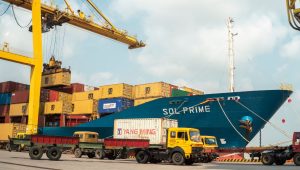
Nearly half of Bangladesh’s small and medium enterprises (SME) would consider entering export markets if policy and procedural barriers were reduced, according to a new study that highlights persistent structural constraints ahead of the country’s LDC graduation.
The finding was presented on Saturday at a national conference in Dhaka organised by Business Initiative Leading Development (BUILD), based on research titled “Institutionalised Exclusion: Bonded Warehouse Policy & SME Export Competitiveness in Bangladesh.”
Covering 107 firms across selected SME clusters, the study found that 48.4 per cent of non-exporting enterprises would attempt exports if given duty-free access to imported raw materials and simplified compliance procedures.
At present, only 13.1 per cent of the surveyed firms engage in any export activity, while direct exporters account for just two firms.
Despite SMEs accounting for more than 90 per cent of industrial establishments, roughly a quarter of GDP, and an estimated 7.8 million jobs, their contribution to exports remains limited, the study noted.

Shifting from aggregate indicators to firm-level performance, researchers said productivity differences do not explain the export gap.
A comparative analysis between exporting and non-exporting firms showed no statistically significant difference in labour productivity, indicating that institutional and policy barriers, rather than capability constraints, are restricting export participation.
Examining utilisation patterns, the study found near-zero use of bonded warehouse facilities among surveyed firms.


None of the 107 enterprises had accessed the system. Awareness of SRO-384, which allows partial exporters to import inputs duty-free against a 100 per cent bank guarantee, stood at just 1.87 per cent, while more than 82 per cent of respondents reported no awareness of either mechanism.
Turning to operational constraints, 85 per cent of firms cited administrative complexity as a key barrier to exporting. Limited access to finance was reported by 65 per cent of respondents, while 64 per cent pointed to high import duties on raw materials.
Within sectoral dynamics, the report identified a “home textile paradox”, where relatively higher export participation coexists with severe input-cost pressures. In some cases, duties on imported yarn were reported at around 40 per cent of input value, a level the study said can exceed annual net profit margins for certain firms.
Across supply chains, all importing firms surveyed relied on commercial intermediaries rather than direct import channels. As a result, duty costs are embedded in input prices, weakening cost competitiveness, the study added.
Speaking on structural positioning, BUILD Chairperson Abul Kasem Khan said SMEs remain constrained despite strong production capacity, particularly due to unequal access to bonded facilities compared with the readymade garment sector.
Presenting the institutional analysis, BUILD Research Director Wasel Bin Shadat said the bonded warehouse framework, originally designed for garments, now functions as a structural filter limiting non-RMG exporters’ market entry.
Outlining policy directions, the study proposed a three-pillar reform framework involving a partial exporter licence, shared bonded warehouse facilities and common facility centres in SME clusters, alongside financing and compliance reforms.
On policy response, Economic Relations Division Secretary Md Shahriar Kader Siddiky said the government would seriously consider the recommendations, adding that implementation capacity and digitalisation remain central to ongoing reform efforts.
He also referred to initiatives including a 150-acre creative hub in Purbachal and an Asian Development Bank-supported programme to improve business facilitation and reduce approval times.
Detailing regulatory adjustments, National Board of Revenue First Secretary Mohammad Naziur Rahman Miah said recent changes to SRO-384 have simplified compliance by removing input-output coefficient requirements and the 30 per cent value addition condition, while extending duty-free import facilities to nine additional sectors against a 100 per cent bank guarantee.
Announcing financial support measures, Bangladesh Bank Executive Director Nawshad Mustafa said a Tk5,000 crore SME fund at 9 per cent interest is being introduced, alongside reforms aimed at improving SMEs’ access to capital markets.
Concluding the discussions, policymakers, regulators and industry representatives focused on reducing structural barriers and expanding Bangladesh’s export base beyond garments.