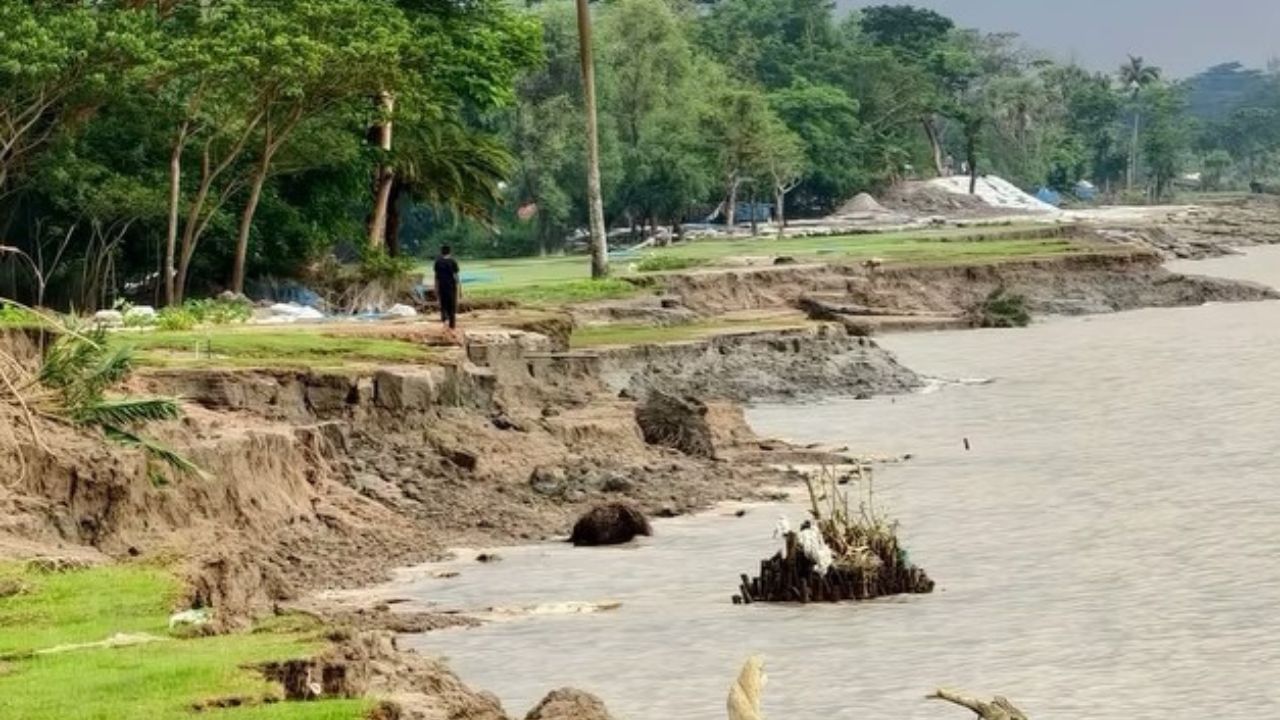



Severe erosion by the Padma River has devastated parts of Shibganj Upazila in Chapainawabganj, washing away more than 200 homes, over 100 bighas of farmland, mango orchards, bamboo groves and countless trees over the past month, while residents await the start of a Tk748 crore embankment project.
On Thursday alone, three more houses in Gomer Char village under Panka Union were swallowed by the river within a few hours. As erosion continues unabated, riverside families are dismantling their homes and moving to safer locations in a desperate attempt to save what they can.
A visit to Gomer Char on Saturday found large sections of the riverbank collapsing under the force of the current. Many families were seen taking apart their homes, while others, having already lost everything, were left uncertain about where to go next.
Biplob, a resident forced to relocate his house, said he had no idea what the future held.
“I do not know what fate has in store for us. I do not know where we will go or how we will survive,” he said.
Another resident, Shahidul, said the river had been some distance away only a day earlier.

“I never imagined I would have to move my house the very next day. I have dismantled it and shifted it a short distance for now, but I still do not know where we will settle permanently,” he said.
Erfan Ali said he had lost the will to continue enduring repeated hardship but was accepting his fate.
“I have already moved my house. Tomorrow I will have to leave, wherever I can,” he said.




Mohammad Ekramul Haque, 66, said he had lost his home to Padma erosion at least 20 times in his lifetime. His house was last washed away two years ago, and with erosion beginning again early in the monsoon, he has once more been forced to relocate.
Another resident, Jobdul Haque, said he rebuilt his home after losing it last year but now faced the same ordeal again.
Local people said most families in the area had been forced to move their homes between 20 and 25 times because of repeated river erosion.
Former Union Parishad member Tarikul Islam said relocating homes had become an almost routine part of life for residents.
“Almost every year we lose our homesteads. This time, too, we have had to move our houses. Many people have even been forced to sell their land at throwaway prices,” he said.
Residents said the Ganges enters Bangladesh through Durlovpur Union and becomes the Padma, with India’s Farakka Barrage located about 18 kilometres upstream. They claimed that when more than 100 gates of the barrage are opened during heavy rainfall and upstream floods, the river’s current intensifies, accelerating erosion. They also said erosion has become more prolonged in recent years, continuing from Ashar to Bhadra even without major floods.
Mohammad Rakibul Islam, sub-divisional engineer of the Bangladesh Water Development Board in Chapainawabganj, said a Tk748 crore project to construct a permanent embankment along the eastern bank of the Padma in Shibganj had already been approved.
“The tender process is almost complete and the contractor is expected to begin work within the next two weeks,” he said.
He added that proposals were also being prepared to construct a permanent embankment on the western bank of the river to ensure long-term protection for riverside communities.
According to the Water Development Board, around 50,000 people live in the Padma riverbank unions of Panka, Durlovpur and Uzirpur in Shibganj.
Local residents said that over the past five years, severe erosion had washed away thousands of family homes, cropland, educational institutions, markets, graveyards and Eidgah grounds. At least 500 families have been forced to leave the area during that period.
They said Panka Union alone has lost at least 15 villages and nearly 1,000 hectares of farmland, with total losses over the past five years estimated at around Tk200 crore.
Residents also warned that nearly 50 government and private educational institutions, a power station, five Border Guard Bangladesh camps, a healthcare centre, four markets, three graveyards and thousands of hectares of farmland remain at risk if effective erosion control measures are not implemented before the monsoon intensifies.