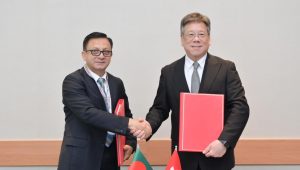
Seventeen private banks have signed a memorandum of understanding with the National Pension Authority (NPA) to facilitate the universal pension scheme through registration, contribution collection and API integration.
The Finance Division confirms the development in a press release on Monday.
Speaking as chief guest at the signing ceremony, Finance Division Secretary Dr Md Khairuzzaman Mozumder urges private banks to extend their full cooperation and actively promote the scheme to ensure wider public participation.
“The successful execution of the universal pension scheme depends largely on the sincerity and proactive involvement of our banking partners,” says Dr Mozumder.

He calls on banks to motivate customers to register and contribute for building a financially secure future.
The event, held at the conference room of the Finance Division, is presided over by Md Mahiuddin Khan, executive chairman of the National Pension Authority.




Managing directors of the participating banks attend the ceremony.
The banks include Bank Asia PLC, Bangladesh Commerce Bank Limited, Bangladesh Development Bank PLC, BASIC Bank Limited, Bengal Commercial Bank PLC, Dhaka Bank PLC, EXIM Bank PLC, Jamuna Bank PLC, Meghna Bank PLC, Mercantile Bank PLC, NRB Bank PLC, NRBC Bank PLC, SBAC Bank PLC, Standard Bank PLC, Shimanto Bank PLC, Social Islami Bank PLC and United Commercial Bank PLC.
With these latest agreements, a total of 41 banks are now working with the NPA to implement the pension scheme.
The authority says it plans to sign similar agreements with all remaining domestically owned banks.
Administered by the NPA, the universal pension scheme offers four tailored programmes—Probash, Progoti, Surakkha and Samata—designed for expatriates, private-sector employees, self-employed individuals and low-income earners.
The scheme provides a unique pension ID for each subscriber, allowing real-time tracking of contributions and returns through an online platform.
In addition to post-retirement financial security, the scheme offers several benefits, including income tax rebates, loan facilities and government co-contributions for the poor and underprivileged groups.