






A decade ago, corporate Bangladesh’s sustainability mission was limited to very few foreign firms and even fewer first-mover, homegrown companies.
With the global call for sustainability growing louder, more firms are embracing key principles – care for the planet, people, society and ensuring good governance. As such, the number of firms transparently reporting their practices with consistency is rising faster.
Environmental, social and governance (ESG) is the most recognised sustainability matrix worldwide, and investment-data provider Bloomberg leads the industry in rating publicly traded firms based on their structured, measurable disclosures of sustainability practices.
A year of significant growth

In 2023, seven local listed firms – Grameenphone, BAT Bangladesh, Marico Bangladesh, BRAC Bank, IDLC Finance, Square Pharmaceuticals, and Walton Hi-Tech Industries – were found in the Bloomberg universe of ESG-rated listed companies.
In 2024, LafargeHolcim, MJL Bangladesh, and BSRM Limited joined the list, taking the total number of Bangladeshi firms in the Bloomberg ESG universe to 10.
This year, however, marked a sharp rise, with six new companies making their mark, each with significantly higher scores.
The new entrants – Linde Bangladesh, Reckitt Benckiser Bangladesh, Singer Bangladesh, Heidelberg Materials Bangladesh, and Robi Axiata – along with City Bank, are helping elevate Bangladesh’s ESG profile globally, intensifying the sustainability race among market leaders across sectors.

New multinational players dominate
The sharpest competition mainly has come from multinational companies.
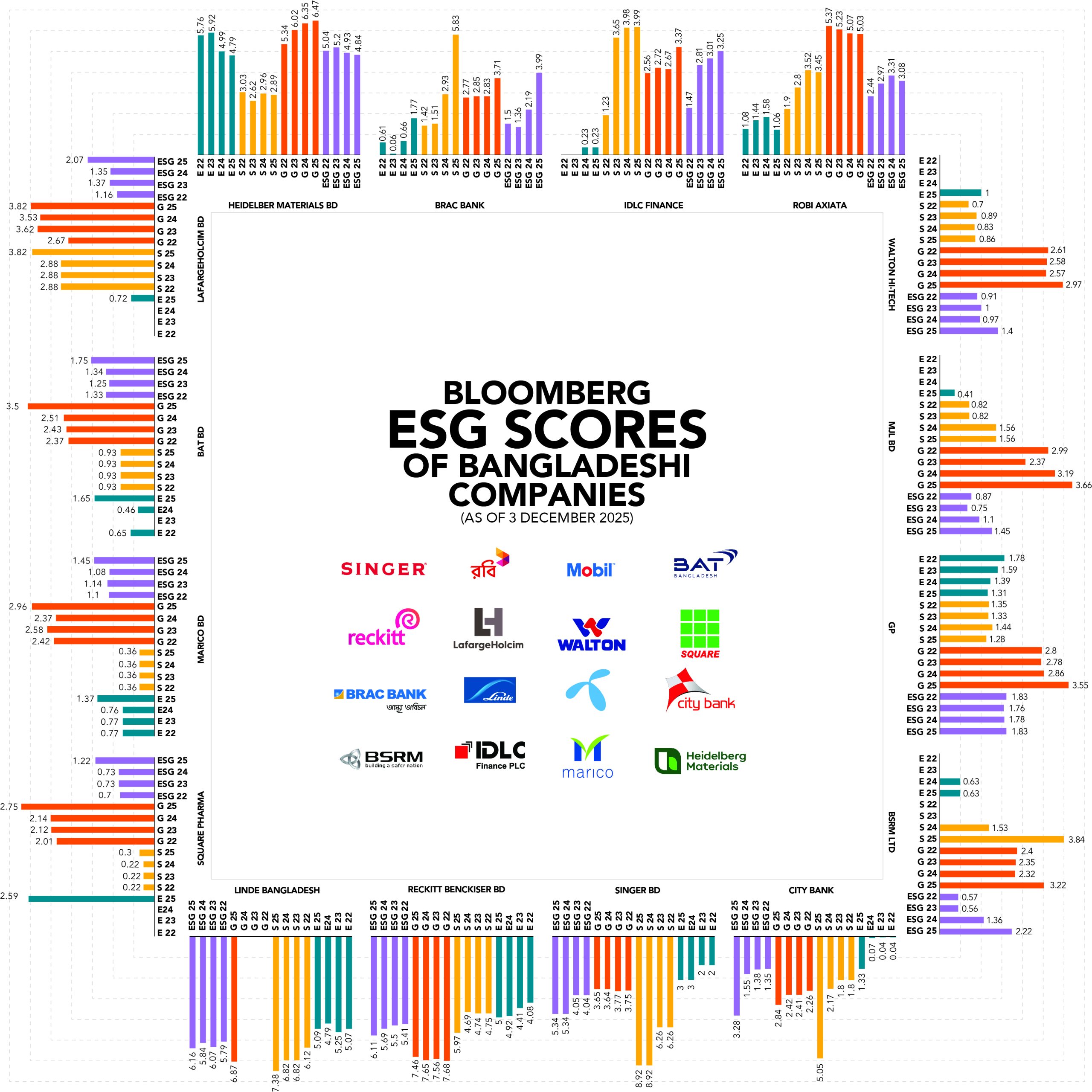
Linde Bangladesh now tops the chart with an ESG performance score of 6.16 out of 10, excelling particularly in the environmental domain with a score of 5.09.
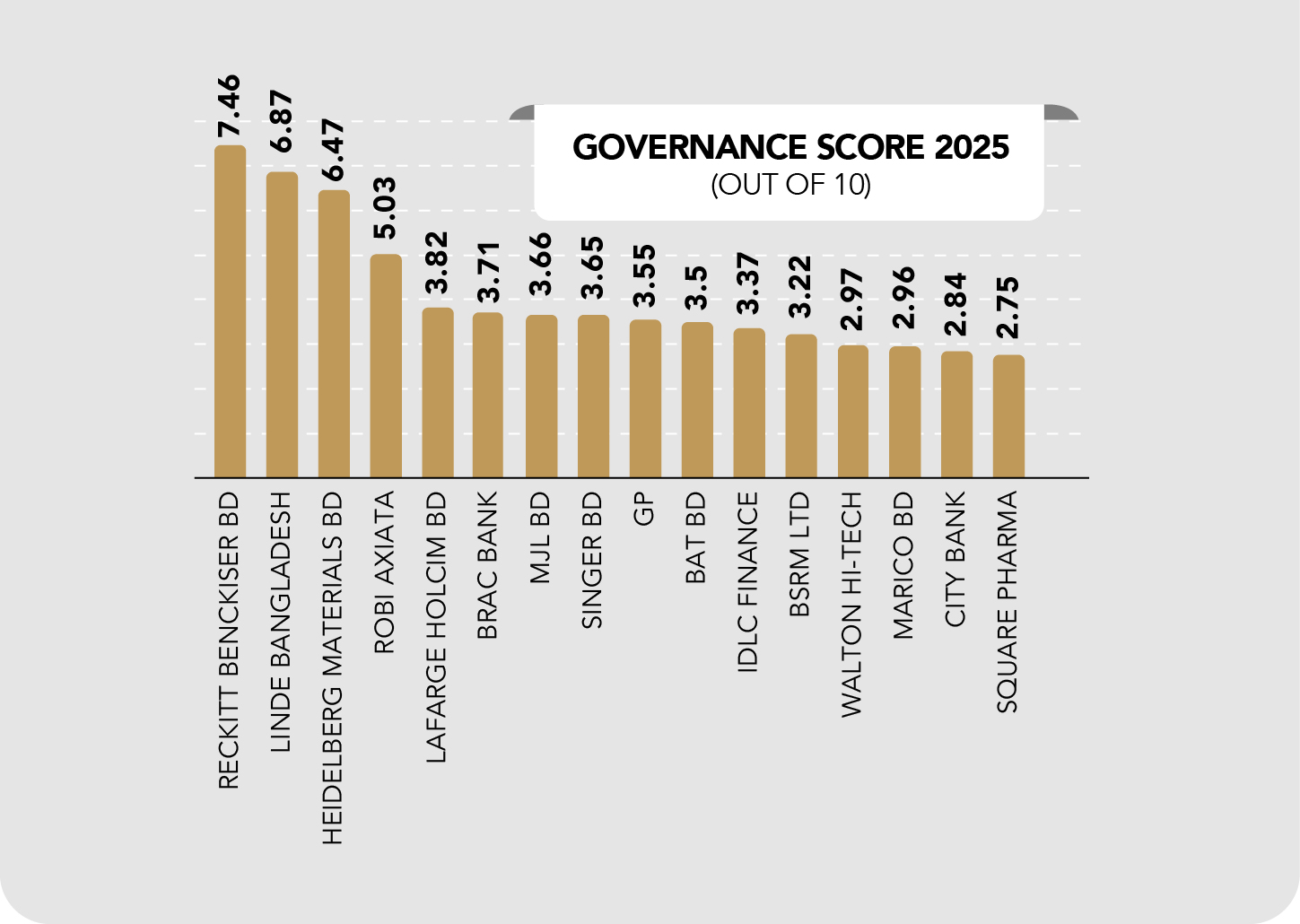
Reckitt Benckiser Bangladesh, a market leader in the homecare industry, claimed second place with an overall score of 6.11, driven by an outstanding 7.46 in governance.
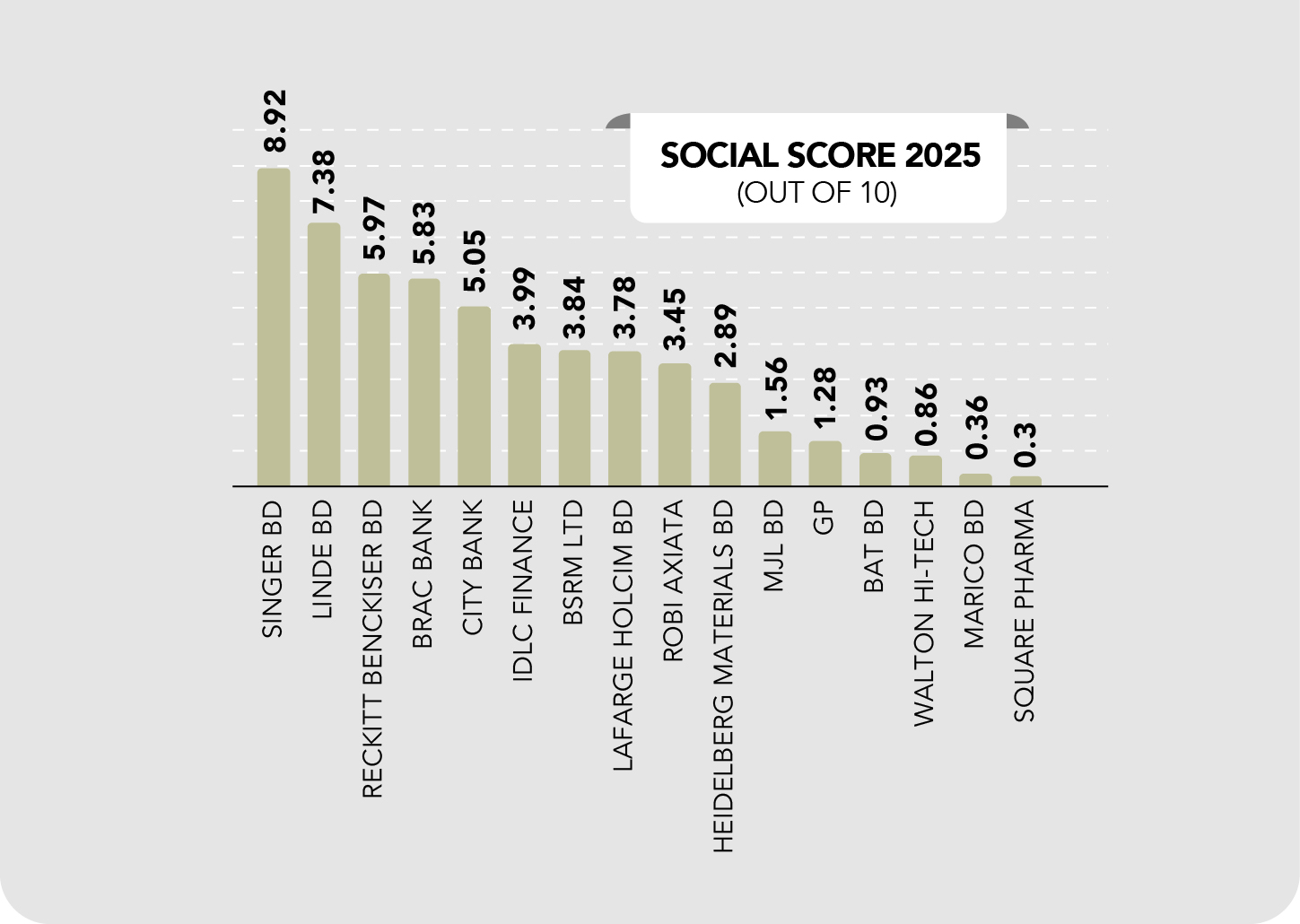
Singer Bangladesh, with a remarkable 8.92 in social criteria, secured third place with an overall ESG score of 5.34, despite lagging the top two in the environmental and governance criteria.
LafargeHolcim Bangladesh improved its ESG score from 1.35 to 2.07 in a year. But its competitor Heidelberg Materials Bangladesh made its debut with a solid 4.84, occupying the fourth spot.
Financial sector shows stronger results
Among the three local financial firms rated by Bloomberg, BRAC Bank saw the biggest improvement, raising its score from 2.19 to 3.99 to land in fifth place.
City Bank, with a score of 3.28, trailed behind at sixth while IDLC Finance, the previous champion, raised its score from 3.01 to 3.28 but dropped to seventh overall.
Grameenphone (GP), a long-time ESG leader, has been outperformed by its competitor Robi Axiata.
While GP raised its score to 1.83 from 1.78, Robi entered with a much higher score of 3.08, taking the eighth spot. As a result, GP fell to 11th place.
Lagging in the race despite higher scores
BSRM Limited, the steel market leader, improved its score from 1.36 to 2.22, securing the ninth spot.
BAT Bangladesh raised its score from 1.34 to 1.75 and now ranks 12th in the table of Bangladeshi ESG-rated public firms.
Marico Bangladesh, the leader in Bangladesh’s haircare market, improved its score from 1.08 to 1.45, placing 13th.
MJL Bangladesh, the lubricant market leader, also saw an increase in its score, rising from 1.1 to 1.4 to secure 14th place.
Walton Hi-Tech, while leading in local manufacturing, improved its score from 0.97 to 1.4 but still placed 15th.
Square Pharmaceuticals, long committed to sustainability, raised its score from 0.73 to 1.22 but remained at the bottom of the list.
Calls for further push
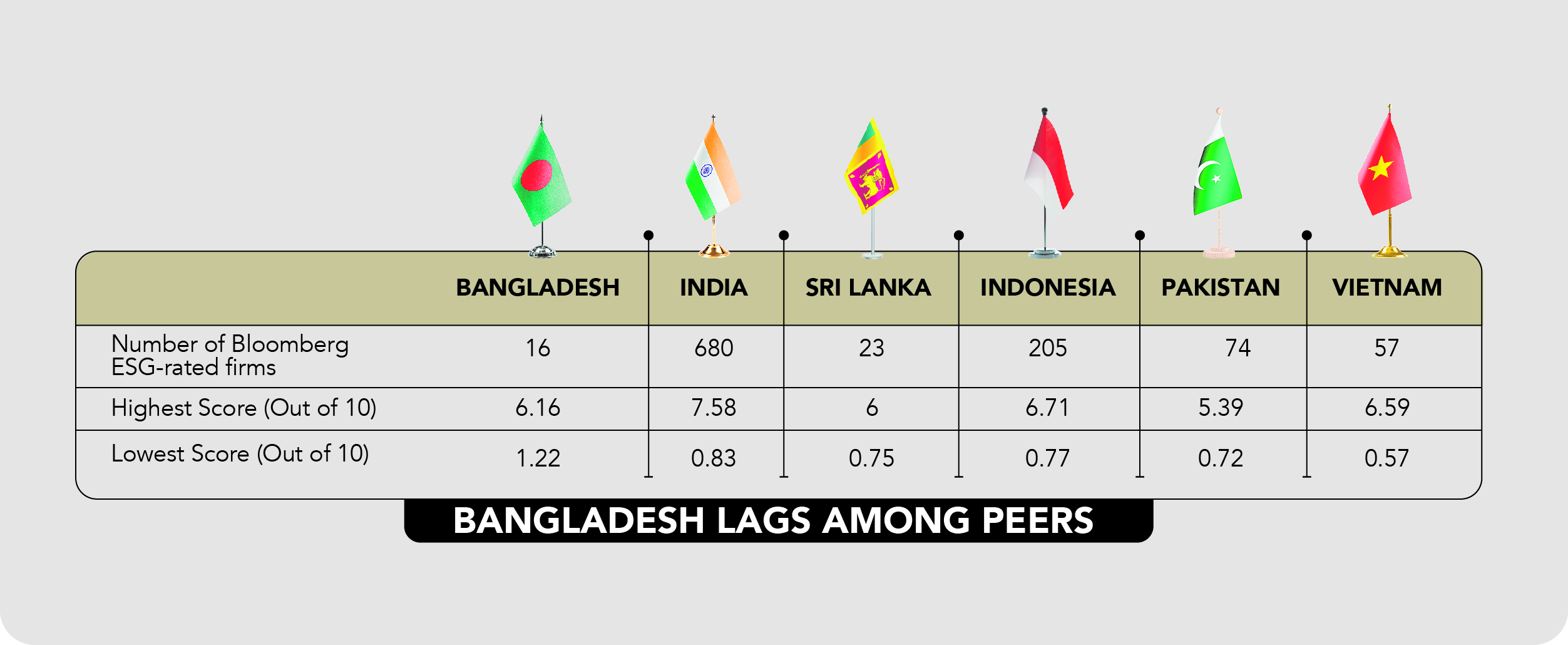
Bangladesh’s progress is notable, but it still lags regional peers.
According to December 2025 updates by Bloomberg, Sri Lanka has 23 ESG-rated firms, Vietnam 57, Pakistan 74, Indonesia 205, and India 680.
However, Bangladesh is home to the highest number of green apparel factories, and more exporters are adopting sustainable practices faster to meet global demands.
Anika Mafiz, head of investment strategy and organisational risk management at BRAC EPL Stock Brokerage, noted that the country can attract more global investment by making its sustainability efforts visible on platforms like Bloomberg.
To strengthen sustainability reporting, experts are calling for regulatory push to foster a culture of transparency in Bangladesh’s corporate sector.
How ESG scores are calculated
Bloomberg’s ESG scoring system rates firms based on their structured, measurable disclosures of sustainability practices.
The platform evaluates companies after getting consistent public disclosures of their ESG performance, assigning them a performance score out of 10.
The ratings are based on hundreds of reporting criteria for each of the three ESG indicators, which can vary by industry.
“Previously, Bloomberg used to publish two types of ESG scores, one for the extent of ESG disclosures out of 100 and the other for actual ESG performance out of 10,” said Ahit Chowdhury, senior executive for investment strategy and risk management at BRAC EPL Stock Brokerage.
Now, Bloomberg provides only the ESG performance score.
Chowdhury added that the ratings reflect companies’ consistent efforts to disclose their sustainability practices and efforts publicly.


