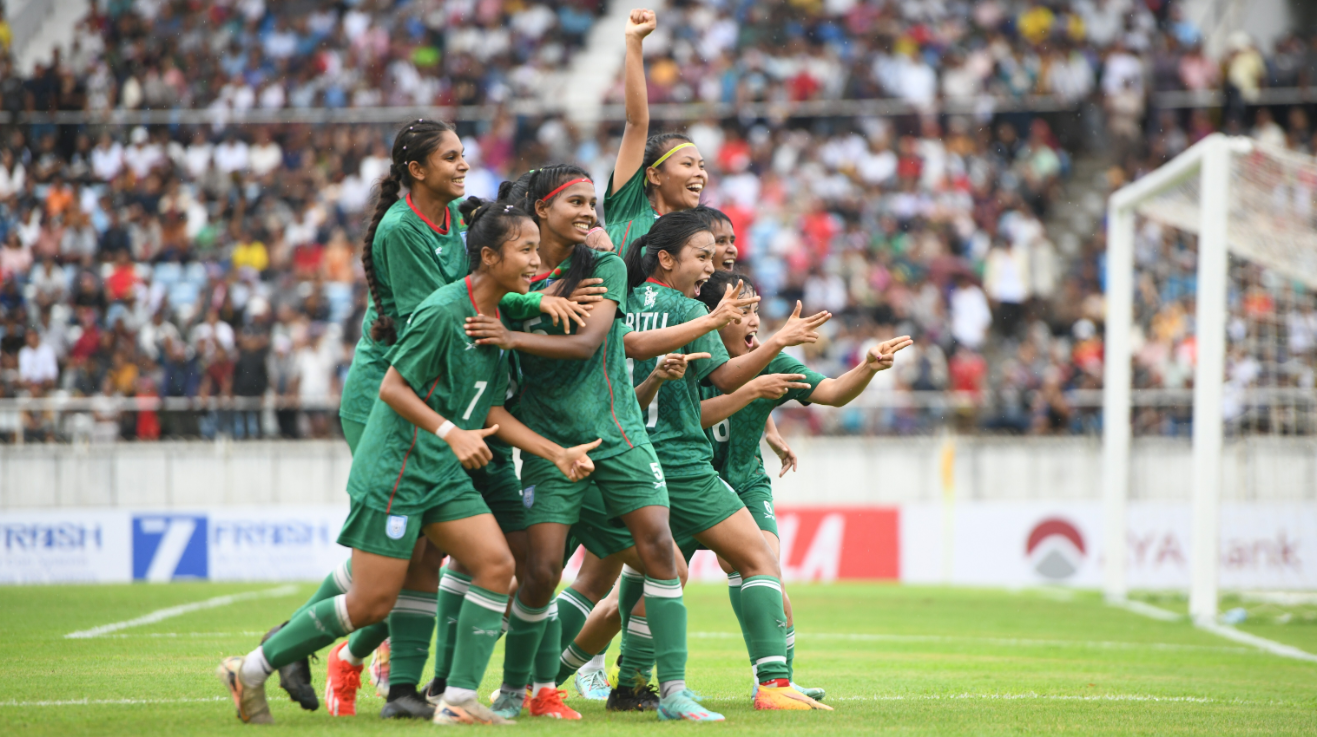

Bangladesh women’s football team steps into history as they make their debut in the AFC Women’s Asian Cup in Australia, facing giants China in their opener on 3 March in Sydney, followed by North Korea and Uzbekistan in a brutal Group B. Legends from different generations of Bangladeshi football defenders like Mohammad Kaisar Hamid, strikers Alfaz Ahmed and Zahid Hasan Ameli, midfielder Mamunul Islam along with current sensation Shekh Morsalin share their expectations for Peter Butler’s side in this massive step up.
Former national captain Mohammad Kaisar Hamid starts from the ground level. He believes effort still counts, even when the odds lean heavily the other way. “If they play with 100 per cent effort, football can still give something back,” he said. He immediately flagged a reality others gloss over. “The weather is different in Australia. That adjustment matters. Sending the team earlier would have helped.”
His core demand stays simple and old-school. “They must throw away negativity and give everything. If they do that, I believe they can get a good result.” Tactically, Hamid speaks like a defender who survived bigger teams. He wants Bangladesh to secure themselves before thinking about ambition. “Against strong teams, you must organise your own house first,” he said. “No silly mistakes. Stay compact.” He laid out the plan without jargon. “We may or may not score. That is not the first concern. We must have a strategy. If a counter-attack comes, then take it. But do not concede because of our own mistakes.”
Alfaz Ahmed, one of Bangladesh’s finest ever strikers and the current coach of Mohammedan S.C., keeps it grounded. He points out the ranking gap, Uzbekistan at 49, Bangladesh at 112, and says the team should not chase unrealistic things “We should accept mentally that we are not here to become champions,” he said. Alfaz framed expectation as restraint, not surrender. “My expectation is simple. Play as well as possible. Play positively. And concede as few goals as possible.” He trusts the coaching staff’s philosophy but understands the limits of preparation. “The coach prefers a high-line pressing game. The players are used to that now,” he said. “If luck helps, success can still come. I saw how fortune helped us against Myanmar before.”
What gives him belief is not tactics but labour. “I have seen their hard work with my own eyes,” he said. “Training every day from five in the morning. Asia will see a new Bangladesh here. That is what I hope.”
The tone hardens when Zahid Hasan Ameli enters the conversation. His words strip emotion from expectation and place responsibility squarely on the system. “Honestly, in this group, there are no expectations,” he said. “China, North Korea and Uzbekistan.”
Ameli does not diminish the moment. He elevates it. “Qualifying for the Asian Cup itself is a massive achievement,” he said. “If you look at the Asian football context, what the women have done is huge.”

He draws a clear line between pride and prediction. “In the first two matches, I have no expectations. China and North Korea are very strong.”
Only one match earns his focus. “The third match against Uzbekistan is the key,” he said. “If we can win that and take three points, that would be a big achievement for us.”
His anger surfaces when preparation enters the discussion. “We did not prepare the way this tournament demanded,” he said. “That is the truth. Ameli openly challenged the narrative around World Cup dreams. “You could not ensure facilities. You could not arrange quality preparation matches. So how can you talk about World Cups and Olympics?” he asked.




He went further, questioning the very purpose of leadership. “What is the job of the federation if they cannot ensure facilities?” he said. “Sitting there and talking means nothing.”
Former captain Mamunul Islam framed the Asian Cup in global terms. “This level is like the second part of the World Cup for us,” he said. “After the World Cup, this is the biggest stage.” He acknowledged how quickly perceptions can shift. “One good match can change many things,” he said. “One bad result reminds you where expectations truly are.”
For him, clarity matters more than optimism. “We knew long ago that we were going to the Asian Cup,” he said. “So the real question is whether we prepared to compete or just to participate.”
Mamunul placed responsibility firmly above the dressing room. “A team’s target must come from the federation, not only from the coach,” he said. “Everyone must be involved, from management to the public.”
His warning cuts deep. “If participation is the only goal, then people deserve to hear that truth,” he said. “Giving false hope sends the wrong message to the nation.”
On the pitch, his football logic stayed sharp. “Modern football defends and attacks as a team,” he said. “Midfield control decides everything. If the midfield works extra hard, you can still compete.”
He did not blame players. He protected them. “Lack of physiotherapists these are management problems,” he said. “The players’ job is to perform on the pitch.”
Yet the present generation still carries belief. Current national team forward Shekh Morsalin framed the moment with optimism rather than anger. “This is a very big achievement for Bangladesh football,” he said. “The way the girls have qualified for the AFC Cup is incredible. I wish them all the very best.”
Facing China, North Korea and Uzbekistan does not intimidate him. “I think our girls have handled the pressure really well so far,” he said. “If they can maintain the same mentality, they can produce something very special for us.”
Asked about World Cup expectations, Morsalin struck a careful balance. “It may sound very difficult, but qualification once seemed difficult too,” he said.
He returned to simplicity. “The players should focus on playing their natural game. World Cup qualification should not become a burden,” he said. “If we play our natural football and a bit of luck goes our way, who knows, we might qualify. But we should not put unnecessary pressure on the team.”