
More than 24 hours after heavy rain inundated the capital, many parts of Dhaka remained underwater on Monday despite rainwaters receding from major roads, leaving hundreds of thousands of residents grappling with severe disruption.
The Bangladesh Meteorological Department (BMD) has warned that rainfall is likely to continue, raising fears that the situation could worsen.
On Monday afternoon, waterlogging persisted in several areas, including Bailey Road, Mouchak, Shantinagar, Kakrail and Naya Paltan. Many roads remained under knee-deep water, making movement difficult for commuters. Despite the flooding, educational institutions remained open and office workers continued to travel to work.
The waterlogging also caused severe traffic congestion in several parts of the city. Many people were seen wading through knee-deep water to reach their destinations. Rickshaw fares also rose sharply, with drivers demanding higher charges, arguing that they could not operate for long in flooded conditions and still needed to cover their daily rental costs.
Muklesur Rahman, a resident of Shantinagar, said the road in front of his house remained submerged. “This road goes underwater every time it rains, and it takes a long time for the water to drain,” he told TIMES of Bangladesh.

A parent from the same neighbourhood said schools had not suspended examinations despite the flooding. “We still have to take our children to school for exams, even though the roads are submerged,” the parent said.
Businesses have also been hit hard by the prolonged waterlogging. Abul Malek, who runs a confectionery shop at Shantinagar intersection, said sales had almost come to a halt. “Water has been standing in front of the shop for several days. Since we sell food items, many products have been damaged, causing financial losses,” he said.
A furniture shop owner in the area said business had been extremely poor over the past three days because customers were unable to reach the shops. University student Tasfia Rashid alleged that rickshaw drivers were charging excessive fares. “A ride that usually costs Tk20 now costs Tk80 because of the flooded roads,” she said.
Dhaka New Market also remained closed for a second consecutive day on Monday after floodwater inundated its entrances, ground-floor shops and surrounding roads. Knee- to waist-deep water entered many ground-floor stores, damaging clothing, footwear, bags, cosmetics and other merchandise.




Old Dhaka residents continue to suffer
Large parts of Old Dhaka also remained inundated on Monday afternoon, including Bakshibazar, Hosni Dalan, Satarawza, Bangshal, Aga Sadeq Road and areas adjacent to Bangladesh Math.
Floodwater covering both narrow lanes and major roads disrupted normal movement, leaving many residents stranded in their homes. Low-income workers, students and office-goers were among the worst affected.
In Bakshibazar’s Tejpata Goli, where roads had already been dug up for Wasa pipeline installation, continuous rainfall left the area waterlogged and virtually impassable. “We have been trapped in our homes since Saturday night. We cannot even go out for urgent needs,” said local resident Amran Hossain.
Another resident, Md Shahidullah, said the road had remained excavated for nearly a month because of the pipeline installation work.
More rain likely
The Bangladesh Meteorological Department said active monsoon conditions continue to prevail across the country.
According to its latest forecast, most areas of Dhaka Division are likely to experience light to moderate rain or thundershowers accompanied by temporary gusty winds. The department also warned of moderate to very heavy rainfall in parts of Dhaka and several other divisions.
Slum dwellers among the worst affected
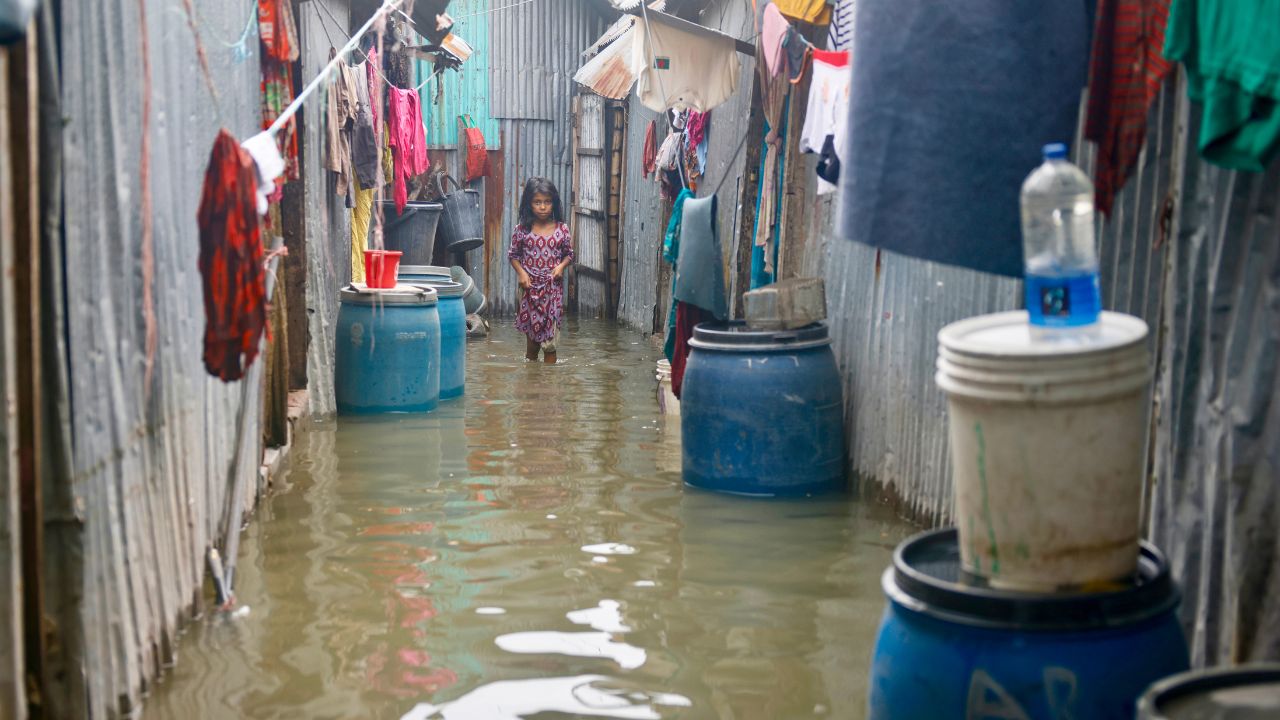
Life has become extremely difficult for residents of several slums across Dhaka, including Korail, Mohakhali Sat Tala, Chalantika in Mirpur, Adabor, Begunbari, Mohammadpur, Bhashantek, Jhilpar, Hazaribagh, Kamalapur, Member Basti and Kalapani.
After two days of continuous rain, many homes were inundated, forcing residents to seek shelter on nearby roads and open spaces.
Most residents are low-income earners, including rickshaw pullers, domestic workers and garment factory employees, whose livelihoods have also been disrupted.
Conditions are particularly severe in Korail, where residents said knee- to waist-deep water had inundated the settlement, leaving families with virtually nowhere to stay. Parents are especially worried about the safety of their children, while shortages of food and safe drinking water have compounded their hardship.
Similar conditions prevail in many other slums, where household belongings have been damaged, cooking has become impossible and access to clean water remains limited.
Jamila Khatun, a resident of Chalantika slum, said: “There is water everywhere. We have nowhere to stay with our children. Even though we have put up plastic sheets by the roadside for shelter, we have no access to food or drinking water. We don’t even have the means to buy them.”