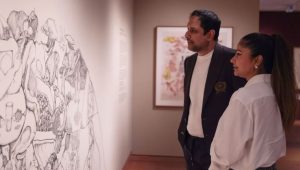
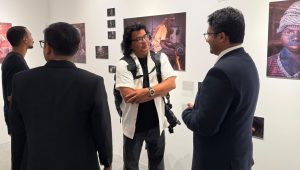
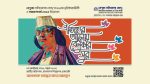
At Garden Gallery Cosmos in Baridhara, Tuesday afternoon unfolded like a quiet dialogue between two distant geographies. The daylong exhibition Shared Horizons brought together the refined sensibilities of Chinese master watercolourist Ma Baiqi and the Bangladesh-rooted, evolving vision of Mong Mong Sho, transforming the intimate gallery space into a living intersection of colour, memory and cultural kinship.
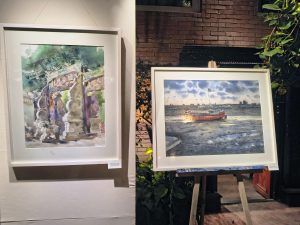
Inaugurated at 5:00 pm on November 18, the exhibition showcased 28 watercolour works that felt less like static images and more like conversations carried across borders.
Curated with the precision of a seasoned storyteller and the tenderness of artists deeply connected to their medium, the show formed part of Gallery Cosmos’ yearlong celebration of fifty years of Bangladesh–China diplomatic ties.
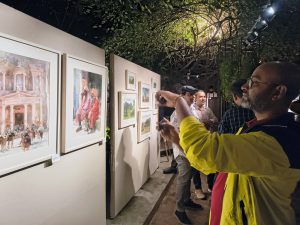
Speaking at the ceremony, Gallery Cosmos Director Enayetullah Khan reflected on the foundation’s longstanding engagement with cultural diplomacy. He noted that the Cosmos Foundation has long worked to strengthen cultural ties, adding that, as founder of the Bangladesh Centre for China Studies, his connection with China runs deep.
“We are honoured to host Ma Baiqi, a master watercolourist, as the resident artist of Gallery Cosmos. I hope our bond will grow stronger and that more of his colleagues will join future exchanges.”

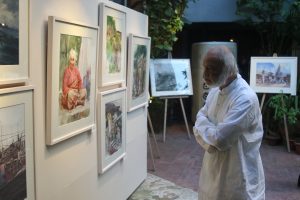
He also thanked Mong Mong Sho, describing him as a Bangladeshi–Chinese artist contributing significantly to bilateral cultural understanding.
“At the people-to-people level, our relations are already strong,” he said, adding that artists remain the greatest peacemakers.
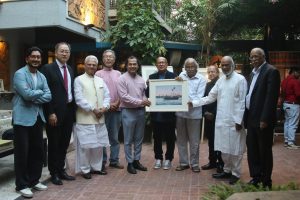



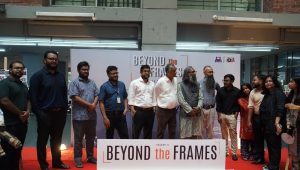
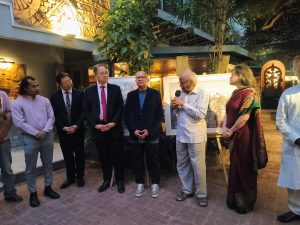
Eminent artist Professor Emeritus Rafiqun Nabi inaugurated the exhibition as Guest of Honour. Distinguished attendees included BNP Standing Committee Member Dr Abdul Moyeen Khan; BNP Vice Chairman and former Home Minister Air Vice Marshal (Retd) Altaf Hossain Chowdhury; and former Foreign Secretary Farooq Sobhan.
Also present were Dr Iftekhar Ahmed Chowdhury, President of the Cosmos Foundation; Liu Zhi, Director (Energy and Power Department) of POWERCHINA Bangladesh; and Xia Daojing, Third Secretary of the Cultural Section of the Chinese Embassy.
Dr Moyeen Khan described art as one of the most effective bridges between nations, emphasising that music, dance and painting transcend borders and require no translation.
“The simplest path to diplomacy is art and culture. Music, dance, painting; they transcend borders and communicate without language. This is how we build peace,” he said.
Former Home Minister Air Vice Marshal (Retd) Altaf Hossain Chowdhury reiterated Bangladesh’s longstanding friendship with China, predicting that China is poised to become the century’s global leader.
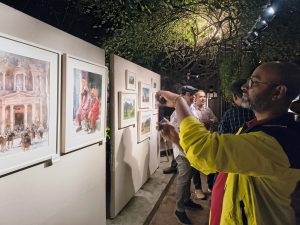
Li Shaopeng, Cultural Counsellor at the Chinese Embassy, described the exhibition as a testament to profound people-to-people ties. “This year marks the 50th anniversary of our diplomatic relations, and next year marks the 10th anniversary of Bangladesh joining the Belt and Road Initiative. Culture will endure far beyond commerce, and through these beautiful paintings we understand each other more deeply,” he said, adding that more collaborative programmes are planned for the coming year.
For the artists, the exhibition served as both reflection and aspiration.
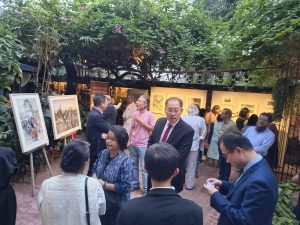
“Business and diplomacy are ongoing, but as artists we also have responsibilities,” said Mong Mong Sho, who grew up in Maheshkhali before pursuing advanced studies in China.
“Through workshops and exchanges, we can strengthen our bond. There is so much to learn from each other’s traditions and landscapes,” he added.
Ma Baiqi, whose career spans exhibitions from China to Scotland, reaffirmed the universal nature of his medium. “Painting has no borders. We feel colours and nature beyond cultural backgrounds,” he said.
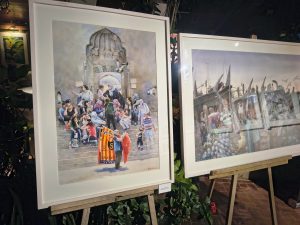
His distinguished career, including selections for the China–Japan Man and Nature Art Exhibition and the Royal Scottish Society of Painters in Watercolour, reflects his commitment to art as a global language.
Together, the two artists and their audience embodied what Shared Horizons set out to be: a gentle but persistent reminder that colour, gesture and imagination often achieve what diplomacy alone cannot.
In the soft grain of watercolour, the cultural distance between Bangladesh and China dissolved into something luminous, fluid and unexpectedly intimate.