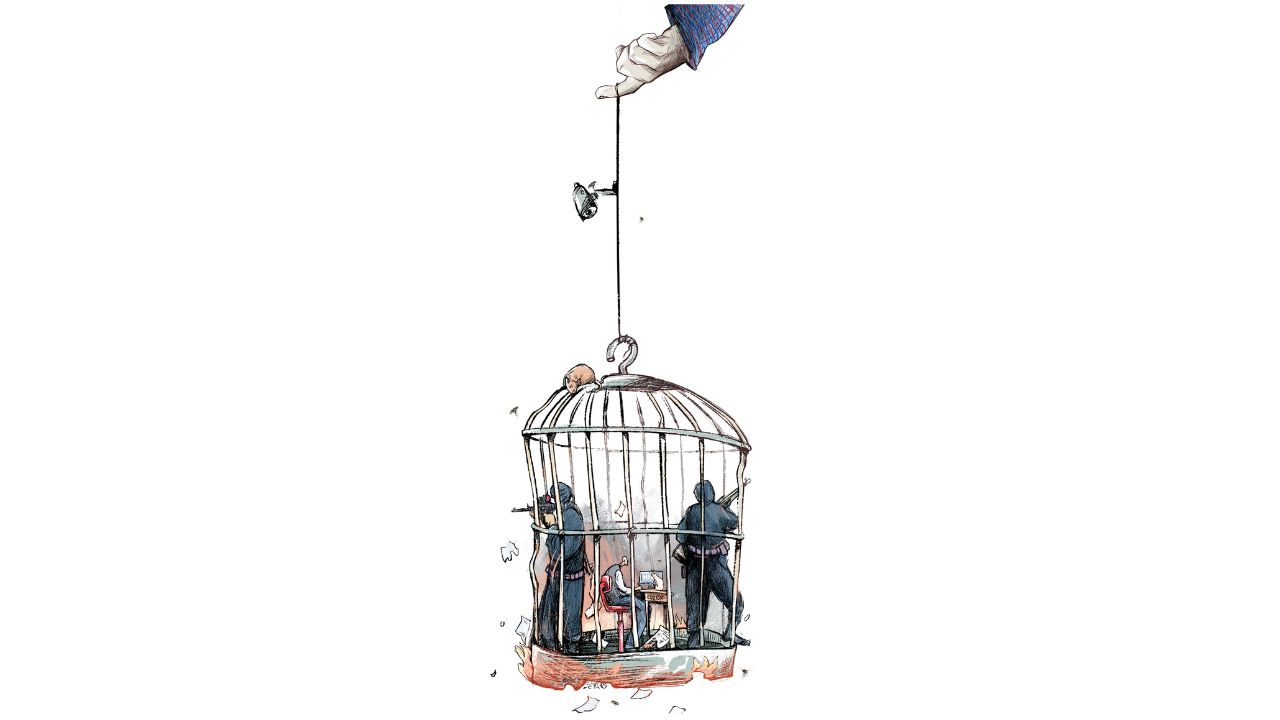



Amid a surge in violence across the country, politicians, parliamentary candidates, senior journalists and other prominent figures are making determined efforts to obtain government-assigned armed guards, citing acute concerns over personal safety.
The demand for so-called “gunmen” has risen sharply in recent days, particularly among candidates contesting the 13th parliamentary election, many of whom say they are reinforcing their own private security arrangements alongside formally applying for state protection.
Several applicants have questioned how many individuals the government can realistically protect through such measures, arguing that the growing reliance on individual gunmen reflects a broader failure to ensure public safety.
Despite the announcement of the election schedule, law and order has remained fragile. Following mounting criticism, the government itself publicly declared that gunmen would be provided to individuals facing security threats.
After a government notification was issued on 15 December, around 40 applications had been submitted by members of civil society by Monday, including politicians, journalists and individuals who played leading roles in the July mass uprising. More than 25 applications have also been filed by government employees, according to officials.

The number of applications has continued to rise since the killing of Inqilab Moncho spokesperson Sharif Osman Hadi and the subsequent attacks on the offices of Prothom Alo and The Daily Star. Many citizens say those incidents deepened fears that violence could escalate further.
Former police chief Nurul Huda told TIMES of Bangladesh that such situations often emerge ahead of elections due to power-centred politics. “But this time the law and order situation is actually fragile,” he said. He added that while gunmen had been provided in the past, he was unaware of any previous instance where the government had made such a public announcement. Huda also said the authorities should strengthen intelligence surveillance rather than relying solely on armed guards.

Following a meeting of the advisory committee on law and order at the Secretariat on Monday, Home Affairs Adviser Jahangir Alam Chowdhury said 20 people facing security risks had been given gunmen. He said the list included the editors of Prothom Alo and The Daily Star.
However, a senior official at the Home Ministry said that no one had yet been provided gunmen “officially”. He said that security arrangements made by the Dhaka Metropolitan Police and the Special Branch were “unofficial” in nature.
Multiple police sources said that several individuals had received temporary protection, including National Citizen Party (NCP) convener Nahid Islam, the party’s southern chief coordinator Hasnat Abdullah, northern chief coordinator Sarjis Alam, and senior joint member secretary Tasnim Jara.
Concerns intensified further on Monday when, days after the killing of Sharif Osman Hadi, NCP coordinator Motaleb Shikder was shot in Khulna. Police said the shooting followed a similar pattern to Hadi’s killing, triggering renewed panic and public debate over whether the government was failing to protect lives and property.
Security has since become a dominant topic of discussion. At a protest meeting organised by the Editors’ Council and the Newspaper Owners’ Association of Bangladesh (NOAB) on Monday, speakers voiced deep concern over the deteriorating situation. The Daily Star Editor Mahfuz Anam said that “survival itself has become difficult, let alone freedom of expression”.
In recent days, several politicians and parliamentary candidates have applied for gunmen as well as firearms licences. Jamaat-e-Islami Assistant Secretary General and Cox’s Bazar-2 candidate Hamidur Rahman Azad told TIMES that his party would request armed protection for candidates in constituencies where security risks were high. He urged the government to ensure the safety of ordinary citizens alongside election candidates.
Applications for gunmen have also been submitted to the Home Ministry for Jamaat-e-Islami chief Shafiqur Rahman, Jatiya Party (JP) chairman Anwar Hossain Manju, Andalib Rahman Partha, Liberal Democratic Party president Oli Ahmed, Ganosamhati Andolon chief coordinator Zonayed Saki, and Islami Andolan Bangladesh ameer Syed Rezaul Karim. Requests have also been made for several frontline activists who led the July movement. Media reports on Monday said gunmen were also being arranged for Masuma Khatun, the sister of Sharif Osman Hadi.
Gazi Ataur Rahman, senior joint secretary-general and spokesperson of Islami Andolan Bangladesh, told TIMES that a country could not function by providing gunmen to individuals. “Politicians always think about ordinary people,” he said. “If there is no security for the general public, then who are we doing politics for?”
Rashed Khan, general secretary of Gono Odhikar Parishad, has also repeatedly warned of growing insecurity affecting candidates and July movement activists. He told TIMES that the government had failed to address the security concerns raised by Osman Hadi before his death. He questioned how many people could realistically be protected through individual gunmen.
Against this backdrop, many parliamentary candidates have begun strengthening their own private security arrangements. During campaign activities, they have increased the number of trusted aides accompanying them, saying the measures are intended to provide immediate protection amid continuing uncertainty.