The dangerous trend of vigilantism disguised as an anti-drug movement has escalated into violent home invasions across Bangladesh.
In a single day, 12 houses were attacked in Kishoreganj, with videos of several homes being set on fire going viral on social media.
In just one week, TIMES of Bangladesh found at least 68 videos documenting mob violence across 21 districts on alleged drug charges.
Among those incidents, the highest number, 32 cases, occurred in the Dhaka division, followed by nine in Rajshahi, eight each in Chittagong and Khulna, six in Mymensingh, two each in Barisal and Rangpur, and one in Sylhet.
While initial videos mostly depicted public harassment, beatings, and protest marches, the nature of these incidents has grown increasingly violent.
In at least one instance, a local Member of Parliament was seen promoting the anti-drug stance that fuelled the mob.
Supreme Court lawyer Mizanur Rahman Khan warned against the dangerous implications of this trend. Speaking to TIMES, he said, “Individuals can easily be targeted out of personal enmity or revenge. When these incidents go viral on Facebook, others copy them, risking the widespread growth of a culture of violence.”
The criminal law expert also cautioned that while many participate under the belief that they are fulfilling a social responsibility or protecting their community, their actions constitute a serious criminal offense.
“Many involved in these mobs do not realise that participating in such violence is itself a punishable crime,” he added.
Attempted demolition of a house
The incident occurred in Faridpur.

The house was still under construction. The brick-and-cement structure had been completed, and preparations were underway for casting the roof.
Before work could proceed, a group armed with hammers, machetes and sticks attacked the building and began vandalising it.
In a video of the incident that later went viral, a young man can be heard saying, “A house built with drug money will not be allowed in this area.”
The attackers alleged that the husband and wife had built the house with proceeds from drug peddling.
Without proving the allegations, local residents demolished the couple’s under-construction home.
On 20 June, a group of people raided 12 houses in the Madhyapara Siddheshwari area of Jashodal Union in Kishoreganj after Juma prayers. Several houses were vandalised and set ablaze. The attackers appeared openly jubilant about their actions.
On the same day, an ‘anti-drug mob’ set fire to a house in Boyra village of Sherpur Sadar upazila. The Fire Service was initially prevented from extinguishing the blaze due to obstruction by the attackers and had to return later. The victim’s family was forced to leave the area.
What the ‘punishment’ features
In early June, vigilante mobs in Faridpur, Brahmanbaria, and Bhola began targeting the homes of alleged drug dealers.



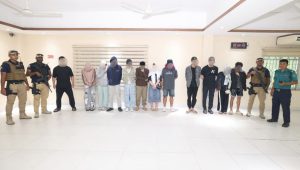
Suspects were handcuffed, beaten, and filmed, sparking a nationwide trend of viral mob violence.
Video analysis reveals that public beatings are the most common form of punishment. Suspects are routinely hunted down, tied to trees, forced to hold their ears, or humiliated by being made to write public apologies on the ground with their noses.
If a suspect is missing, mobs frequently target their family members or property instead. This brutal trend stems from deep public frustration.
Locals complain that arrested drug dealers are quickly released on bail, only to immediately resume their illegal trade.
This systemic failure has convinced many that the legal process offers no permanent solution.
Experts agree that institutional failure drives this vigilantism.
Jurist Mizanur Rahman Khan said, “If the police and the Department of Narcotics Control had played an effective role, such mob violence would not have happened.”
Rezaul Karim, a professor of criminology at Dhaka University, added that easy bail creates a perception that the risk of punishment is low, which encourages re-offending.
Ijazul Islam, executive director of the Human Rights Support Society (HRSS), attributes the violence to deep-seated mistrust, saying that the public believes drug dealers collude with corrupt officials to escape long-term punishment.
Where the danger lies
Sumaiya Iqbal, an assistant professor at the Department of Criminology at Dhaka University, warns that this growing trend of vigilantism poses a severe risk to society.
“When citizens bypass the legal system to mete out their own justice, it creates a highly volatile and dangerous environment. Leaving the power of punishment in the hands of a mob yields no social benefit,” she explained.
“Mob violence is inherently uncontrollable,” Sumaiya added. “Ultimately, it risks violating the constitutional rights of both the accused and the innocent bystanders caught in the crossfire.”
The genesis of the mob
Bangladesh’s current crisis of mob violence traces back to the power vacuum following the regime change on 5 August 2024. As law enforcement collapsed and police stations were attacked, local groups began implementing “mob justice.”
What began as a chaotic reaction to an administrative vacuum soon expanded into a tool for settling ordinary criminal allegations, such as theft and drug dealing, as well as deeply personal disputes.
The political landscape shifted further when the BNP assumed power after the 12 February national elections.
Although Home Minister Salahuddin Ahmed asserted that “the days of mobs are over,” public confidence remains low due to a perceived lack of government crackdown.
The human rights monitoring group Law and Arbitration Centre reports a grim toll. At least 174 fatalities from mob violence have been recorded since August 2024.
Criminal law expert Mizanur Rahman emphasises that this short-circuiting of the legal system is self-defeating.
“This trend ultimately breaks down the rule of law,” Rahman notes. “When a mob takes over, the distinction between innocence and guilt disappears, leaving the door wide open for personal revenge and dangerous rumours to dictate life and death.”
MPs too emerge as ‘inciters’
Alongside grassroots anti-drug campaigns, aggressive rhetoric from certain political figures has recently come under intense scrutiny.
In a video circulating online, individuals carrying out vigilante punishments in Brahmankanda, under Bhanga of Faridpur, claimed they were acting on the direct instructions of local MP and BNP leader Shahidul Islam Babul.
When questioned, MP Babul told TIMES, “Drugs must be tackled through social awareness. However, this does not mean demolishing homes or assaulting individuals. I have issued no such directives.”
In contrast, other lawmakers have taken a significantly tougher stance.
Addressing a public event, Madaripur-1 (Shibchar) MP Sayed Uddin Ahmad Hanzala urged locals to take drastic action. “Wherever you identify a drug dealer, banish them from the community,” he said. “If they try to return to the area after being released from prison, do not allow them to stay. If they succeed in doing so, it will only prove the weakness of the local community.”
Efforts to reach Sayed Uddin Ahmad Hanzala for comment were unsuccessful, as he did not respond to multiple calls and text.
Meanwhile, during a Upazila Law and Order Committee meeting at the Madhabpur Upazila Parishad auditorium, Habiganj-4 MP Syed Md Faisal was captured on video arguing that law enforcement alone cannot stop the drug trade. Instead, he called for a robust social movement that actively unites teachers, students, guardians, religious leaders, and civic-minded citizens.
Asked later by TIMES if such movements risks inciting mob violence, Syed Md Faisal claimed that he did not make any such statement in the meeting.
Where lies a solution
Human rights activist Ijazul Islam believes that public trust can only be restored if real criminals are brought to justice and the law is applied equally to all citizens.
He emphasises the need for robust anti-drug awareness campaigns within families, local communities, and educational institutions, alongside accessible counselling services and an education system deeply rooted in moral and human values.
Criminologist Sumaiya Iqbal highlights that economic realities are also deeply intertwined with the drug epidemic. “Many individuals drift into the drug trade simply due to severe financial crises,” she explained.
Stressing the vital role of rehabilitation, Sumaiya noted that global models offer a sustainable blueprint.
Initiatives are being implemented across various countries to economically reintegrate former offenders back into society. Without proper rehabilitation and alternative livelihoods, it is incredibly difficult to break the cycle and prevent the reoccurrence of crime.”