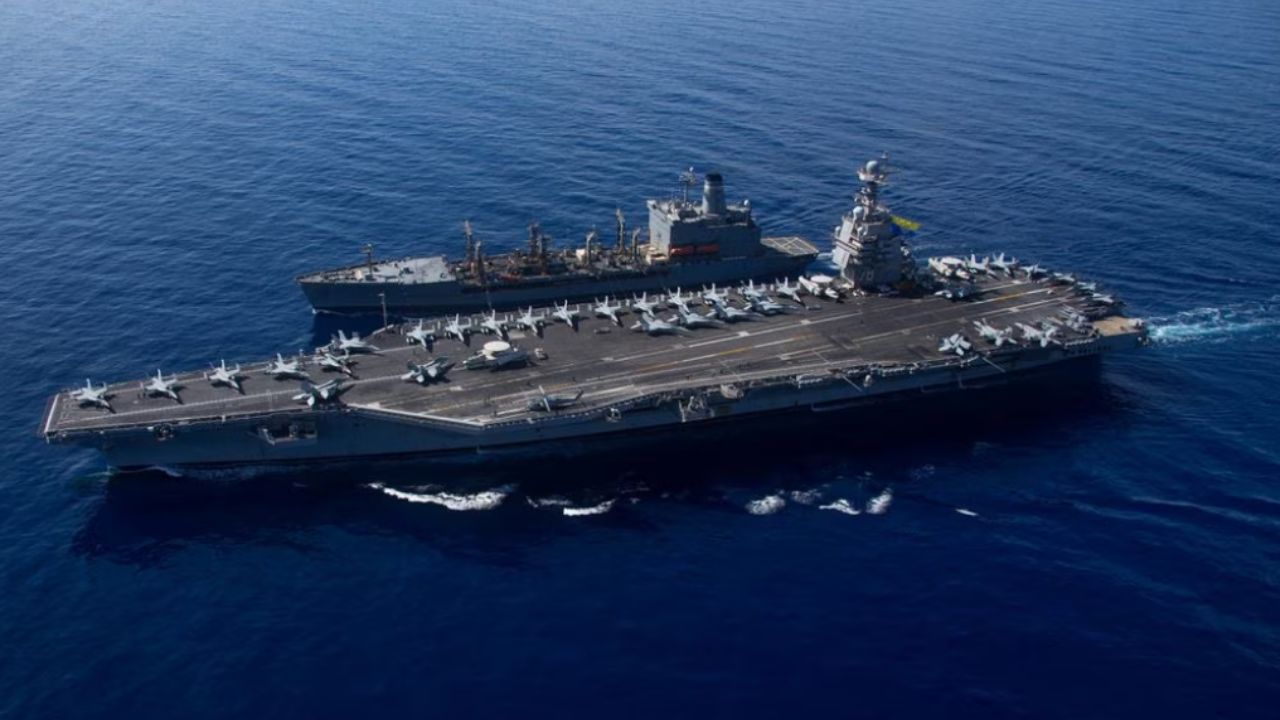
Venezuelan President Nicolás Maduro has accused the United States of “fabricating a war” following the deployment of the world’s largest aircraft carrier, the USS Gerald R Ford, to the Caribbean, in what marks a major escalation of US military activity in the region.
The carrier, capable of carrying up to 90 aircraft, was ordered to move from the Mediterranean on Friday by US Defence Secretary Pete Hegseth.
Maduro, speaking to state media, denounced the move, saying, “They promised never to engage in war again, and yet they are fabricating a new eternal war.”
The United States has intensified its military presence across the Caribbean in recent weeks, deploying warships, a nuclear submarine, and F-35 fighter jets. Officials say these operations are aimed at combating drug trafficking, reports BBC.

In that context, the Pentagon has conducted a series of airstrikes on vessels alleged to belong to criminal organisations, including an operation on Friday that reportedly killed six members of the Tren de Aragua alliance.



The strikes have sparked criticism across the region, with experts questioning their legality and suggesting that the US is using anti-drug operations to exert pressure on the Venezuelan government. The Trump administration insists it is targeting narcotics traffickers but has been accused by analysts and some members of Congress of seeking to intimidate Maduro and destabilize his administration.
Maduro is a longtime foe of Trump, and the US president has accused him of being the leader of a drug-trafficking organisation which he denies.
“This is about regime change,” said Dr Christopher Sabatini, senior fellow for Latin America at Chatham House think tank. “The US likely does not intend to invade but is signaling its capability, aiming to instill fear among the Venezuelan military and Maduro’s inner circle.”
The Pentagon said the USS Gerald R Ford’s deployment will operate under the US Southern Command area, which covers Central and South America as well as the Caribbean. Spokesman Sean Parnell explained that the additional forces would enhance US capabilities to disrupt narcotics trafficking and dismantle transnational criminal organisations.
President Trump has repeatedly raised the possibility of “land action” in Venezuela, stating this week, “We are certainly looking at land now, because we’ve got the sea very well under control.” CNN has reported that Trump is considering targeting cocaine production facilities and trafficking routes inside Venezuela, though no final decision has been made.
The USS Gerald R Ford, which last publicly reported its location off the coast of Croatia in the Adriatic Sea, can carry a mix of jets, transport, and reconnaissance aircraft. Its deployment signals a significant increase in US military presence in the Caribbean and is likely to heighten tensions with Venezuela, which Washington has long accused of sheltering drug traffickers.
The carrier can operate as part of a strike group, accompanied by destroyers and other vessels equipped for missile and combat operations. Observers note that its arrival underscores the US commitment to both anti-narcotics missions and strategic signaling in the region.