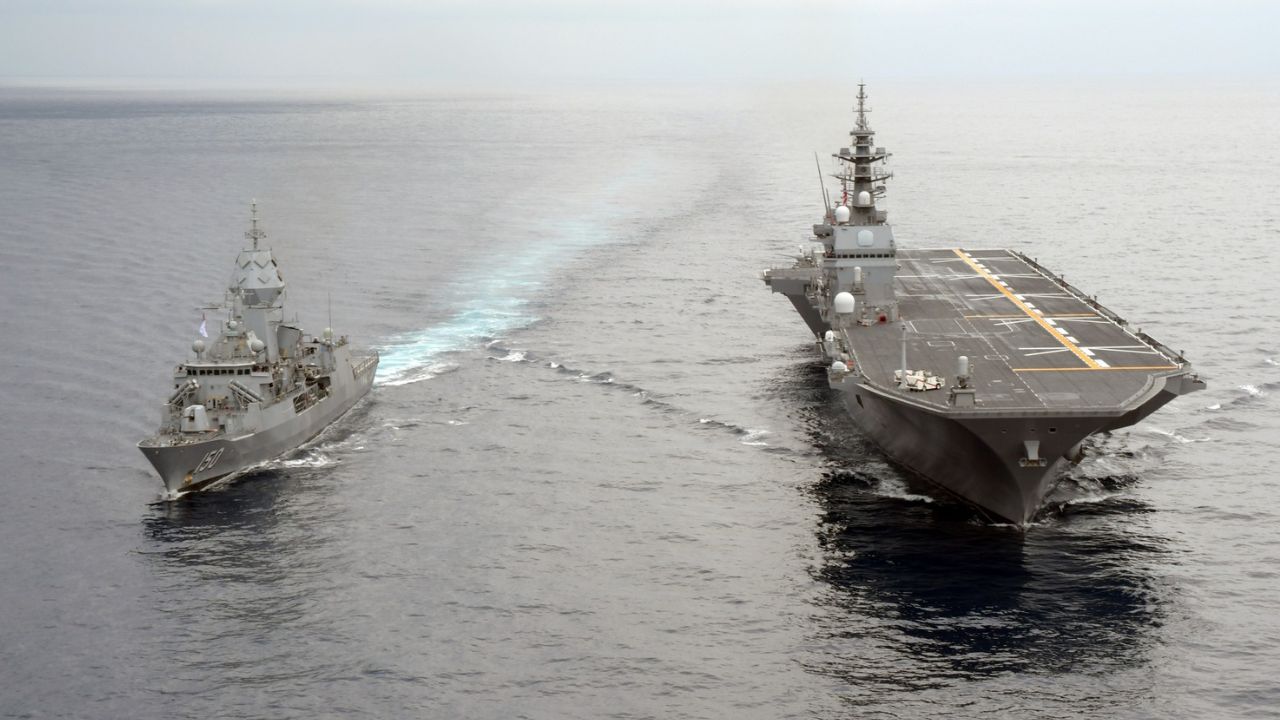



The United States and Japan carried out joint sea and air exercises with the Philippines in the South China Sea over five days to 25 July, the Philippine military said on Sunday, as China responded by staging its own naval and air patrol and accusing Manila of destabilising the region, reports Reuters.
The overlapping shows of force came as the Philippines and China traded accusations over a fresh confrontation between their vessels in the disputed waterway, underscoring the persistent friction between Beijing and a US-backed Manila over control of the strategic sea lane.
Warships, coastguard ships, surveillance planes and fighter jets from the Philippines, the United States and Japan took part in the manoeuvres, which ran from 21 July and were designed to strengthen coordination between the allied forces, according to the Armed Forces of the Philippines. The exact location of the exercises was not disclosed.
The drills form part of an expanding programme of joint military activity that the Philippines has staged with Washington and Tokyo in recent years, as it seeks support in resisting Beijing’s extensive territorial claims over the waterway.
Chinese naval and coastguard vessels have shadowed similar exercises in the past. In a statement, the Philippine military said the drills reflected the lasting cooperation between the allied nations in fostering peace and security across the Indo-Pacific.
The exercises began a day after Manila alleged that Chinese coastguard personnel had struck a Filipino sailor with a baton during an encounter at Second Thomas Shoal. Beijing rejected the account, saying Philippine vessels had rammed Chinese boats and initiated the confrontation.

Tensions escalated further as the drills continued, with the Philippine Coast Guard accusing its Chinese counterpart of firing water cannon at Philippine government vessels near Scarborough Shoal on both Thursday and Friday.
China said it had responded with lawful measures after Philippine ships repeatedly entered the area without authorisation.
Separately on Saturday, the Philippines’ newly appointed armed forces chief of staff, Antonio Nafarrete, travelled to Thitu Island, a Philippine-held outpost in the disputed Spratly archipelago roughly 480 kilometres west of Palawan province.
He told troops stationed there that their presence was essential to safeguarding the outpost and promised continued support to bolster their operational readiness.

China claims sovereignty over almost the entirety of the South China Sea and does not recognise a 2016 international arbitration ruling that dismissed the legal basis for those claims.
Beijing’s response came from the Southern Theatre Command of the People’s Liberation Army, which said on Sunday it had organised a routine naval and air patrol in the South China Sea.
Its spokesman, Senior Colonel Zhai Shichen, said the Philippines had enlisted foreign nations to conduct what he called “so-called joint patrols” in the waterway, which he argued were disrupting the area and undermining regional peace and stability.
Zhai added that the Southern Theatre Command’s forces would remain committed to defending China’s territorial sovereignty and maritime rights, while working to preserve stability in the region.
Beijing’s claims over the South China Sea are disputed by several Southeast Asian nations with overlapping territorial claims, and the arbitration ruling it rejects was issued in 2016 by a tribunal in The Hague after a case brought by the Philippines.
The row over the South China Sea has simmered for decades, but confrontations between Philippine and Chinese vessels have grown more frequent and, at times, more physical in recent years, drawing in the United States and its allies under longstanding defence commitments to Manila.
Manila and Washington are bound by a decades-old mutual defence treaty, which US officials have previously said applies to armed attacks on Philippine forces, vessels and aircraft anywhere in the South China Sea, including in the Spratly Islands and around Scarborough Shoal.
Japan has separately deepened defence ties with the Philippines in recent years, expanding joint training and coordination between their armed forces as part of a broader push by Manila to widen its network of security partners.
Both the latest joint exercises and the disputed encounters at Second Thomas Shoal and Scarborough Shoal form part of a long-running pattern in which Philippine vessels attempting to resupply outposts or patrol nearby waters have run into Chinese coastguard and naval assets operating in the same areas.
Manila has repeatedly accused Beijing of aggressive manoeuvres in such encounters, while China has consistently maintained that its forces are acting lawfully to defend what it regards as its own territory.
Thitu Island, visited by Nafarrete on Saturday, is the largest of the Philippine-held features in the Spratly Islands and hosts a small civilian population alongside military personnel.
The island lies within a chain of reefs and islets also claimed in whole or in part by China, Vietnam, Malaysia, Brunei and Taiwan.
Neither Washington nor Tokyo issued immediate public comment on Sunday’s exchange of accusations between
Manila and Beijing, though both governments have in the past voiced support for the Philippines in its disputes with China and criticised Beijing’s conduct in the contested waters.