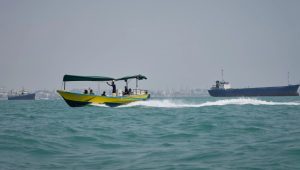
Washington has issued navigation guidance for US-flagged ships passing through the Strait of Hormuz, urging them to maintain maximum distance from Iran’s territorial waters amid tensions between Washington and Tehran.
The guidance, published on Monday by the US Maritime Administration, also cautions American ship captains against allowing Iranian authorities to board their vessels, reports Al Jazeera.
“If Iranian forces board a US-flagged commercial vessel, the crew should not forcibly resist the boarding party. Refraining from forcible resistance does not imply consent or agreement to that boarding,” the advisory states.
“It is recommended that US-flagged commercial vessels transiting these waters remain as far as possible from Iran’s territorial sea without compromising navigational safety. When transiting eastbound in the Strait of Hormuz, it is recommended that vessels transit close to Oman’s territorial sea.”
The advisory follows a round of indirect US-Iran discussions held in Oman on Friday, which came after weeks of heightened rhetoric and threats that pushed relations close to open conflict.
Threats to maritime traffic
International shipping routes have long been vulnerable to political and military tensions, particularly in the Middle East.

In the 1980s, during the Iran-Iraq war, merchant vessels were repeatedly attacked by both sides in a period that became known as the Tanker War.
More recently, Yemen’s Houthi movement has targeted vessels linked to Israel in the Red Sea, saying the attacks were intended to pressure Israel to halt what the group described as its genocidal war on Gaza.
Following Israeli air strikes on Iran in June last year, an Iranian legislator warned that Tehran could consider shutting down the Strait of Hormuz if hostilities escalated further. The narrow waterway links the Gulf with the Indian Ocean and is a key route for global energy shipments.




The US government refers to Hormuz as the “world’s most important oil chokepoint” because of its strategic role in global oil transport.
In late January, Iran’s Islamic Revolutionary Guard Corps (IRGC) carried out naval drills in the strait, prompting warnings from the US military against any “unsafe and unprofessional” actions.
The US later said it had downed an Iranian drone that came close to one of its aircraft carriers operating in the area.
Washington has also seized Iranian oil tankers in the past as part of its sanctions campaign against Tehran.
In 2019, the United Arab Emirates reported what it said were acts of sabotage against four vessels within its territorial waters in the Gulf of Oman.
Despite these incidents, there have been no recent public threats from Iran or other actors directed at commercial shipping in or around the Gulf.
Meanwhile, the United States has continued to reinforce its military presence in the region. President Donald Trump has repeatedly warned of renewed military action against Iran, which experienced widespread anti-government demonstrations last month.
Nuclear negotiations
In December, Trump said the US would strike Iran if it attempts to revive its nuclear and missile programmes. During the June 2025 conflict initiated by Israel, US forces bombed Iran’s three primary nuclear sites, even as talks between Tehran and Washington were under way.
Iranian officials have stressed that the current negotiations are “exclusively nuclear”, while the Trump administration has indicated it also wants to address Iran’s missile capabilities and its backing of regional groups such as Hezbollah and Hamas.
One of the central disputes in past talks has been Iran’s right to enrich uranium. Tehran, which denies seeking nuclear weapons, argues that domestic enrichment does not breach its obligations under the Treaty on the Non-Proliferation of Nuclear Weapons (NPT).
Trump, however, has insisted on a zero-enrichment policy.
When asked whether Washington has set a firm red line on enrichment, US Vice President JD Vance told reporters in Armenia on Monday that Trump would likely keep his negotiating position confidential.
“If you go back to the original negotiation that happened between us and the Iranians, the president was trying very, very hard to actually strike a constructive deal that would have been good for the United States,” Vance said.
“But frankly, the entire administration agreed if the Iranians were smart enough to have made that agreement, then it would have been good for them, too.”