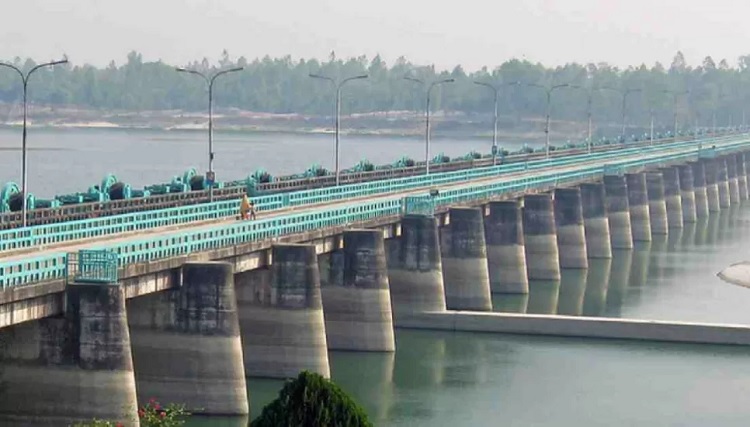



The Ganges Water Sharing Treaty between Bangladesh and India is set to expire in December this year, raising concerns among policymakers and analysts about the urgency of initiating negotiations for its renewal.
Article 12 of the treaty, signed in 1996, stipulates that the agreement would remain in force for a period of 30 years and could be renewed on the basis of mutual consent. With less than a year remaining before its expiry, diplomatic and technical preparations for renewal have become increasingly important.
Diplomatic analysts believe negotiations must begin immediately, as the timeframe is limited and the process of concluding a new agreement requires both technical preparation and political consensus.
They emphasise that before formal negotiations begin, there must be a broad political understanding between the leaderships of the two countries.
Former ambassador Md Abdul Hye said political engagement is essential for the successful renewal of the treaty.
“Political engagement is a must to conclude the deal. This agreement is important for both Bangladesh and India, and the sooner talks begin, the better it will be,” he said.

Former ambassador and former deputy high commissioner of Bangladesh mission in New Delhi Mahbub Hassan Saleh echoed the same view, stressing the importance of political consensus.
“To reach any agreement, Dhaka and Delhi must have a political understanding about future cooperation in different areas, including water sharing,” he said.
According to him, there must be a clearly articulated political mandate to guide the negotiations. Such a mandate could be demonstrated through meetings between the foreign ministers at the Joint Consultative Commission or discussions between water resources ministers at the Joint Rivers Commission.
Any of these platforms could serve as an effective mechanism to launch formal negotiations.




Joint tech committee yet to be formed
During a visit to New Delhi in June 2024 by former Prime Minister Sheikh Hasina, both sides agreed to establish a Joint Technical Committee to begin discussions on the renewal of the treaty. The commitment was reflected in the joint statement issued after the visit.
The statement welcomed the formation of the committee to initiate discussions on renewal of the 1996 treaty and also mentioned cooperation on conservation and management of the Teesta River within Bangladesh with Indian assistance under a mutually agreed timeframe.
However, nearly 20 months later, the Joint Technical Committee has yet to be formally established, according to sources in the Foreign Ministry, Water Resources Ministry and Joint Rivers Commission.
A senior official at the water resources ministry said the government is aware of the urgency of the issue.
“We are aware that time is limited. The new government has assumed office only recently, and we will move quickly on this matter,” he said.
Officials at the Joint Rivers Commission said technical preparations on Bangladesh’s side are largely complete and the country is ready to engage in negotiations.
“We have completed our technical homework and are ready for discussions,” a senior official said.
According to him, extensive technical information has been compiled, including historical data on water flow in the Ganges and detailed analyses of seasonal variations. The Joint Rivers Commission of the two countries held three regular meetings last year where the issue of treaty renewal was discussed informally.
Need for strong political understanding
Experts emphasise that water sharing is a highly politically sensitive issue and any cross-border river agreement requires strong political understanding between the countries involved.
Ambassador Saleh noted that public sentiment in Bangladesh remains an important factor in negotiations. He said, “The successful conclusion of the treaty will help reduce anti-India sentiment and create a more positive environment for bilateral cooperation.”
Saleh added, “If both sides agree then renewal of the Ganges Water Sharing Treaty for next 30 years would be less problematic though it still requires the consent of the State Government of West Bengal, which is certainly not a given.” Saleh further said, “With both sides sounding the need for a larger amount of water during the lean period than what is specified in the existing agreement, the negotiations for a new Ganges Water Sharing Treaty wouldn’t be easy.”
Saleh also emphasised the importance of engaging the government of the Indian state of West Bengal, which plays a critical role in water-sharing issues involving transboundary rivers.
Recalling the negotiations that led to the signing of the treaty in 1996, he noted the importance of political engagement at multiple levels.
“I was a young officer when the treaty was signed. Then West Bengal chief minister Jyoti Basu visited Dhaka in November, just a month before the agreement was concluded. It was a very productive visit, and he gave his consent for the signing of the treaty,” Saleh said.