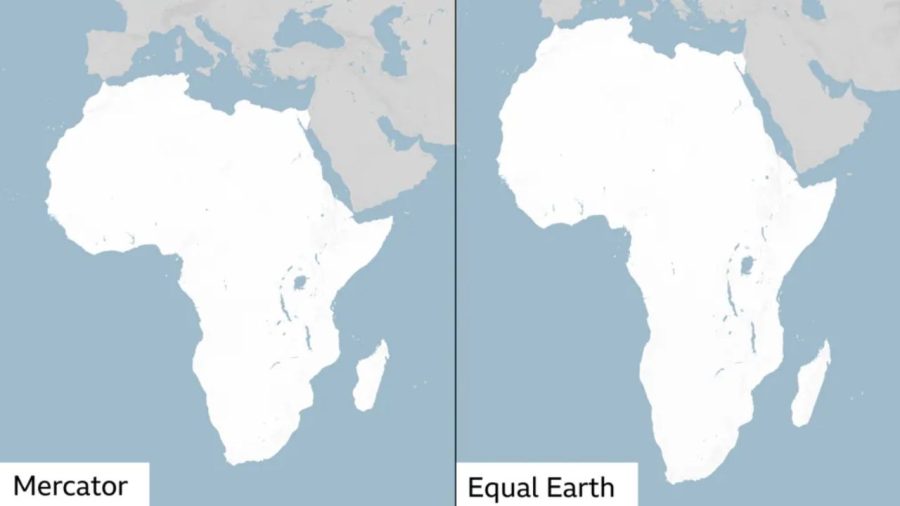

The United Nations General Assembly has voted to replace the traditional world map with a projection that more accurately reflects the true size of Africa.
The “Correct the Map” resolution, sponsored by Togo and supported by members of the African Union (AU), won backing from 164 countries, including France and the United Kingdom, reports BBC.
The United States was the only country to vote against the resolution, while six nations abstained.
Although the UN vote is non-binding, it is expected to lead to changes in the maps used by institutions worldwide.
The Mercator projection, widely used since the 16th Century, has faced longstanding criticism because it portrays Africa as being roughly similar in size to Greenland, despite the African continent being 14 times larger.
Critics argue that the distortion can minimise perceptions of the development needs and potential of countries located near the equator.

Flemish cartographer Gerardus Mercator designed the map in 1569 to assist European explorers with navigation across the world.
The distortion results from the difficulty of accurately depicting the curved surface of a globe on a two-dimensional map. Every attempt to draw the world on a flat surface requires certain compromises.
Under the Mercator projection, areas near the equator appear smaller than their actual size, while countries closer to the poles appear disproportionately larger.
In an effort to address the distortion, a group of cartographers developed the Equal Earth projection in 2018, an equal-area map designed to provide a more accurate representation of the relative sizes of landmasses.



In February, the AU’s 54 member states adopted the projection, saying it “more accurately represents the sizes of all continents, particularly Africa”.
Online campaign group #CorrectTheMap said, “You could fit the United States, China, India, Japan, Mexico and much of Europe into Africa and still have land to spare.”
Ahead of Friday’s vote, Togolese Foreign Minister Robert Dussey told the Reuters news agency, “A fair world begins with a fair map.”
He had earlier told a UN briefing: “A map is never neutral. It shapes perceptions, influences how the place of peoples and continents in the world is understood.”
French Foreign Minister Jean-Noël Barrot also supported the initiative and said his ministry would stop using the Mercator projection.
“Changing the map obviously doesn’t change the world. But correcting a representation that distorts it is already an act of truth,” he said.
However, Yaryna Ferencevych, a US representative at the UN, criticised the resolution, saying it mocked the work and purpose of the UN General Assembly.
“Instead of focusing on genuine problems of international peace, prosperity, or good relations, this body is debating map projects from the 16th Century, and their role in promoting reparations and ‘cognitive justice’,” she said.
In March, the United States also criticised a resolution adopted by the UN that declared the transatlantic slave trade “the gravest crime against humanity”.
Lerato Mogoatlhe of Africa No Filter, one of the organisations behind the campaign to abandon the Mercator map, told the BBC that Africa’s portrayal on traditional world maps went beyond a technical cartographic problem.
“Africa’s misrepresentation on world maps is not just a cartographic error – it’s a narrative issue,” she said.
It formed part of efforts to challenge what she described as the “world’s longest misinformation and disinformation” about Africa.
Kenyan geographer Kioko Muendo said the Mercator projection had also implicitly understated Africa’s enormous resources, population and investment potential.
“Maps are more than just guides for travellers – they shape how regions are perceived politically and economically,” he told the BBC.