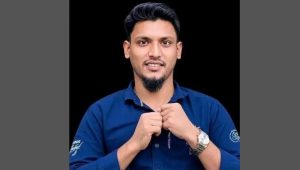
In the spring of 1971, as Bangladesh stood on the edge of a war that would redefine its future, a 17-year-old science student quietly prepared to leave home—perhaps forever.
Freedom fighter Shahiduzzaman, who goes by a single name only, is now a veteran journalist. In an interview with TIMES of Bangladesh, he recalled the moment he made his decision. Before slipping away, he spoke to his mother.
“I told her, ‘If I don’t return one night, assume I’ve gone to fight the war. Don’t look for me,’” he recalled.
At the time, Shahiduzzaman was studying science in Barisal, dreaming of a university education. He came from a modest family in Gopalganj and, like many young people of his generation, had little interest in politics—until the aftermath of Pakistan’s 1970 general election changed everything.
The refusal of the military regime to hand over power to the elected Bengali majority, followed by widespread violence, transformed political frustration into resolve.
“We were the majority, but our votes were ignored,” he said. “Then the atrocities began across the country.”
The turning point, he said, came on 7 March, when Sheikh Mujibur Rahman called for resistance.

“We understood one thing,” Shahiduzzaman recalled. “They were killing us like enemies, not treating us as brothers. We couldn’t respond with bare hands. The answer to arms had to be arms.”
Sometime in late April or early May, he left home without notice and crossed into India. Inside his shirt pocket, he carried a handwritten note: “If I die for this country, I’ll be proud.”
He was sent to Chakulia, a former World War II airfield in what was then Bihar’s Singhbhum district (now Jharkhand), where he trained for more than a month under Indian supervision. There, teenage volunteers learned the mechanics of guerrilla warfare—handling rifles, Sten guns, mortars, anti-tank mines, and explosives.
“We were trained in hit-and-run tactics—jhopp bujhe kop,” he said, using a phrase fighters used to describe sudden ambushes.


Because of his slight build, Sector 9 commander Major Jalil assigned him a lighter Patchett submachine gun—known locally as a “Petagan”—instead of a standard SLR.
By August, Shahiduzzaman and a group of 27 fighters re-entered Bangladesh through the flooded Jessore–Khulna region, wading through waist-deep water to reach their positions. Their first ambush took place near Kaliganj.
After the operation, they ran nearly ten miles through mud before taking shelter in a cowshed. An elderly woman found them there and offered rice gruel and salt.
“She asked, ‘Are you freedom fighters?’ Then she said, ‘Eat, sons,’” Shahiduzzaman recalled.
“That’s how the war was,” he said. “Ninety-nine percent of the people were involved. Everyone supported us.”
As fighting intensified, Gopalganj became a major battleground. On 6 November, Shahiduzzaman’s unit took part in the battle of Bhatiapara, attacking a Pakistani position at a railway station and river port. Armed with limited weapons, they fought for six to seven hours.
At dawn, Pakistani Sabre jets appeared, followed by heavy mortar fire.
“Shells were raining down,” he said. “The comrade next to me was shot in the forehead.”
Shahiduzzaman was wounded by shrapnel in his legs and stomach. To escape, he jumped into the Madhumati River, hiding among water hyacinths until the current carried him to safety.
“Twenty-five of us were injured. Two or three were killed,” he said.
Gopalganj was liberated on 8 December 1971. Bangladesh achieved full independence eight days later, though Bhatiapara remained under Pakistani control until 19 December.
After the war, Shahiduzzaman helped organise rehabilitation and food distribution at relief camps, assisting those displaced by months of violence.
More than five decades later, he remains deeply protective of the history he lived through. Now the Editor and CEO of News Network and a founding member of the Economic Reporters Forum, he continues to speak out against what he sees as distortions of the Liberation War.
“We didn’t fight for power or personal gain,” he said. “We fought because the country called.”
He rejects narratives that frame the war as merely an India–Pakistan conflict.
“We never thought about dying,” he said. “We thought only about freeing our land from those who raped our mothers and sisters and killed hundreds of thousands.”
“Without 1971,” he added quietly, “there is no Bangladesh.”