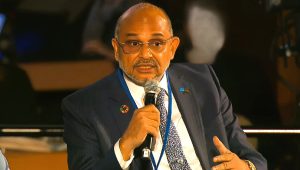
Prime Minister Tarique Rahman on Tuesday expressed his dissatisfaction with the teacher recruitment process at Dhaka University (DU), stating that it had not been conducted as it should have been and was heavily influenced by political bias.
Speaking at an exchange meeting with students at Professor Muzaffar Ahmed Chowdhury Auditorium of the university, the prime minister emphasised that the government aims to curb corruption as much as possible.
He noted that had 16 billion dollars not been laundered during the previous government’s tenure, significant development work could have been carried out for the country’s universities and other sectors.
Earlier at 11am, the prime minister inaugurated a day-long event titled “National Workshop on Transforming Higher Education” at Nabab Nawab Ali Chowdhury Senate Bhaban of Dhaka University.

The workshop aimed to create a time-befitting, inclusive, and sustainable transformation of the country’s higher education system.
During the event, Tarique stressed that redesigning the curriculum from the primary to the higher education level is a “demand of the time”.



He announced the government’s plan to provide innovation grants at the college and university levels and said the government is going to make vocational education mandatory starting from the school level.
The prime minister highlighted the importance of making higher education technology-dependent and skill-based.
He warned that it would be difficult to survive in a competitive world if universities do not focus on research and innovation instead of relying solely on rote learning.
“We want to build such an education system where every student can utilise their potential,” the prime minister said, adding that the government intends to prevent ‘brain drain’ by nurturing and fostering talent to build the nation.
He said despite limited resources, it is possible to achieve something new through their effective use.
The prime minister concluded by stating that the current democratic government aims to establish a knowledge- and merit-based state and society.
The foundation of such a society, he noted, is an environment where education, research, merit, competence, and creativity receive the highest priority.