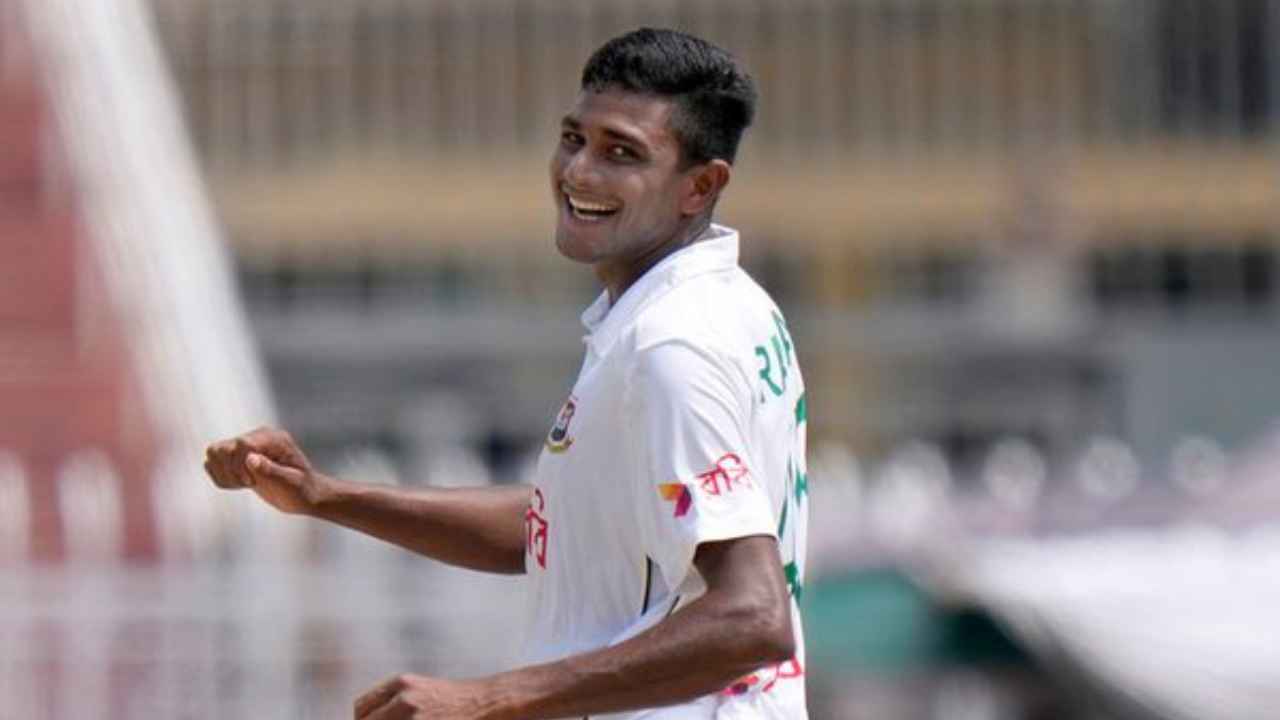



Bangladesh are set to tour Australia for a two match Test series after 23 years, a long awaited return that forms part of the ongoing World Test Championship cycle. Among the storylines building towards it, one stood out: Nahid Rana, the tall, raw pace bowler who has become one of world cricket’s most closely watched exports, was finally set to test himself on Australian soil. Cricket Australia had built real hype around him ahead of the Tests in Darwin, from 13 to 17 August, and Mackay, from 22 to 26 August.
That anticipation has now evaporated. The Bangladesh Cricket Board (BCB) confirmed on Saturday that Rana has been ruled out of the tour after sustaining a grade 2 side strain during the T20I series in Zimbabwe.
“Fast bowler Nahid Rana has been ruled out of the upcoming Test series against Australia after sustaining a left side strain during the match on 17 July 2026,” the BCB said in a media release. “Subsequent scans confirmed a grade 2 side strain. He is expected to require approximately four weeks for tissue healing, followed by a further two to four weeks of bowling workload progression. His overall recovery period is estimated at six to eight weeks from the date of injury.”

Rana is not the only absentee for the series opener in Darwin. Shoriful Islam, recovering from a hamstring injury picked up on the same Zimbabwe tour, is due to resume bowling on 29 July, while Litton Das, sidelined with a calf strain suffered during the ODI series against Australia, begins fitness training on 28 July. Litton is considered unlikely to return before the second Test, subject to his rehabilitation and fitness clearance.
With the Australia itinerary confirmed as far back as 22 March, the timing of Rana’s injury has raised an uncomfortable question: could his workload have been managed differently in the run up to a series Bangladesh had circled for years.




Rana was rested for the one off Test against Zimbabwe, which Bangladesh went on to lose by an innings and 85 runs, before returning for the ODI series, where he took seven wickets across two matches, six of them in the opener. That series was lost too. By the time the T20Is arrived, Bangladesh had suffered back to back series defeats, and with Mustafizur Rahman and Shoriful Islam already carrying injuries of their own and out of the squad, Rana was picked for the first two matches. He managed just 2.3 overs in the second game before limping off with the side strain that has now ended his Australia dream before it began.
A team management source told this publication that Rana’s inclusion was not simply about giving him game time. “We did not bring him in simply for game time,” the source said. “The situation demanded it because we were losing.” The same source insisted the workload had been managed according to plan, pointing out that Rana had missed the Test and had been rested for the third ODI. “There was no issue with his workload or workload management. He was not overloaded in any way, and his workload management was fine.”
Not everyone in Bangladesh cricket sees it quite so cleanly. Khaled Mahmud Sujon, the former BCB director and Bangladesh captain now serving as the board’s newly appointed age level mentor, struck a more candid note a day before the BCB’s confirmation. “After losing the ODI series, we found ourselves in a difficult situation and perhaps, in our desperation to win the series, we lost sight of workload management at that point,” he said.
There is also a weather dimension to consider. Zimbabwe experiences its coldest and driest stretch of the year between June and August, with average temperatures of 14 to 21 degrees Celsius. Asked whether cold conditions could have contributed to the injury, a BCB medical official was measured in response. “For a fast bowler, cold weather can therefore increase the risk, especially if the body is not properly warmed up,” the official said. “But a side strain is generally caused by a combination of workload, muscle fatigue and mechanical stress rather than temperature alone.” Another BCB official close to the setup maintained that Rana’s workload had never been a concern. “Nahid Rana did not play the Test match, so this was not a workload issue. Generally speaking, his workload was minimal. We had no workload related concerns with him.”
The stakes attached to managing Rana properly are not lost on those who have worked closely with him. During the most recent Pakistan Super League, former England seamer Dominic Cork, working as a commentator while Rana represented Peshawar Zalmi, made a pointed appeal to Bangladesh’s think tank. “You are listening, Bangladesh. He is an asset for world cricket. Manage him well, look after him.”
For now, that management has produced the opposite of what Bangladesh wanted. A bowler being built up as one of the central figures of a historic tour will instead watch it from home, another instalment in the familiar tension between winning today and protecting the players a team will need tomorrow.