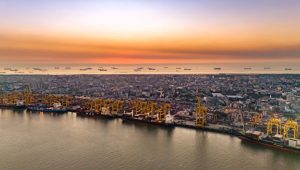
Bangladesh has made impressive economic progress over the past few decades. Much of this success can be attributed to Dhaka. Metro Dhaka produces approximately one-fifth of the country’s GDP and provides nearly half of all formal jobs.
Today, Dhaka’s transport system is under severe pressure. Thousands of commuters lose about an hour every working day sitting in traffic. Busy period traffic speeds often fall to the high single digits. Congestion is estimated to cost the economy over US$12.5 billion annually (7 percent of Bangladesh’s 2014 GDP).
The costs go far beyond lost time. Poor transport contributes to dangerous air pollution. Dhaka’s average PM2.5 levels reaches 78 µg/m³ (World Health Organization’s recommended level is 5 µg/m³).
Road crashes, excessive traffic noise, unreliable public transport and poor access also reduce productivity and damage public health. The burden falls heavily on vulnerable transport users (pedestrians, cyclists and women) and lower-income communities.
These problems did not appear overnight. Dhaka has grown rapidly, but transport infrastructure has failed to keep pace. Demand for transport infrastructure and services far outstrips the supply. The problem is also institutional.
Several agencies share Dhaka transport responsibilities. They lack effective coordination. Limited funding, weak enforcement and inconsistent regulation have reduced the quality of public transport and encouraged disorderly use of road space.
Illegal parking, growing dependence on private vehicles, inadequate walking and cycling facilities, and fixed office hours have all made congestion worse. This has created a vicious cycle.
As buses become slower and less reliable, more people choose private vehicles. More private vehicles create even greater congestion, making public transport less attractive. Breaking this cycle requires a different approach.

Dhaka should first make better use of existing roads, rather than relying mainly on expensive construction projects. Many improvements can be achieved quickly and at a relatively low cost.
The proposed strategy comprises three phases and five simple guiding principles. The principles are: (a) spending public money wisely; (b) making transport safer and cleaner; (c) prioritizing affordable high-impact measures; (d) strengthening institutions through better coordination and legal reforms; and (e) ensuring an inclusive transport system that serves all, especially vulnerable groups.
The first phase (next 18 months) focuses on delivering quick and visible improvements. These will include better traffic signal management, stronger enforcement, bus-priority lanes (where appropriate), digital parking management, removal of illegal parking, improved footpaths and pedestrian crossings, and adoption and implementation of a clear e-rickshaw clear policy and strategy. It also prioritises faster implementation of major ongoing projects, including metro rail and expressways.
These are relatively low-cost measures that can make a noticeable difference. Better traffic management can improve bus reliability, reduce congestion, make walking safer and restore public confidence in the transport system.
Progress should be tracked through simple and publicly available performance indicators. This will help citizens to see whether improvements are being delivered.
Indicators may include: a marginal reduction of peak-hour travel time, a moderate improvement in bus reliability, clearance of moderate footpath length, a substantial reduction of illegal parking, and a marginal increase in bus ridership on improved routes.



Furthermore, this first phase should also prepare the groundwork for longer-term reforms and investments, including institutional strengthening, regulatory changes and future infrastructure investments.
The second phase (next three years) focuses on building a stronger, better-integrated transport system. The focus shifts to improved services, stronger institutions and better connections among transport modes.
Priority measures will include integrating buses with metro services, introducing a single ticketing system, reorganising bus routes, improving feeder buses, expanding walking and cycling facilities, modernising the bus fleet with cleaner technologies, and strengthening parking management through appropriate institutional arrangements.
A stronger Dhaka Transport Coordination Authority (DTCA) will be essential. If necessary, the existing law should be amended to give the agency greater authority to coordinate planning and implementation.
Better coordination among different agencies will improve service quality, encourage greater use of public transport and prepare the city for larger investments in the future.
Success can be measured through increased public transport use, expanded walking and cycling networks, lower transport emissions, a higher share of cleaner buses in the fleet, and stronger parking revenue collection, with proceeds reinvested in parking management and improvements to public transport.
The third phase looks beyond the next few years. The aim is to transform Dhaka into a modern, low-emission and well-connected city.
This will require expanding metro, monorail and Bus Rapid Transit (BRT) systems (best matching travel demand), developing transport hubs, improving areas around metro stations, integrating transport with land-use planning, expanding electric vehicle charging facilities and investing in climate-resilient infrastructure.
These long-term investments should create a transport system that is faster, cleaner and safer. The overall goal could be: increasing average peak-hour traffic speeds to at least 15 km/h; raising public transport use to 40 percent; halving road deaths and reducing congestion-related economic losses by a half.
Achieving these outcomes will require a sustained political commitment and stable financing over many years.
The strategy faces risks from limited funding, weak institutional coordination, political changes, resistance to reforms, weak enforcement and climate impacts.
These can be mitigated by prioritising affordable, high-impact projects, strengthening DTCA’s leadership, building political consensus, engaging stakeholders, improving public awareness, expanding digital traffic enforcement and making infrastructure more climate resilient.
Global conflicts (Middle East and Ukraine wars), rising trade barriers, and disruptions to energy and shipping routes might tighten Bangladesh’s public finances.
Such a situation will require a more affordable transport strategy for Dhaka. Under such constraints, priority should be given to practical, low-cost measures that deliver visible results within six to twenty-four months.
Implementation should proceed in three stages: first, strengthening traffic enforcement, management and public awareness; second, completing key operational improvements; and third, expanding successful measures citywide while closely monitoring performance and making necessary adjustments.
Immediate priorities include optimising traffic signals, strengthening enforcement, removing illegal parking and encroachments, introducing digital parking management, restoring footpaths, improving pedestrian crossings, piloting bus-priority lanes, raising public awareness and establishing a transport performance monitoring system.
Within 12–24 months, these measures could deliver measurable improvements in travel times, public transport use, footpath recovery and illegal parking. Regular publication of performance indicators will strengthen transparency, public confidence and accountability.
Dhaka’s sustainable transport requires integration of transport, land-use, investment and employment policies. Priorities include: (a) strengthening secondary cities to reduce migration; (b) promoting higher-density mixed-use development around MRT and BRT stations; (c) regenerating older neighbourhoods; (d) enforcing zoning to control unplanned growth; (e) using land pooling for infrastructure and affordable housing; and (f) limiting low-density development and adopting parking maximums policies along mass transit corridors.
Dhaka’s transport crisis cannot be solved overnight. Also, it should not be accepted as inevitable. Many of the solutions are affordable and can deliver quick results. What has been missing is consistent implementation, better coordination and sustained political commitment.
Improving Dhaka’s transport system is not simply about reducing traffic. It is about protecting public health, improving quality of life and strengthening Bangladesh’s economy.
By combining affordable short-term improvements with well-planned long-term investments and appropriate policy measures, Dhaka can become a cleaner, safer, more efficient and more inclusive city. The time to act is now.
The writer is a Senior Transport Specialist (Retd.) at the World Bank, Washington, DC. He can be reached at [email protected]