


State Minister for Primary and Mass Education Bobby Hajjaj on Tuesday warned of strict action against private primary education institutions if they charge excessive fees from students, clarifying that they may only collect logical and fair fees in return for services.
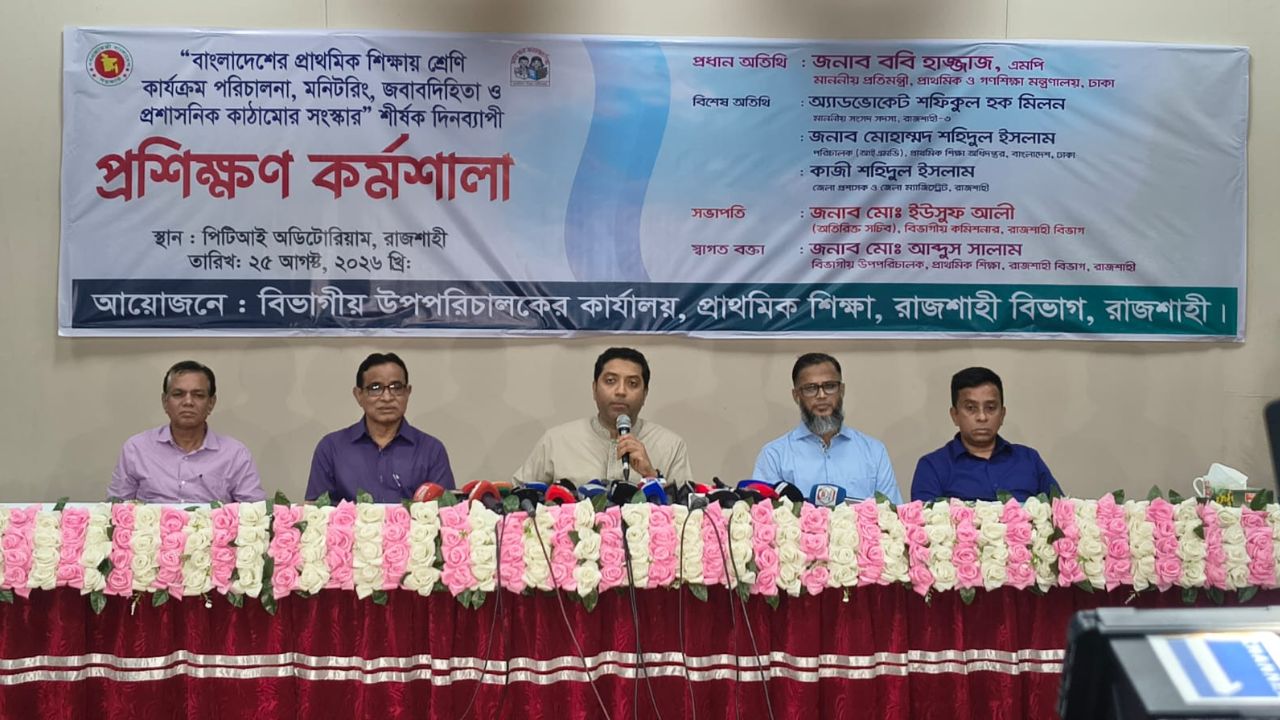
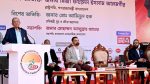
Addressing journalists after a day-long training workshop titled “Classroom Activities Management, Monitoring, Accountability and Administrative Structure Reform in Primary Education of Bangladesh” at Rajshahi PTI conference room on Tuesday, the state minister outlined several reform initiatives.
A new policy for primary education is being formulated to focus on improving the quality of education in all types of government and private primary schools, Hajjaj said.
He added that a new pay scale for teachers is also being developed in consultation with sector stakeholders, which is expected to benefit and satisfy them.
Moreover, free school uniforms will be distributed to all primary school students nationwide by next year, in line with the prime minister’s announcement, and a third language will be taught to make students career-oriented.

Emphasising the importance of the actual state of schools over paper reports, Hajjaj said, “The actual learning outcome of a student, not good paper reports, will be the main yardstick of success in primary education.”
He said teacher and student attendance, learning progress, and the practical effectiveness of school activities will be verified directly to ensure alignment between field-level realities and official reports.


This effective monitoring system will eventually encompass all primary schools across the country, not just government ones.
Hajjaj explained that a countrywide action plan is currently being implemented, which includes continuous workshops for primary education officials.
Such workshops have already been held in Mymensingh, Barishal, Sylhet, and Rajshahi divisions, and will be organised in Khulna, Rangpur, and Dhaka divisions in phases.
The Rajshahi workshop aimed to brief field officials on ongoing and future reforms and gather their long-term experience and realistic feedback to bring positive changes in areas like school monitoring, teacher and administrative management, curriculum reform, technology usage, classroom and infrastructure development, safe and usable toilets, and classroom environments and furniture.
He urged officials to play an active role in implementing the government’s first 180-day action plan, the subsequent 180-day programme, and the five-year commitment, with the ultimate goal of keeping every child in school and ensuring quality education.
The workshop was chaired by Rajshahi Divisional Commissioner (Additional Secretary) Md Yusuf Ali. Special guests included Member of Parliament for Rajshahi-3 Shofiqul Haq Milon, Deputy Commissioner Kazi Shahidul Islam, and Director of the Directorate of Primary Education Shahidul Islam.
All district and upazila primary education officers of Rajshahi division, along with relevant education administration officials, were in attendance.
Earlier, the State Minister arrived at Shah Makhdum Airport, Rajshahi, by air around 8am on Tuesday, where he was welcomed with flowers by Shofiqul Haque Milon.
During a meeting in the VIP lounge, Hajjaj and Milon discussed various district issues, including the local primary education system.
The meeting was attended by Paba Upazila Executive Officer Md Ibnul Abedin, Paba Upazila Assistant Commissioner (Land) Mohammad Mehdi Hasan, Rajshahi Divisional Deputy Director of Primary Education Abdus Salam, and other relevant officials.