






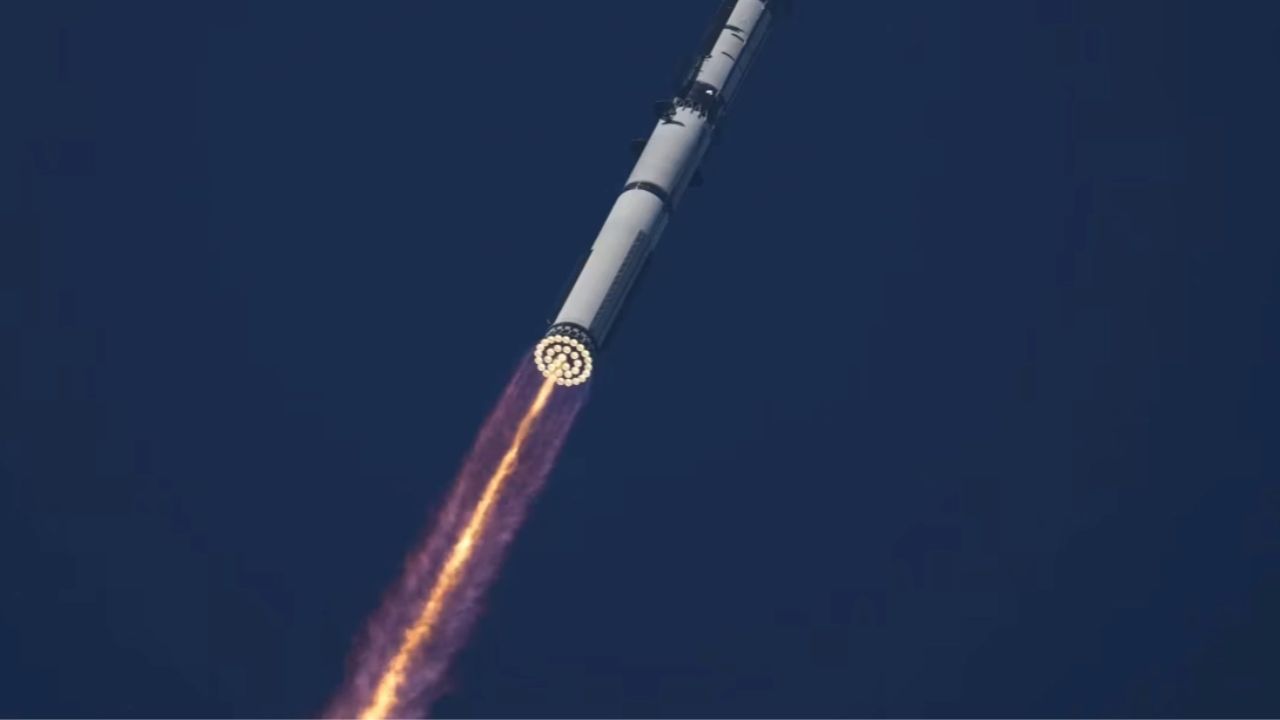
SpaceX’s Starship completed a test flight with a successful soft splashdown in the Indian Ocean an hour after launch. It was the rocket’s 13th test flight.
The company, owned by Elon Musk, cited engine failure at liftoff during an aborted launch attempt last week, reports BBC.
According to SpaceX, this was also the second flight for this version of Starship, called V3, and its first flight as a publicly traded company.
The latest flight test of SpaceX’s Starship began with the Super Heavy booster igniting all 33 Raptor 3 engines, ascending over the Gulf of America.
Following a successful first-stage ascent, the vehicle performed a hot-staging manoeuvre, during which the Starship upper stage ignited its six Raptor engines to continue its journey to space.
During the return sequence, the Super Heavy booster executed a directional flip manoeuvre, utilising a modified startup sequence designed to be more robust to timing variability.
This marked the first flight of a Super Heavy V3, which successfully completed the high thrust portion of its boostback burn using all 33 engines. Although a subset of engines ignited for the landing burn, the booster ultimately experienced a hard splashdown in the Gulf.
Starship’s upper stage achieved its planned velocity and trajectory after a full-duration ascent burn. During the mission, the vehicle successfully deployed 20 Starlink V3 satellites, with SpaceX engineers establishing communication through radio frequency and laser links to download key telemetry.
The satellites, deployed on a pre-planned trajectory, were expected to demise upon re-entry approximately 20 minutes after deployment.
In a key demonstration of core capabilities for future orbital missions, the vehicle successfully reignited a single Raptor engine while in space.
Upon re-entering the Earth’s atmosphere, Starship gathered critical performance data on its heatshield. It executed a dynamic banking manoeuvre to mimic future return trajectories to Starbase before guiding itself via four flaps toward a pre-planned zone in the Indian Ocean.
Following a successful landing flip and a landing burn powered by three Raptor engines, Starship achieved a soft splashdown. The vehicle remained intact, providing the first critical views of an intact heatshield following such a mission.


