
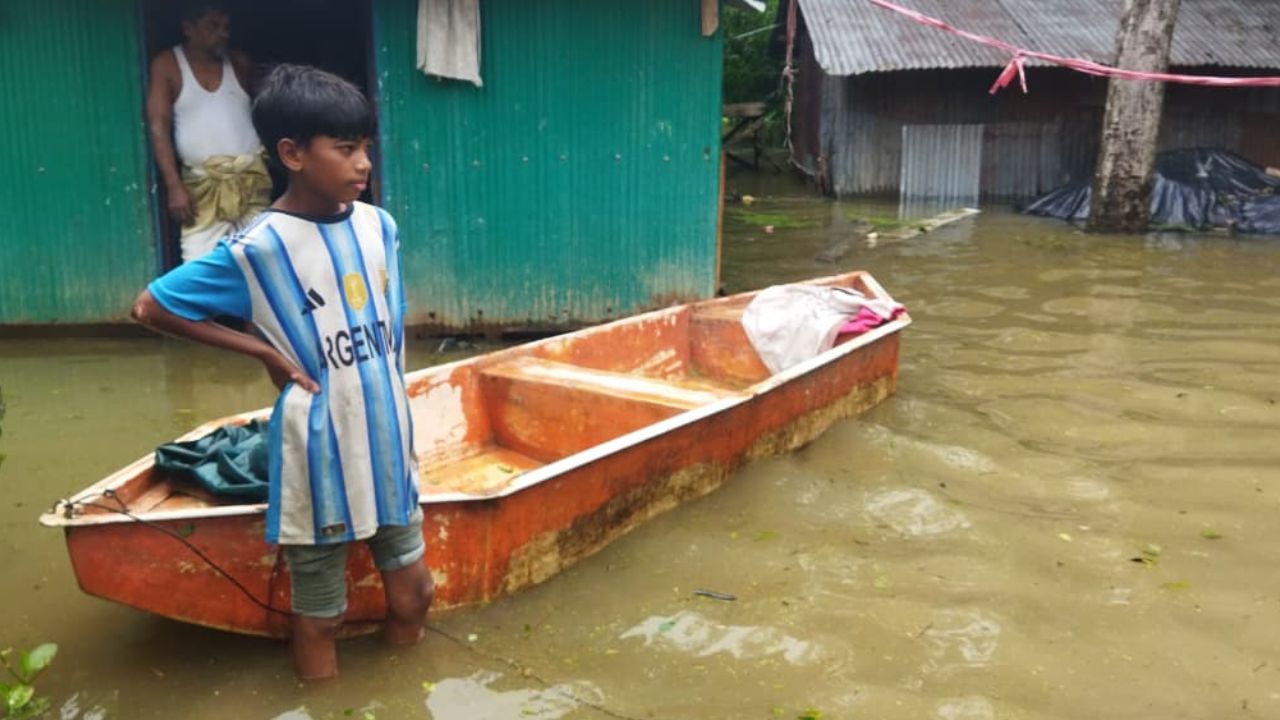

More than a week after floodwaters receded from Chattogram, rehabilitation remains stalled, with no visible work under way in the worst-hit areas.
Government agencies have sent detailed damage assessments to higher authorities, but funds and materials have yet to reach the ground, leaving hundreds of thousands of people struggling amid widespread destruction.
Education, agriculture, fisheries, housing and infrastructure have all suffered severe losses requiring special government allocations. For now, however, the damage figures remain trapped in official files.
Chattogram Divisional Commissioner Md Ziauddin said the full assessment had been sent to the government and efforts were under way to prioritise rehabilitation.
The Chattogram District Primary Education Office initially identified 182 damaged primary schools. After verification, 130 were included in the final list, with institutions in Chattogram city and Satkania, Banshkhali, Lohagara, Fatikchhari and Hathazari among the worst affected.
District Primary Education Officer Firoz Ahmad said floodwaters had destroyed furniture, cupboards and important documents in most schools. Although structural damage was comparatively limited, major repairs would still be needed to make the schools fit for classes.

“We have submitted the final list to the government through the deputy commissioner and to the directorate. Today, 3 August, we also sent the names of the 130 schools. But no rehabilitation allocation has reached us so far,” he said.
He added that the issue had been discussed at the Circuit House, but no clear instruction had been given on the release of funds.
Agriculture and fisheries, the backbone of the rural economy, suffered the heaviest blows.
Across five districts in Chattogram Division, agricultural losses are estimated at Tk401.91 crore. More than 21,117 hectares of cropland were affected, destroying nearly 1.5 lakh tonnes of crops and devastating 1,96,510 farming families. Aus paddy and summer vegetables were almost completely wiped out.




Abdul Malek, 48, a farmer from Banshkhali, said, “I had Aus paddy and seasonal vegetables on nearly five acres. Everything was destroyed. The land is still covered in mud and cannot be cultivated. I borrowed from banks and NGOs, and now I do not know how I will repay the loans. We hear about government assistance, but no one has come to help.”
The fisheries sector suffered losses of Tk210.10 crore, most of which were in Chattogram. Floodwaters inundated 23,610 ponds and 789 shrimp farms, washing away fish and fry worth hundreds of crores of taka.
According to the Department of Fisheries, more than 6,830 tonnes of fish and 7.66 crore fish fry were swept away.
Chattogram District Fisheries Officer Salma Begum said no rehabilitation allocation had yet been received.
“Affected fish farmers are living in extreme despair,” she said.
Jahangir Alam, 42, a fish farmer from Satkania, said all the fish and fry in his ponds had been washed away.
“I built the farm with years of savings. Restocking the ponds will require a lot of money. Without rehabilitation assistance, it will be very difficult for small farmers like us to recover,” he said.
The battered road network has further slowed recovery.
According to the Roads and Highways Department and the Local Government Engineering Department, 2,021 kilometres of roads in Chattogram and Cox’s Bazar were damaged. In Chattogram Zone alone, 212.94 kilometres were affected.
The floods also severed 846 road links, with repairs estimated to cost at least Tk423 crore.
Housing losses were equally severe. According to the deputy commissioner’s report, 26,506 houses were damaged, including 20,193 that were partially or completely destroyed. Around 1,85,000 families were affected, and 16 people died.
The district administration has allocated 800 bundles of corrugated tin sheets and Tk24 lakh for homeless families—far below the scale of need.
Officials have identified the declining water-carrying capacity of rivers and canals as a major factor behind the floods. A lack of regular dredging in the Karnaphuli and Sangu rivers and their tributaries has caused heavy siltation, slowing drainage and prolonging waterlogging.
Prime Minister Tarique Rahman is scheduled to visit Chattogram on 9 August and may inspect flood-hit areas in Banshkhali, Fatikchhari and Hathazari.