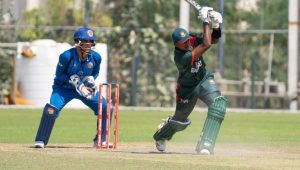



Mohammad Rubel could be more than another spinner trying to break into the Bangladesh team. He could be part of a change in the way the next generation of Bangladesh bowls.
For decades, Bangladesh cricket has relied heavily on conventional finger spin, particularly left arm spin. Mohammad Rafique, Enamul Haque Moni set examples, and generations followed them. Shakib Al Hasan and Abdur Razzak gave a new level to that legacy.
But Rubel represents something different. At 30, he is in the Bangladesh High Performance team, and the right-arm spinner has a doosra, a carrom ball, a conventional off break and a seam up delivery among his variations. He does not want the batter to know which way the next ball will go.
And right now, batters in Australia are struggling to work him out. Rubel has taken 11 wickets in three matches in the Top End T20, at an average of just 5.27 and an economy rate of 4.83.
He has been particularly difficult for left handers. Rubel comes around the wicket and can send the ball down with the seam upright. The delivery moves back towards the left hander. He attacks the stumps, looking for the gap between bat and pad.
Batters cannot simply prepare for the ball coming in. Rubel can bowl the conventional off break. He has a good carrom ball. And then there is the doosra, a delivery that has become increasingly rare among modern spinners.
That is what makes the description of Rubel as a mystery spinner more fitting than simply calling him a right arm off spinner.
Bangladesh do not have many bowlers like him. Bangladeshi spin bowling coach Sohel Islam believes Rubel can go much further.

“He’s a very good prospect,” Sohel told TIMES of Bangladesh.
“We want to elevate him through the levels. He’s currently in the Bangladesh HP team. Then maybe he can go into the A team and then into the national team. But he’s a brilliant prospect.”
Sohel believes Bangladesh’s history shows how one generation of successful bowlers can influence the next.
“Why does Afghanistan excel in leg spin or mystery spin? Because Rashid Khan and others set an example,” he said.
“In our country too, Mohammad Rafique, Shakib Al Hasan and others set an example of how left arm spinners excel. So over the years we have produced a lot of left arm spinners.”
Now Sohel believes bowlers such as Rubel could help expand Bangladesh’s spin bowling identity.




“I think Mohammad Rubel and the others can set a new example, and they can make sure the spin bowling culture changes and new mystery spinners and carrom ball bowlers emerge and shine at the top level,” Sohel said.
Rubel is not alone in offering something unconventional.
Aliss Islam has brought mystery spin into Bangladesh’s top level domestic circuit, while Rishad Hossain has emerged as a leg spinner at international level.
Sohel believes Rubel, Aliss and Rishad can create excitement among a new generation of children. If young players see unconventional spinners succeed, they may be encouraged to experiment instead of simply following the traditional route of finger spin.
Successful examples can create a culture. That makes Rubel an interesting figure at an interesting time.
And nothing about the man who could help inspire that change has been particularly conventional either.
Rubel is a late bloomer. For years, he worked as a professional marriage registrar in Chattogram while continuing to play cricket. His life was divided between his work and the game he refused to leave behind. He could finish officiating a marriage and then head for cricket.
His route into professional cricket was similarly unusual. Rubel spent years in the lower levels rather than moving through Bangladesh’s established age group pathway. He performed consistently in the local leagues and impressed for Gazi Tyres Cricket Academy before making another mark in the Chattogram Regional T20.
Those performances eventually opened the door to the NCL T20, where people outside his local cricket circles really began to take notice.
Rubel took 10 wickets in eight matches at an economy rate of 5.20 and was named the tournament’s Most Promising Cricketer.
The BPL followed. Rubel took four wickets in three matches in 2026. It was not a remarkable individual campaign, but he ended it as part of the champion Rajshahi Warriors squad.
The Dhaka Premier Division Cricket League 2026 provided stronger evidence that his breakthrough was not temporary.
Playing for Gazi Group Cricketers, Rubel took 20 wickets in 10 matches. He averaged 18.25, conceded only 4.11 runs per over and recorded a best of 6 for 23.
His progression eventually took him somewhere that once seemed a long way from the lower levels of Chattogram: Bangladesh HP.
“We are nurturing him so that he can maintain this progression of his,” Sohel said.
His inclusion itself is unusual. Rubel received his first opportunity in a BCB High Performance team at an age when such programmes are normally associated with much younger prospects.
And he has responded by taking wickets in Australia. The bigger question is now how much higher he can go.
Sohel has already outlined the possible route. HP first, then potentially the A team and, if Rubel continues progressing, perhaps the national team.
There are no guarantees. But there is something fitting about the fact that Rubel’s opportunity has arrived this way.