


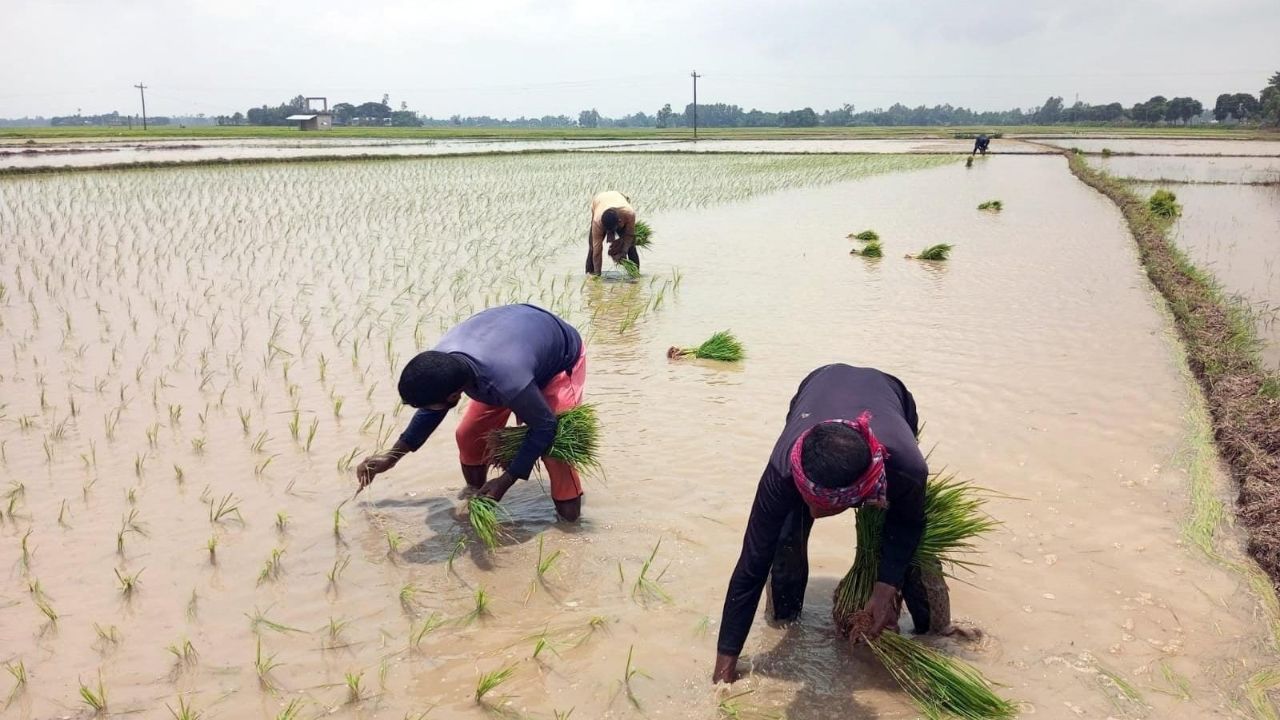
Farmer Ohidul Islam of Raninagar upazila in Naogaon had to irrigate his Aman fields this season because of inadequate rainfall. A fertiliser shortage added to his difficulties, while buying fertiliser at higher prices increased his cultivation costs by Tk700 to Tk1,000 per bigha compared with last year.
Even if he harvests 18 maunds per bigha, his production cost will rise by more than Tk55 per maund. Yet the government has increased the paddy procurement price by only Tk1 per kilogramme from last year, leaving him dissatisfied with the new rate.
Lokman Ali, a farmer from Chakraja village in Mahadebpur upazila of the district, said his cost of producing Aman paddy was Tk17,500 per bigha last season. This season, expenses on fertiliser, seeds, pesticides and labour are expected to push the figure above Tk18,000.
Government figures also show a rise in production costs. However, farmers claim that the increase is higher than official estimates.
Naogaon Department of Agricultural Extension Deputy Director Md Manjur Rahman said inadequate rainfall at the beginning of the cultivation season had forced farmers to irrigate their fields several times, increasing production costs. He estimated that farmers might incur an additional cost of around Tk500 per bigha this season.

The rising cost of cultivation raises questions about how far the government has considered farmers’ financial pressures when setting procurement prices. After the BNP came to power, it did not increase the procurement price of Boro paddy this year. For Aman, it has raised the paddy rate by just Tk1 per kilogramme while reducing the procurement prices of both types of rice by Tk1.
According to government figures, the production cost of Boro paddy was Tk30.05 per kilogramme in the 2024-25 fiscal year. It rose to Tk34.11 in 2025-26.
For Aman paddy, the production cost increased from Tk29.39 per kilogramme in 2024-25 to Tk30.46 in 2025-26. Final figures for the current season are not yet available. However, seed prices have risen, fertiliser is not available at government-fixed rates, and diesel prices have increased by Tk35 in two phases. Costs of pesticides and other inputs have also gone up.




Farmers also do not yet know how much they will have to spend on labour and transport this season. Against this backdrop, the government’s decision to procure paddy at Tk35 per kilogramme has failed to satisfy Ohidul and Lokman.
For the 2026-27 fiscal year’s Aman season, the government has set a target of procuring 300,000 tonnes of paddy and 550,000 tonnes of rice. The rice target comprises 500,000 tonnes of parboiled rice and 50,000 tonnes of non-parboiled rice.
The procurement price of paddy has been raised from Tk34 per kilogramme last year to Tk35. The price of parboiled rice has been cut from Tk50 to Tk49, while that of non-parboiled rice has been reduced from Tk49 to Tk48.
Food Minister Afroza Khanam Rita told a press conference that the government would procure more paddy than its announced target if farmers wanted to sell, and arrangements had been made to facilitate this.
Aman paddy procurement will run from 14 November to 28 February, according to the announced schedule. Rice procurement will begin on 1 December and continue until 28 February.
The procurement rates have raised concerns among farmers and rice mill owners as they face rising production costs and uncertainty over rice prices.
Farhad Hossain Chokdar, general secretary of the Naogaon District Rice Mill Owners’ Group, told TIMES that imports last season had reduced demand for and sales of locally produced rice to some extent. This had left mills with unsold stocks from the previous season. The need for additional capital to procure new paddy has also put mill owners under financial pressure. They are now concerned about whether supplying rice at the announced rates will generate the expected profit.

Professor Jahangir Alam Khan of Department of Agricultural Economics at Bangladesh Agricultural University said, “Tk35, or even the previous rate of Tk34, is nowhere near sufficient compared with current production costs.”
He said, “The production cost of Aman paddy is generally somewhat lower than that of other seasons. But the situation is different this year. There was an irrigation shortage, farmers had to buy fertiliser at higher prices, and they could not obtain fertiliser in the quantities they needed. As a result, irrigation costs increased significantly. These factors have further raised the cost of production per unit this season. In this situation, the government should have procured paddy directly from farmers.”
A fall in paddy prices followed the government’s decision not to increase the Boro procurement rate this year. However, rice prices rose after farmers had already sold their paddy, leaving them unable to benefit from the increase.
Jahangir told TIMES, “The actual benefit to farmers depends on the procurement price of paddy, not the price of rice. This is because the government does not buy rice from farmers; it buys paddy. On the other hand, rice is procured from mill owners.
“Therefore, the most important issue for farmers is how many lakh tonnes of paddy the government buys directly from them. In reality, however, under the existing government procurement policy, ordinary farmers rarely get the opportunity to sell their paddy directly to the government.”