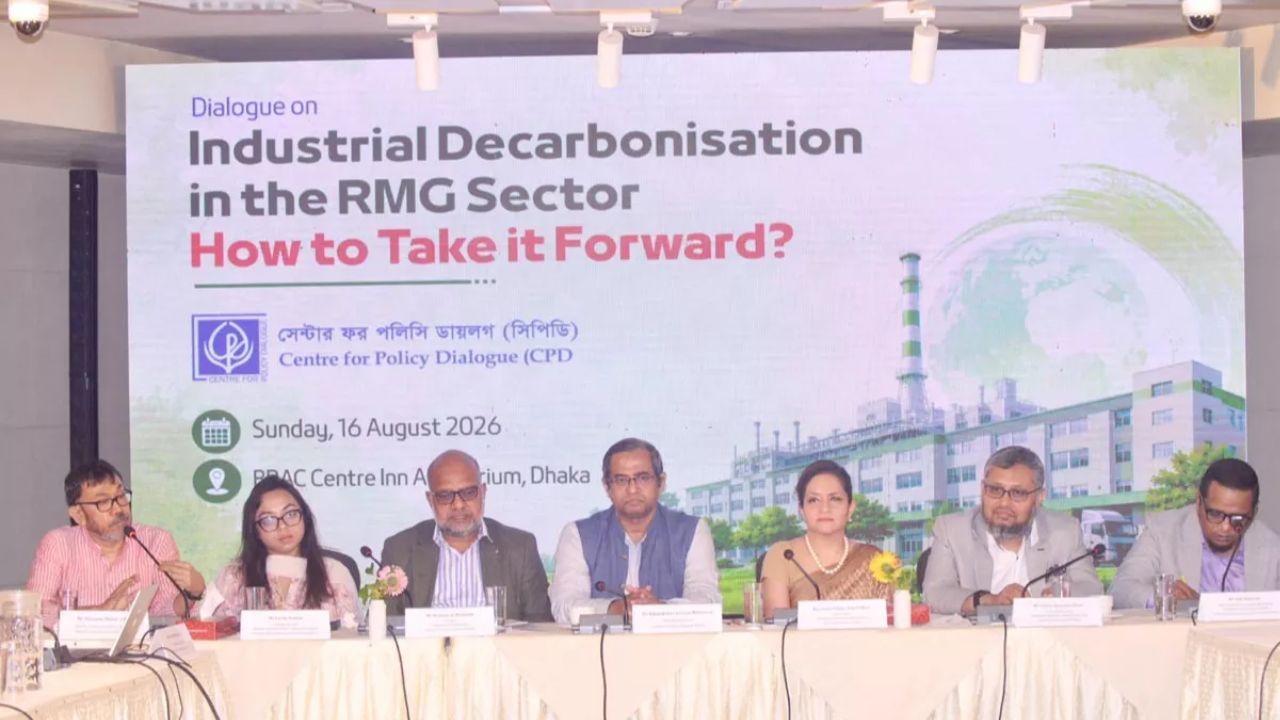



Bangladesh’s garment factories could cut average monthly energy costs by 15.7 per cent if renewable energy supplies 30 per cent of their electricity demand, according to a Centre for Policy Dialogue (CPD) study based on data from 350 factories.
The study found that even a 10 per cent shift to solar power could reduce average monthly energy costs by 5.5 per cent, as the export sector faces rising energy costs, supply risks and growing pressure from global buyers to reduce carbon emissions.
CPD said renewable energy has become an issue of energy security and competitiveness for Bangladesh’s largest export sector, with dependence on imported liquefied natural gas exposing manufacturers to fuel-price volatility, foreign exchange pressure and supply disruptions.
“Relying solely on imported LNG will not be sustainable in the long run,” CPD Research Director Khondaker Golam Moazzem said.
He said the ongoing gas crisis could intensify further, putting pressure on the garment sector and the wider economy. While the Bangladesh Garment Manufacturers and Exporters Association is encouraging factories to explore renewable energy, manufacturers need clearer information on financing and technology options to support the transition, he added.
CPD modelling showed that meeting 30 per cent of a factory’s electricity demand through solar power could reduce average monthly energy costs from Tk9.98 lakh to Tk8.46 lakh. A Monte Carlo simulation involving 1,000 scenarios for each factory also found that renewable adoption reduced energy-cost volatility in 96 per cent of factories.

However, smaller factories face bigger barriers in making the shift. The study found the smallest factories had an estimated energy-efficiency gap of 57.3 per cent compared with the efficiency frontier, while the gap for the largest factories was 8.9 per cent, mainly due to older machinery and tighter financing constraints.
Machine efficiency also varied significantly. A band-knife cutting machine was around 300 times more energy-intensive per unit of output than a laser-cutting machine, while a buttonhole machine was around 140 times more energy-intensive than the most efficient sewing-machine types.
Optimising or replacing machinery across the 350 factories could generate average factory-level energy savings of 10.17 per cent, but full adoption would require Tk13,209 crore in investment, according to the study.




Industry leaders said Bangladesh has limited time to accelerate the transition as major export markets introduce stricter environmental requirements.
“There are multiple European Union and UK directives and regulations coming into enforcement in the coming years that require energy transition, so we have very little time in hand,” Bangladesh Garment Manufacturers and Exporters Association Vice President Vidiya Amrit Khan said.
She called for tax and VAT support for renewable-energy investment, saying, “We want 0 per cent tax, without an additional 15 per cent VAT on RE.”
Bangladesh Sustainable and Renewable Energy Association President Mostafa Al Mahmud said taxation issues affecting solar technologies remained a major obstacle.
“The National Board of Revenue’s SRO is still a bottleneck, where more than 50 per cent VAT remains on solar technologies,” he said.
“Without taking out-of-the-box decisions by the government and clearing these bottlenecks, we are heading towards a bigger energy disaster,” he warned.
Bangladesh Knitwear Manufacturers and Exporters Association Executive President Fazlee Shamim Ehsan said Bangladesh is falling behind competitors in renewable-energy adoption and needs better access to available funds.
“There are many EU regulations. We have many funds but those are not accessible. We must explore those pathways to access those funds,” he said.
DBL Group Chief Sustainability Officer Mohammed Zahidullah said large-scale solar investment would be central to Bangladesh’s decarbonisation effort.
“The code of decarbonisation is nothing but solar renewable energy for Bangladesh,” he said, warning that slower progress could affect export competitiveness as countries such as India, Pakistan and Vietnam move faster in renewable-energy integration.
CPD recommended expanding rooftop solar, promoting renewable electrification, encouraging energy-efficient machinery, developing alternatives for energy-intensive industrial processes, conducting energy audits and simplifying approval procedures.
It also called for blended finance combining private investment, concessional lending and government-backed credit to help factories overcome financing barriers.
With global brands increasingly imposing supply-chain decarbonisation requirements and carbon-sensitive trade measures emerging, CPD warned that continued investment in fossil-fuel infrastructure could create stranded or underutilised assets.
Moazzem called for a coordinated initiative involving the Bangladesh Garment Manufacturers and Exporters Association, Bangladesh Knitwear Manufacturers and Exporters Association, Bangladesh Sustainable and Renewable Energy Association, Petrobangla and other stakeholders to remove barriers and accelerate the renewable-energy transition.