




Bangladesh’s banking sector is facing its worst-ever bad loan crisis, with fresh official figures showing non-performing loans have surged to Tk6.44 lakh crore — more than one-third of total outstanding credit.
Bangladesh Bank’s disclosure on Wednesday also reveals a record Tk3.44 lakh crore provisioning shortfall, laying bare how little protection banks have against mounting defaults.
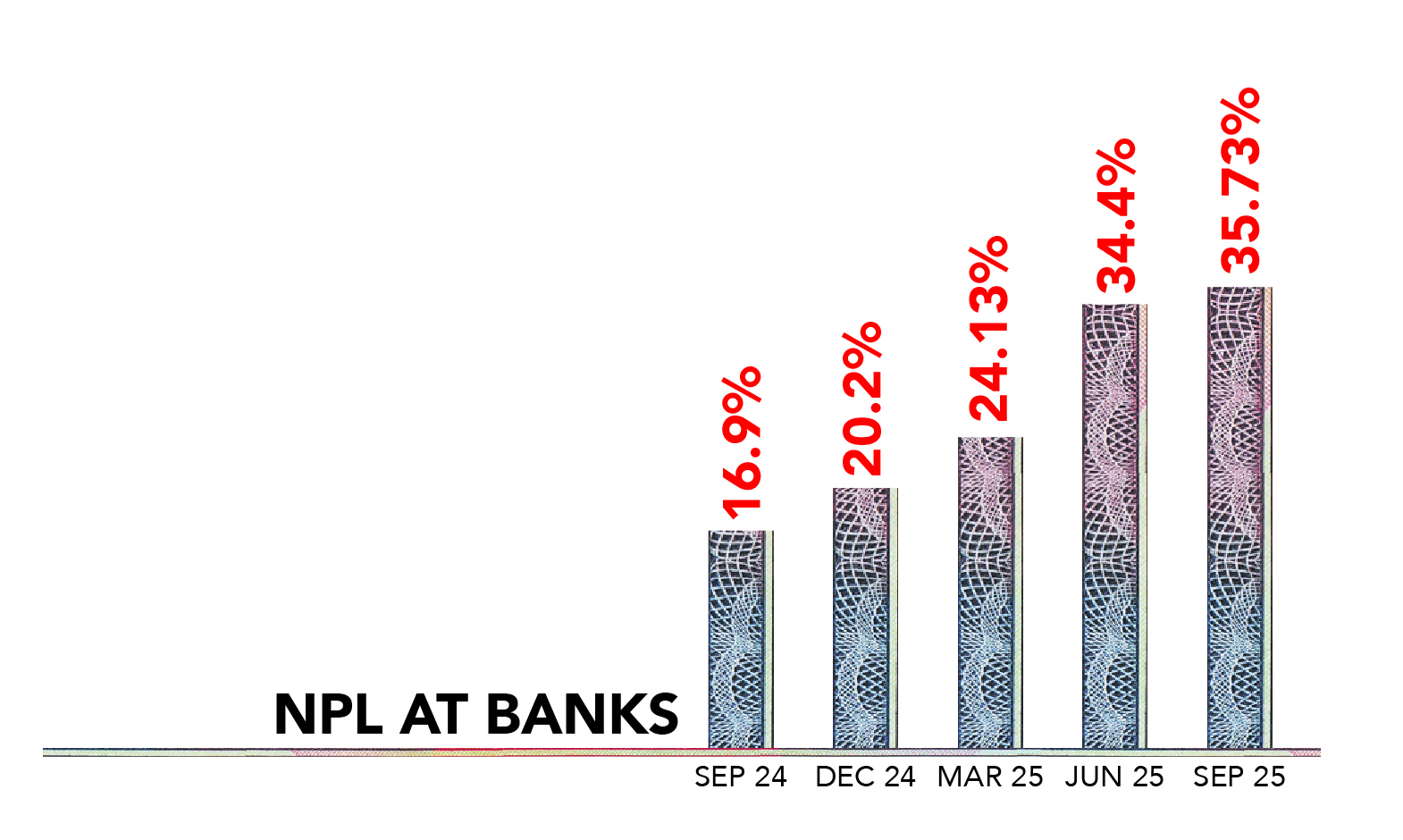
The central bank’s quarterly update shows that, as of 30 September, 35.73 percent of all loans had become classified. Just six months earlier, classified loans totalled Tk4.20 lakh crore, or 24 percent of outstanding credit.
Officials at Bangladesh Bank describe the jump as long-suppressed defaults finally entering the books, rather than a sudden collapse in repayment behaviour.
The shift follows the reinstatement of the 2012 loan-classification rules — an IMF requirement under the country’s $5.5 billion programme — under which a loan becomes overdue the day after a missed instalment and is treated as non-performing after three months of non-payment.

Previously, banks could delay classification for up to nine months, allowing distressed borrowers to appear “regular’’ for years. With that loophole removed, banks have been forced to recognise thousands of crores in overdue loans that had been quietly rolled over or cosmetically restructured.
Zahid Hussain, former lead economist at the World Bank’s Dhaka Office, told TIMES of Bangladesh that the rise in NPLs was expected. “In June last year, we estimated that distressed assets in the banking sector would exceed Tk6.75 lakh crore,” he said.
Bankers say the surge also reflects the breakdown of the political protection system that shielded powerful borrowers for more than a decade. After the August 2024 uprising, several influential groups lost access to regulatory indulgence and immediately stopped servicing large exposures.




Bangladesh Bank officials told TIMES that several Shariah-based banks linked to S Alam Group, as well as conventional banks connected to Beximco, Sikdar, NASSA and Thermax Group, had “severely understated’’ defaulted loans. Once rules tightened, they said, the real level of delinquency “spilled into the open’’.
As these exposures surfaced, the scale of the problem overwhelmed the sector’s loss-absorption capacity. Wednesday’s disclosure shows banks were required to hold Tk4,74,598 crore in provisions at the end of September but had only Tk1,30,366 crore.
Even after including Tk98,344 crore in suspended interest, the sector can cover only 35 percent of its bad loans, leaving two-thirds completely unprotected and posing a direct threat to capital adequacy.
This mismatch makes the IMF’s NPL-reduction targets appear increasingly unattainable. Bangladesh committed to reducing private-bank NPLs below 5 percent and state-bank NPLs below 10 percent by 2026. Yet the latest data show state banks are already close to 50 percent NPLs, while private banks are nearing 20 percent.
A former executive director of Bangladesh Bank told TIMES that “the uncovered portion alone can wipe out the capital of multiple banks,’’ warning that some institutions may require urgent intervention to remain solvent.
The crisis looks even more serious in historical context. NPLs stood at 41.1 percent in 1999 but fell to 6.1 percent by 2011 after reforms and stronger supervision. Progress then reversed as insider lending expanded, political influence deepened and banks repeatedly evergreen loans to avoid recognising losses. Many of those exposures — protected for years through pressure, name-lending and balance-sheet manipulation — have now turned visibly toxic under closer scrutiny.
According to senior Bangladesh Bank officials, distressed assets — including classified loans, write-offs, repeatedly rescheduled exposures and loans stuck in courts — have already exceeded Tk10 lakh crore, meaning almost half of all bank credit is either unpaid or immobilised. The officials describe Wednesday’s dataset as the first unfiltered picture of the sector in more than a decade.
By September, total outstanding loans were Tk18.03 lakh crore, of which Tk6.44 lakh crore were classified. Crucially, after adjusting for provisions and suspended interest, net NPLs stood at 26.40 percent, indicating that more than a quarter of all effective lending is exposed to loss.
Economists warn that unless the government implements sweeping reforms — enforcing fit-and-proper rules and restraining politically exposed borrowers — the crisis will deepen, choking credit flows and eroding public confidence.
Despite these concerns, Bangladesh Bank says it expects the NPL ratio to decline as defaulters continue to receive policy support. The central bank’s acting spokesperson, Mohammad Shahriar Siddiqui, said hundreds of defaulters have already restructured their loans under existing facilities. “We are expecting a downward trend in the NPL ratio in the next quarter,’’ he added.
Economist Zahid Hussain strongly criticised the move. “Bangladesh Bank has been playing an accounting game by restructuring distressed loans,” he said.
“Previously, the central bank followed the same path and failed. The focus now should be on reducing bad loans through recovery, instead of sweeping them under the carpet again.”