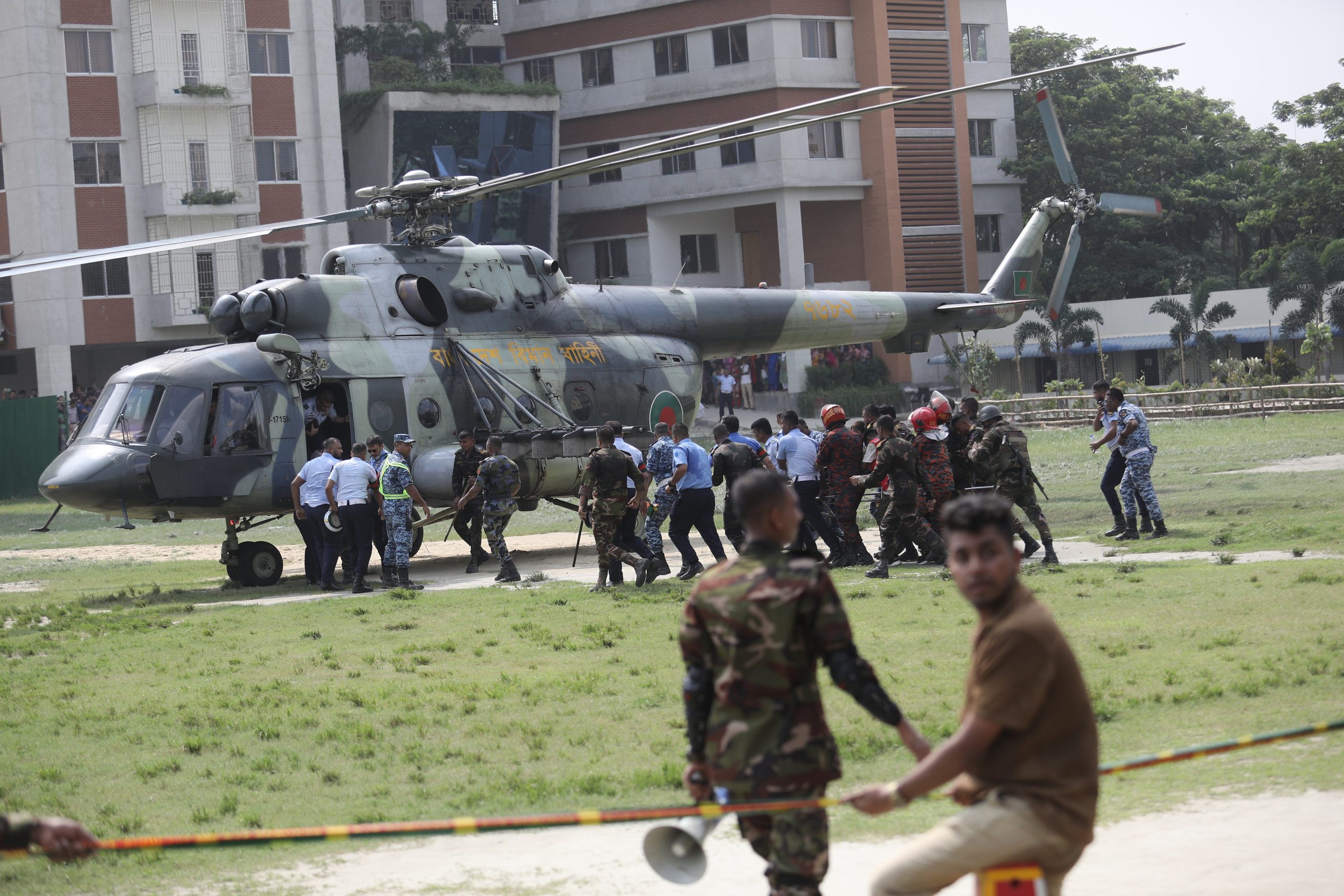

On 21 July 2025, classes had just ended at the primary section of Milestone School. As the children celebrated the end to another school day, the sky suddenly roared.
Within seconds, a training fighter jet crashed onto the school’s roof.
The Milestone tragedy led to 29 people losing their lives and injured over a hundred. Initially, it seemed like a simple accident, but over time, questions began to arise: Was this really just a simple accident?
Or was this the combined manifestation of short-sightedness, indecision, and irresponsibility?
How safe is it to conduct fighter jet training flights in the middle of a densely populated city like Dhaka? Even now, a clear answer remains elusive. “Every capital has a military airbase,” says the Air Force, but in reality, even countries like Iraq, Jordan, and Qatar do not conduct such flights over densely populated areas.

So why is Dhaka an exception?
After the Milestone crash, the Bangladesh Institute of Planners (BIP) published a report stating that no structure should be constructed within 500 feet of an airport runway. Within a 4-kilometer radius, known as the “approach zone”, structures up to 150 feet high are allowed.
But no clear guidelines were provided regarding the type or use of these buildings. This has resulted in a two-pronged reality: While technically, these buildings are legal, in practice, they create a highly risky environment where a single human error can lead to devastating and deadly outcomes.



The Milestone tragedy reveals itself as being part of a larger problem. Events like the collapse of Rana Plaza which led to the deaths of over a thousand workers, the explosion inside of a shopping mall in Bailey Road caused by faulty gas cylinders, electric wiring and air conditions, and the Chawk Bazar fire, all share a common thread: Weak planning, a lack of policy, and poor supervision.
Although Bangladesh has a law that specifically addresses disaster management – the Disaster Management Act, 2012 – its implementation is weak. According to urban planners, the country’s disaster policy is still largely relief-focused.
This means that the government is almost always reacting to disasters, instead of paying attention to prevention or preparedness, ensuring that such disasters are prevented in the future.
Professor of Urban and Regional Planning at Rajshahi University of Engineering and Technology Dr Md Abdul Wakil sees this reaction-focused mindset as a major barrier to reducing disaster risks. He told TIMES of Bangladesh, “Urban development must be considered together with risk management. We keep making the same mistakes, and each time citizens pay the price. Another major problem is that we do not follow rules.”
Explaining disaster risk reduction, he added, “We are surprised when accidents happen, yet the risks were predictable. We should conduct transparent and proper investigations – ask who approved it, how was it implemented, and why. But since we do not take action, the risks remain. Over time, these risks only increase.”
When speaking to TIMES, Department of Disaster Science and Climate Resilience at the University of Dhaka Professor Dr Md Zillur Rahman told TIMES about the importance of hazard or risk assessment. “If infrastructure and safety measures are designed according to the magnitude of each potential hazard, it is possible to reduce the extent of casualties. This is extremely important for early warning and risk reduction.”
He also highlighted the obstacles in implementing risk assessment, mentioning the lack of monitoring by the government or organisations during risk evaluation and implementation. Additionally, he pointed out corruption, lack of capacity, and inadequate review in project execution as significant challenges.
In order to overcome these risks, he emphasised the need for proper assessment of probabilities and effective practice for the projects.
A recent United Nations report states that nowadays, man-made disasters are deadlier than naturally occuring ones. Mismanagement, flawed development, and excessive pressure on the environment are changing the very nature of the disasters people suffer through. Climate change and rapid urbanisation have only worked to make the risks associated with disasters even more complex.
UN Disaster Risk Reduction Fellow and media personality Mohammad Monsurul Haque said, “The world looks to Bangladesh as a role model for handling natural disasters. But, in recent years, man-made disasters have come into the spotlight, increasing the scale of damage.”
According to him, the key to solving this problem lies with people. “In addressing man-made disasters, we, as humans, have the most important role.”
Therefore, like every year, this International Day for Disaster Risk Reduction teaches us not only to think again about disasters, but to think about them differently. It urges us to think beyond simply surviving disasters, but also work on preventing these disasters from taking place altogether by identifying risks in advance, planning ahead, and implementing the right policies.