






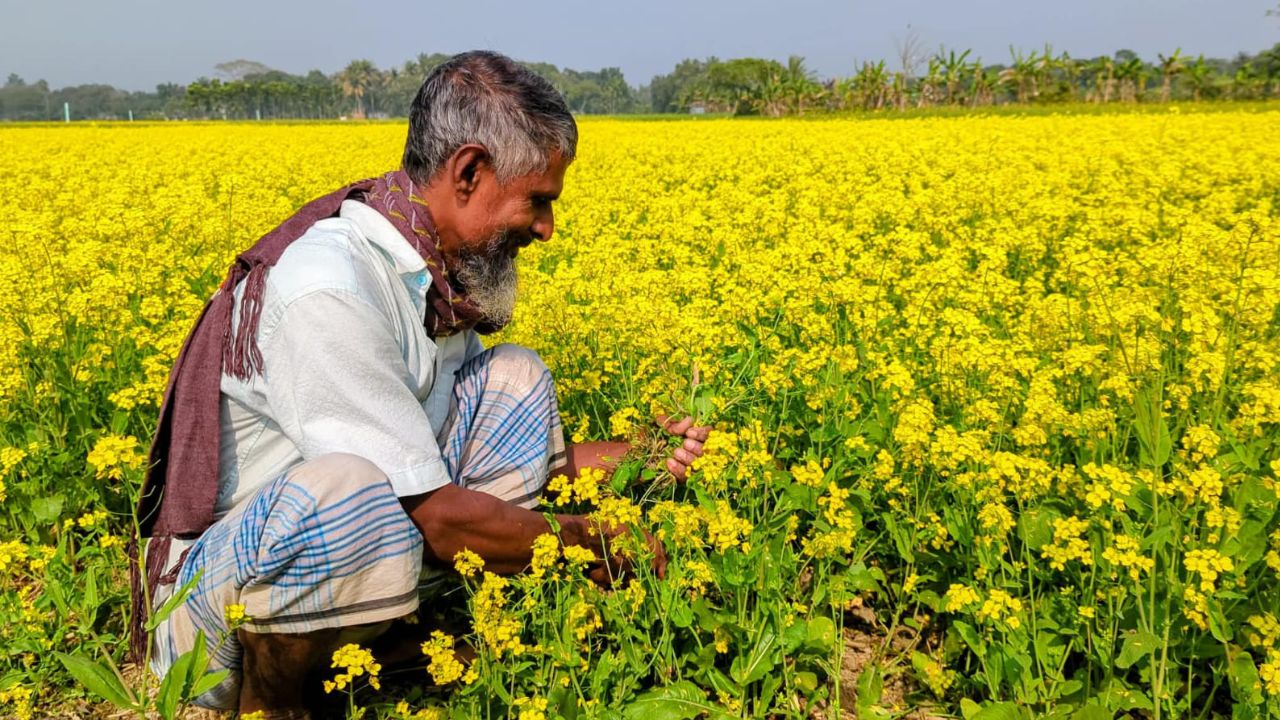
Mustard production in Rajbari district is expected to reach a market value of about Tk62,98,40,000 this season, driven by expanded cultivation, favourable weather and steady prices.
According to the Department of Agricultural Extension, mustard has been cultivated on 5,832 hectares of land across the district this season, including 1,835 hectares in Rajbari Sadar, 2,165 hectares in Goalanda, 400 hectares in Pangsha, 957 hectares in Baliakandi and 475 hectares in Kalukhali.
Agriculture officials estimate an average yield of around 1,300 kilograms per hectare, taking total output to about 7,873 tonnes, while mustard is currently selling at between Tk3,000 and Tk3,500 per maund in local markets.
Farmer Md Anju Sheikh, 58, from Barlahuria village under Ramkantapur Union in Rajbari Sadar, said he cultivated mustard on eight pakis of land this season, citing low production costs and easy management as key reasons.
Like him, many farmers in the village, including Jamsed Mollah, Nazrul Sheikh and Md Alamgir, have cultivated high-yielding mustard varieties such as Tori-7, local strains, BARI, BINA and Rai, encouraged by last season’s prices and favourable growing conditions.
With good weather prevailing, mustard yields have been strong across all five upazilas, turning large stretches of farmland into yellow fields in full bloom, attracting bees, butterflies and visitors alike.
Visitor Al Amin Khokon said dew-covered mustard flowers swaying in the winter breeze and shimmering under soft sunlight had transformed the fields into a striking seasonal landscape.
Another visitor, Shimul Parvez Titul, said the sight of bees collecting nectar and butterflies moving from flower to flower created a scene of rare natural beauty.
Farmer Anju Sheikh said mustard cultivation required relatively little fertiliser, irrigation or weeding, as seeds could be sown soon after early Aman paddy harvest, making it more profitable than many other crops.
Farmer Jamsed Mollah said he cultivated mustard on two pakis of land and hoped for better prices this year, as costs for land preparation, irrigation and fertiliser had increased.
Farmer Nazrul Sheikh said he cultivated mustard on four pakis and that new mustard was currently selling at around Tk3,500 per maund, adding that prices of Tk4,000 per maund would ensure better profits for farmers.
Farmer Md Alamgir said he spent about Tk5,000 per bigha on mustard cultivation and earned around Tk10,000 in profit after costs, noting that mustard farming also helped reduce fertiliser use for subsequent Boro rice.
Sub-assistant agriculture officer Dipta Kumar Sharma said farmers were being encouraged to cultivate oilseeds to reduce dependence on imported edible oil, increase cropping intensity and improve soil fertility, adding that favourable weather could ensure both good yields and fair prices.
Rajbari Sadar Upazila Agriculture Officer Md Joni Khan said mustard seeds had been distributed among small and marginal farmers under incentive programmes to boost oilseed production, while low input costs and limited need for pesticides were making the crop increasingly attractive to farmers.


