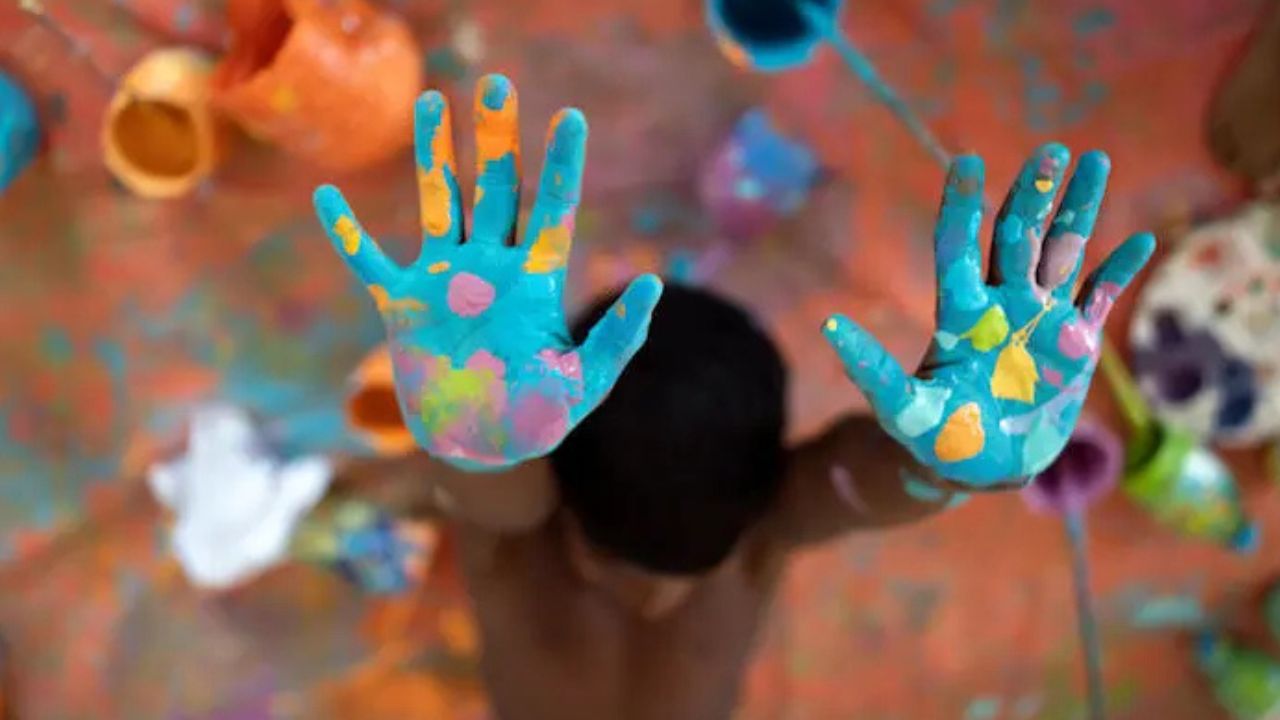



The blank spaces on the canvas may be more important than the colours.
Pubali Bank PLC’s “Colours of Bangladesh” painting competition was announced as a celebration of the creativity, originality and artistic expression of children with special needs. The winning artworks will be featured in the bank’s 2027 desk calendar.
But before the children pick up their brushes, the competition has already drawn a boundary around their imagination.
A condition in the official guidelines says participants “cannot include any human beings or animals” in their paintings.
The instruction, highlighted in bold red letters, sits alongside the themes children are allowed to choose from: Bangladesh’s nature, the country’s six seasons or native flowers.
The message is clear: paint the landscape, the flowers and the seasons, but leave out the people and creatures that often fill a child’s emotional world.

For critics, that restriction cuts directly against the stated purpose of the initiative.
Experts say children with special needs often communicate through images what they may struggle to express through words. Limiting what they can draw, they argue, risks turning an exercise in self-expression into an exercise in obedience.
“If these children are controlled and forced to create something in a certain way, their opportunity for personal creative expression will be narrowed. If they are being controlled, then what remains of the purpose of creativity?”


Professor Nisar Hossain of the Department of Drawing and Painting at the University of Dhaka told TIMES.
He said freedom is essential for nurturing artistic ability, particularly among children with special needs.
“Children with special needs naturally paint from the heart, drawing on their immediate world – which is why parents so often feature in their artwork,” explains Dr Sultana Algin, Professor of Psychiatry at Bangladesh Medical University.
“Forcing specific themes or ideas onto them doesn’t showcase their creativity; it simply imposes someone else’s. And yes, pushing those boundaries can easily cause them distress,” she told TIMES of Bangladesh.
“It is an absurd proposition – an affront to both life and art,” said artist, curator, and former Shilpakala Academy director Mustafa Zaman. “Without human forms, you can produce abstract art, but that is a choice only a mature artist can make.
If art is an exploration of reality and dreams, children should not paint with their backs turned to a world where human figures spark creative inspiration. If this stems from what some call the ‘Islamisation’ of our social sphere, those enforcing such strictures must wake up: Islam forbids idolatry, not human representation.”
Artist and Fine Arts lecturer at Shanto-Mariam University of Creative Technology Khadiza Tun Numani said a restriction that may appear harmless in an ordinary children’s competition takes on a different meaning when applied to children with special needs.
“These children should be given the maximum possible freedom to create,” she said.
According to her, children with special needs do not share identical experiences. Some may have physical challenges, some developmental differences and others emotional sensitivities.
“Giving them a specific subject and then telling them what they cannot draw can create additional mental pressure,” she said.
She warned that excessive restrictions could make some children fearful, damage their confidence and affect their willingness to express themselves.
Calendar needs versus children’s creativity
Pubali Bank, however, says the restriction is not about controlling children’s creativity but about meeting the requirements of its calendar.
Mohammad Mizanur Rahman, head of public relations and assistant general manager of Pubali Bank PLC, told TIMES that the bank’s calendar reaches people across the country, including through rural branches and religious institutions.
He said the decision to avoid human and animal figures was taken because many calendars are used in mosques and other religious spaces.
“This is not a general painting competition. We are collecting specific types of artwork for our calendar,” he said.
Rahman said the bank needs nature-based paintings without people or animals and that artworks outside those requirements would not be selected.