

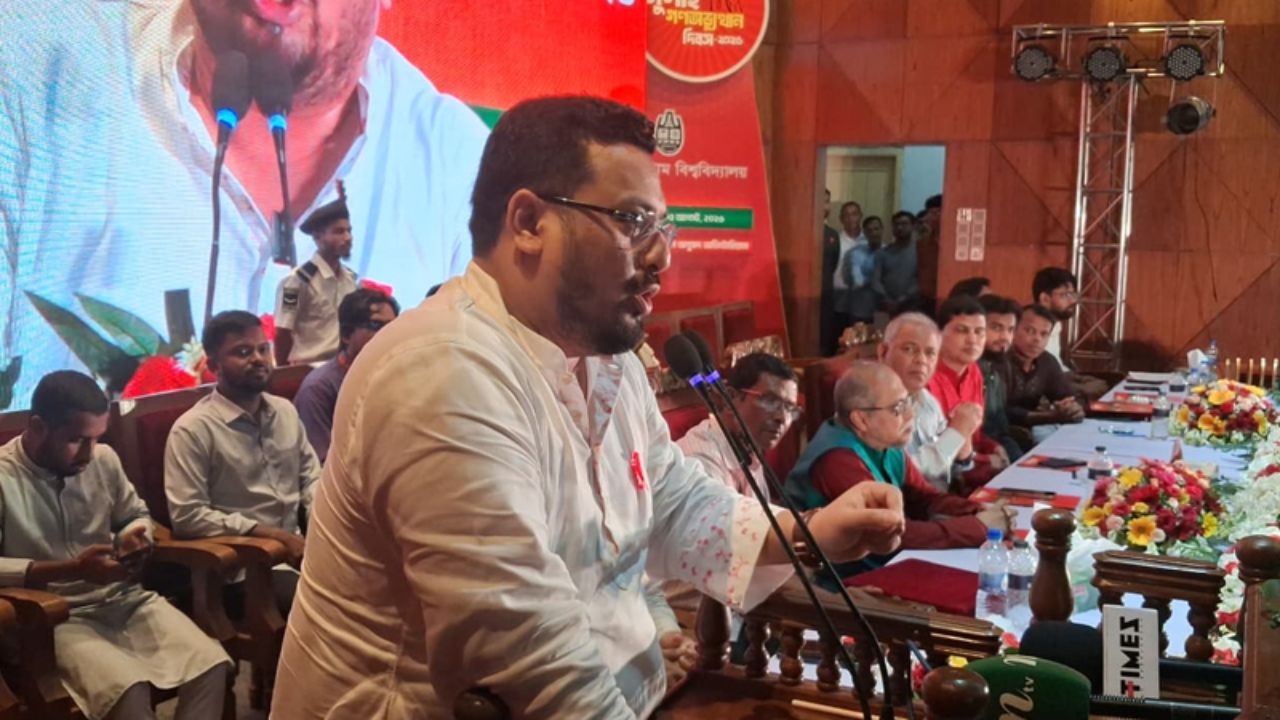



MJL Bangladesh PLC believes business success must create lasting value while protecting the planet, stakeholders and empowering people, its Managing Director Azam J Chowdhury told TIMES of Bangladesh in an interview.
As an Alliance Partner of ExxonMobil Asia Pacific Pte Ltd, the company works on sustainable energy solutions and best practices in lubricant manufacturing. Its operations are fully aligned with all 17 United Nations Sustainable Development Goals.
“We never approached sustainability as a checklist. For us, it is a way of thinking and operating that must hold up over the decades, not just the next quarters,” Chowdhury said, describing sustainability as both commercial logic and a market-leading firm’s ethical duty. His company is chasing “a climate ambition driven by engineering.”
MJL’s environmental commitments follow the Paris Agreement and rely on measurable engineering. It has pledged net-zero greenhouse-gas emissions by 2050 and already reduced carbon dioxide (CO₂) emissions by 9.03 per cent year-on-year.
Chowdhury said results must be tangible, adding, “If a climate commitment cannot be measured in tonnes of carbon avoided or kilowatts saved, it is not a commitment.”
Mobil House in Dhaka reinforces that statement. The Leadership in Energy and Environmental Design (LEED) Platinum-certified building uses 30 per cent less energy than a typical office and reuses all wastewater through a zero-liquid-discharge system, meaning no industrial water is released into the environment.
The Chattogram Lube Oil Blending Plant adopts similar principles, with solar power supplying 30 per cent of canteen energy. Magnetic-bearing chillers — machines that reduce electricity consumption by eliminating mechanical friction — lower power use, while LED lighting systems further cut energy demand.
MJL also enforces strict waste management. Mobil House maintains zero liquid discharge, and about 90 per cent of operational waste is recycled through a reverse-osmosis water-treatment plant, a filtration system commonly used to purify industrial water.
Chowdhury summed up the approach as “waste is a resource waiting for a better idea.”
Safety, skills and communities at the core
The company’s people-first strategy is built on safety, skills and community welfare. It has maintained a zero-casualty record since 2021 and reduced recoverable injuries by 70 per cent. Employees receive comprehensive medical check-ups and confidential mental-health support.
Training is treated as a long-term investment. Each employee receives more than 20 hours annually, totalling 3,600 hours in 2024. Training covers health, safety and environment standards, literacy on environmental, social and governance (ESG) issues and advanced technical capabilities. Equal Employment Opportunity (EEO) and diversity principles guide hiring and career development.
Beyond its workforce, MJL supports the Bakhtunnessa Chowdhury Diabetes Center and runs skills programmes for mechanics and drivers, benefiting around 3,200 people. The company also mobilised relief for flood-affected families.
“Sustainability must be felt outside the factory boundary,” Chowdhury said. “If communities thrive, industries thrive.”
Governance reinforced by ethics and transparency
Governance underpins all sustainability efforts. The Business Ethics Policy is strictly enforced, with zero confirmed distortion cases in 2024. The company applies zero tolerance for child labour across operations and the extended value chain. Chowdhury said the rule is “non-negotiable, under any circumstance.”
A senior-level Report Review Panel validates sustainability reporting. The company aligns disclosures with the Global Reporting Initiative (GRI) and the Task Force on Climate-related Financial Disclosures, frameworks widely used for transparent corporate reporting.
The commitment to transparent governance has earned the Institute of Chartered Secretaries of Bangladesh National Awards for Corporate Governance Excellence for more than five consecutive years.
MJL has also topped its industry in the Bloomberg ESG ranking for three consecutive years.
Supply-chain innovation that cuts emissions and cost
MJL’s redesign of lubricant packaging and transport has delivered major sustainability gains.
The introduction of 20,000-litre and 1,000-litre bulk packaging reduced raw-material use by 94 per cent and transport needs by 54 per cent in 2024.
MJL also works to reduce indirect emissions, commonly known as Scope 3 emissions. Mobil synthetic oils help customers achieve up to 7 per cent energy savings in industrial equipment, preventing more than 5,000 tonnes of carbon-equivalent emissions annually.
The Chattogram blending plant meets international standards under ExxonMobil’s Product Integrity Management System (PIMS). It holds ISO 9001 for quality management, ISO 14001 for environmental management and ISO 45001 for workplace safety. The facility earned a “Satisfactory” 3PIMS rating and scored 3.9 out of 4 in Quality Practices and Guidelines.
Technical support enhances efficiency. Real-time lubricant analysis helps customers extend oil-change cycles and cut consumption by up to 40 per cent. Lubrication surveys have lowered industrial lubricant use by about 20 per cent, translating environmental gains into financial savings.
Sustainability as strategy and national contribution
The company aims to continue leading Bangladesh’s lubricant industry while upholding strong governance and environmental standards.
A low-carbon operating model drives innovation and efficiency, while transparent reporting strengthens investor confidence, Chowdhury said.
The company’s efforts also support national priorities. The net-zero 2050 target aligns with the Bangladesh Climate Change Strategy and Action Plan and strengthens the country’s Paris Agreement commitments.
Industrial clients using MJL lubricants achieve about 98.5 per cent machinery uptime, meaning machines operate longer without breakdowns. This cuts downtime, reduces waste and lowers overall environmental impact.
MJL supports more than 3,500 jobs across its value chain and sources 65 per cent of packaging material locally.
Vocational programmes equip workers with skills needed for a more advanced industrial economy. “Our responsibility is to leave behind a stronger industrial foundation than the one we inherited,” Chowdhury said.
Investment proving sustainability pays
Sustainability gains reflect sustained investment. MJL has invested heavily in green infrastructure at Mobil House and at its Chattogram and Jashore facilities. The advanced Lube Oil Blending Plant uses energy-efficient machinery, modern blending systems and optimised layouts that minimise waste.
SAP Enterprise Resource Planning (ERP) software enables real-time tracking of production, compliance and logistics.
Operational spending also supports research and development, which accounts for about 2 per cent of the annual budget, and continuous training.
Returns are measurable. Bulk packaging has reduced internal costs by 20 per cent. Water consumption at Mobil House has been halved through recycling and rainwater harvesting. Predictive-maintenance services have lowered client operating expenditure by roughly 5 per cent. Energy-efficiency measures have reduced reliance on grid electricity, which accounts for 92.35 per cent of MJL’s carbon footprint.
The shift to bulk packaging offers a clear example. MJL financed new 20,000-litre containers, closed-loop transfer systems and staff training. One textile client saved $1,50,000 annually after switching from drums to bulk deliveries. Packaging use fell by 94 per cent, transport trips by 54 per cent and spill incidents by 80 per cent.
“Good sustainability is good economics,” Chowdhury said. “When the numbers align with the values, it becomes a permanent part of the business.”
An engineering roadmap to net zero
MJL’s Net-Zero 2050 Roadmap sets out a detailed decarbonisation plan.
Between 2024 and 2030, the company aims to cut Scope 1 and Scope 2 emissions by 30 per cent from the 2024 baseline. It plans to raise renewable-energy use to 12 per cent, increase female workforce participation to 8 per cent and eliminate diesel by switching to liquefied petroleum gas, natural gas and electric forklifts.
Between 2031 and 2040, the focus will move to deeper decarbonisation and circularity. MJL targets a 60 per cent reduction in Scope 1 and 2 emissions and 100 per cent renewable electricity through expanded solar systems and power-purchase agreements.
Between 2041 and 2050, the company plans to achieve absolute net-zero greenhouse-gas emissions. Suppliers will be required to disclose emissions. Zero-waste lubricant-packaging practices will be fully introduced. The entire diesel fleet will transition to electric vehicles.
Remaining emissions will be neutralised through nature-based solutions, including mangrove restoration in the Sundarbans.
MJL demonstrates how engineering discipline, transparent governance and community investment can reshape industrial leadership in Bangladesh.
By combining global standards with local expertise and measurable outcomes, the company has built a model where climate responsibility, operational excellence and economic contribution keep strengthening one another, said Chowdhury, the founder of a top Bangladeshi conglomerate East Coast Group.


