Japanese investment will pick up again once political stability returns after the elections, said Japan Bangladesh Chamber of Commerce and Industry (JBCCI) President Tareq Rafi Bhuiyan Jun.
“When the new government assumes office, Japanese investors will decide on new investments,” he told Times of Bangladesh in an exclusive interview, stressing that political clarity is now the deciding factor for long-term commitments.
The political transition after August 2024 has slowed several projects funded by the Japan International Cooperation Agency (JICA), Jun said, adding that major undertakings such as metro rail expansion and the third terminal at Dhaka Airport have also been affected.
“Following the formation of the interim government, several major Japan International Cooperation Agency-funded projects have slowed due to uncertainty and delayed decision-making,” he explained. “Investors need policy continuity and clarity; frequent changes disrupt foreign direct investment (FDI) and confidence.”
He said the approval of the Matarbari project by the Executive Committee of the National Economic Council was one of the few encouraging developments during this period of hesitation.

Private-sector activity has not collapsed despite the slowdown. “Private investment hasn’t stopped. Several project negotiations are ongoing,” he pointed out, predicting that Japanese private-sector engagement could gather speed by mid-2026 once the political direction becomes clear.
Jun said confidence between Bangladesh and Japan remains intact. “There has been no negative reaction from Japan,” he remarked. “The Japanese government and business community remain interested in continued cooperation.”
Diplomatic and high-level engagements have continued through this period. “The Chief Adviser and key advisers have visited Japan and held meetings with both government and private sector representatives,” he said. “Also high-level government officials from Japan have come to Bangladesh.”
He added that the interim government is refraining from major long-term decisions ahead of the national polls, leaving larger policy choices for the elected administration.




Trade between the two countries has room to grow. “Two-way trade currently stands at $3.5 billion, with a $500 million trade gap,” he said. “Trade volume may reach $8–10 billion within five years.”
Japan’s footprint in Bangladesh extends far beyond private capital. “Japanese private investment stands at $2–2.5 billion, but including development cooperation, overall involvement exceeds $20 billion,” he explained.
Japanese companies are exploring broader sectors. “Future Japanese interest spans consumer goods, food processing, leather, engineering, electronics and IT,” he said. “Japan is also exploring recruitment of skilled Bangladeshi manpower due to domestic labour shortages.”
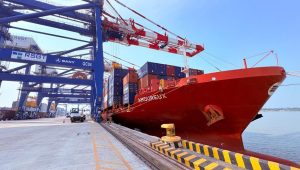
On Chattogram Port operations, Jun said global operators bring standards Bangladesh needs. “These operators bring world-class standards. Local companies should be given preference only if they meet the same criteria and efficiency,” he commented. “If they cannot, foreign operators are justified.”
He said agreements must also ensure “protection of national interests, transparency and long-term benefit.”
Japan’s strategic interests in Chattogram, Cox’s Bazar and the Bay of Bengal remain strong. “Japan remains interested in investment in Chattogram and economic zones,” he said. He pointed out that Japanese firms are active in the National Special Economic Zone in Mirsarai. “Although a Japan-exclusive zone in Mirsarai was reconsidered after feasibility studies, interest remains strong,” he added.
Jun highlighted the continuation of major infrastructure commitments. “Japan has supported a coal-based power plant in Matarbari, ongoing deep-sea port development, ongoing access road from Chakaria to Matarbari and an economic zone is planned there,” he said, describing them as long-term strategic projects that persist despite temporary uncertainty.
He said operational obstacles remain a concern. “Customs procedures, value added tax (VAT) and tax issues, National Board of Revenue-related complexities—these affect everyone,” he said. “Clearing imported goods is more time-consuming and costly here than in many countries. Improvements are urgently needed.”
Jun said the JBCCI is working to expand bilateral economic engagement. “JBCCI actively works to bring more Japanese investment,” he explained, describing it as “a truly bilateral chamber with 16 board members—8 Bangladeshi, 8 Japanese,” focused on policy advocacy, investor support and business facilitation.
He said the chamber has added value over the decades. “JBCCI has contributed to strengthening Japan–Bangladesh relations for over 21 years,” he said, mentioning its role in providing private-sector input to Economic Partnership Agreement negotiations.
Japanese companies are prepared to move once political clarity returns, he said, adding that investment decisions will progress as soon as an elected government begins setting long-term policy direction.