
After the restoration of democracy in Bangladesh in 1991 through an innovative neutral caretaker system of government, four elections held under the said system were more or less acceptable, reflecting the will of the voters largely. However, after the annulment of the caretaker system in 2011, the next three elections held under the Sheikh Hasina government suffered from a legitimacy crisis as major political parties either boycotted or were kept at bay by the Awami League (AL).
In August 2024, Sheikh Hasina’s government was deposed. And, in the next general elections, held recently under Yunus’s interim government, AL was barred from contesting. The Yunus government could have allowed AL to take part in the elections to at least demonstrate its desire for inclusive elections. The ploy should have been to vote out AL for its alleged infamy, earned through governance failures and the repression of dissent during its long tenure of about 16 years. Instead, however, the Yunus government went for the continuation of exclusionary politics. As a result, democracy continues to be the core casualty in the democratic progression of Bangladesh. Meanwhile, the performance of the Younus government during its one and a half year tenure was pretty dismal in terms of law and order and governance, with mobocracy becoming its hallmark.
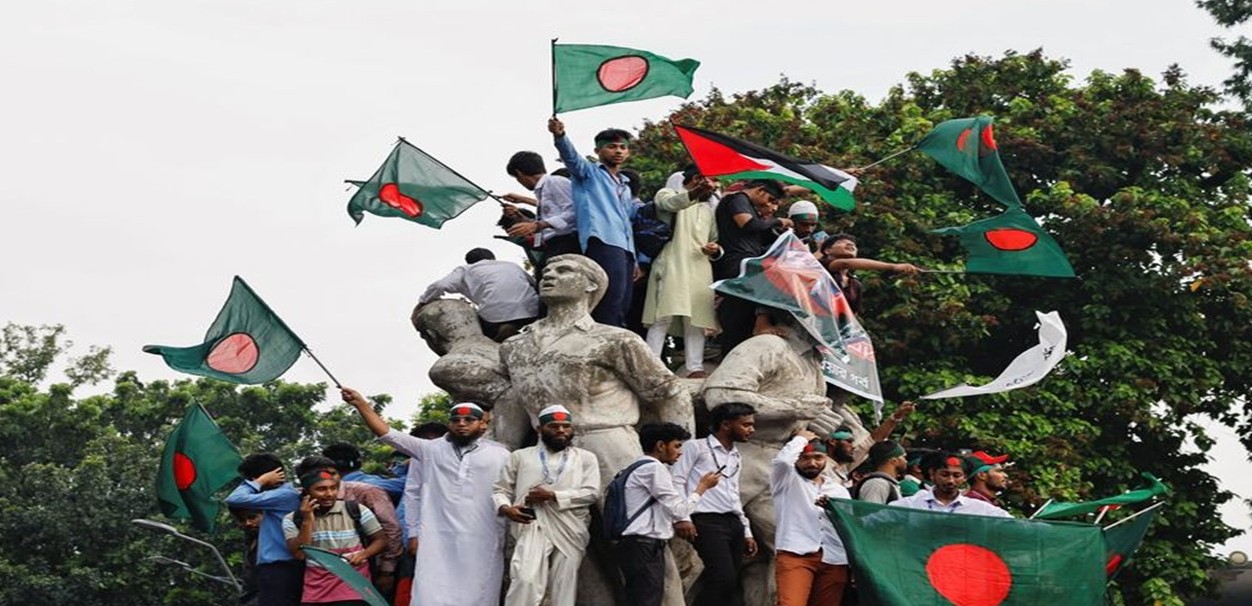
The message of the student-led uprising in July 2024 was simple and clear. They fought for accountability, justice, and a government that would rise above partisan interests to restore democratic norms. However, the tenure of the interim government revealed how far those aspirations remained from reality. The assessments focusing on key issues such as the economy, judicial reform, politicisation, law and order, and media freedom presented rather a gloomy picture. While the government earned some credit in areas like the economy, its role in many other crucial domains was widely criticised.

One thing about Dr. Yunus was conspicuous: he and his government were keener to change the names of various institutions as if they were the key reforms aiming at strengthening democratic norms in the country. Such alacrity in this task rather badly exposed the vindictiveness of him and his cohorts against AL and its Premio Sheikh Hasina. Repeated vandalism at Dhanmondi 32, a historical place concerning Bangladesh’s independence, was a hallmark of Dr. Yunus’s long-cherished vengeance against Sheikh Mujibur Rahman. During its tenure, the interim government faced severe criticism over ‘mob violence’ across the country. It failed significantly in areas like fundamental reform, law and order, and freedom of expression. Thus, much of the change that people hoped for through the mass uprising remained elusive.
There are genuine criticisms that politicisation continued in the administration. In fact, one party was simply replaced by another. Questions were raised about good governance and the prevention of corruption. It was alleged that a new form of politicisation had emerged. The interim government under Professor Yunus was not able to avoid allegations of cronyism, favouritism, and conflicts of interest in decision-making.




In the 13th general elections, held on 12 February 2026, Bangladesh Nationalist Party (BNP), under the leadership of Tarique Rahman, won a landslide two-thirds majority in the elections, outshining Bangladesh Jamaat-e-Islami (BJI)-led 11-party alliance. Though a large number of voters seemed to boycott the elections because of the non-participation of AL, many voters, especially the youth, were happy to be able to cast their votes. In fact, both BNP and BJI made the most of the absence of AL. The race must have been a lot more competitive had AL been there in the contest. BJI gained unprecedented success in the elections, winning 68 seats alone, with 18 seats as its best in its track record. In fact, there was a serious media hype that Jamaat-e-Islami was going to come to power this time around. The election results, however, clearly show that the majority of people of Bangladesh took a firm stand against religion-based politics, which is indeed an eye-opener for the whole of South Asia.
In fact, the electoral process and practice in Bangladesh have remained highly problematic since the 2014 elections. The previous 3 elections lacked credibility because of AL’s manipulation and manoeuvering; the exclusion of AL in the recent elections is being termed by many as retaliation for AL’s previous anti-democratic stance. Anyway, exclusion remains the ultimate character of all four elections.
AL’s political activities were banned by the Yunus government rather arbitrarily, and that is why it could not participate in the elections. It is difficult to say whether BNP will take any initiative to withdraw that ban in the near future and pave the way for AL’s peaceful return to the political sphere. The possibility is highly unlikely, though. Some are in favour of a reconciliation. However, they also seek AL’s repentance for that to happen. AL leadership is still not ready to subscribe to that idea.
The scenario is, thus, quite complicated. As such, a prediction about the future course of action is still premature. Admittedly, however, only elections including all major political parties can meaningfully contribute to establishing democracy in a country. All the major political parties have a responsibility for that. Hopefully, new developments will take place in Bangladesh to have an inclusive society in all respects. For that, however, all the political stakeholders will have to carry their weight, which is rather far-fetched in Bangladesh.
(The views expressed in this article are solely those of the author)
The writer is a Professor, Department of Public Administration, University of Chittagong, Bangladesh. Email: [email protected]