





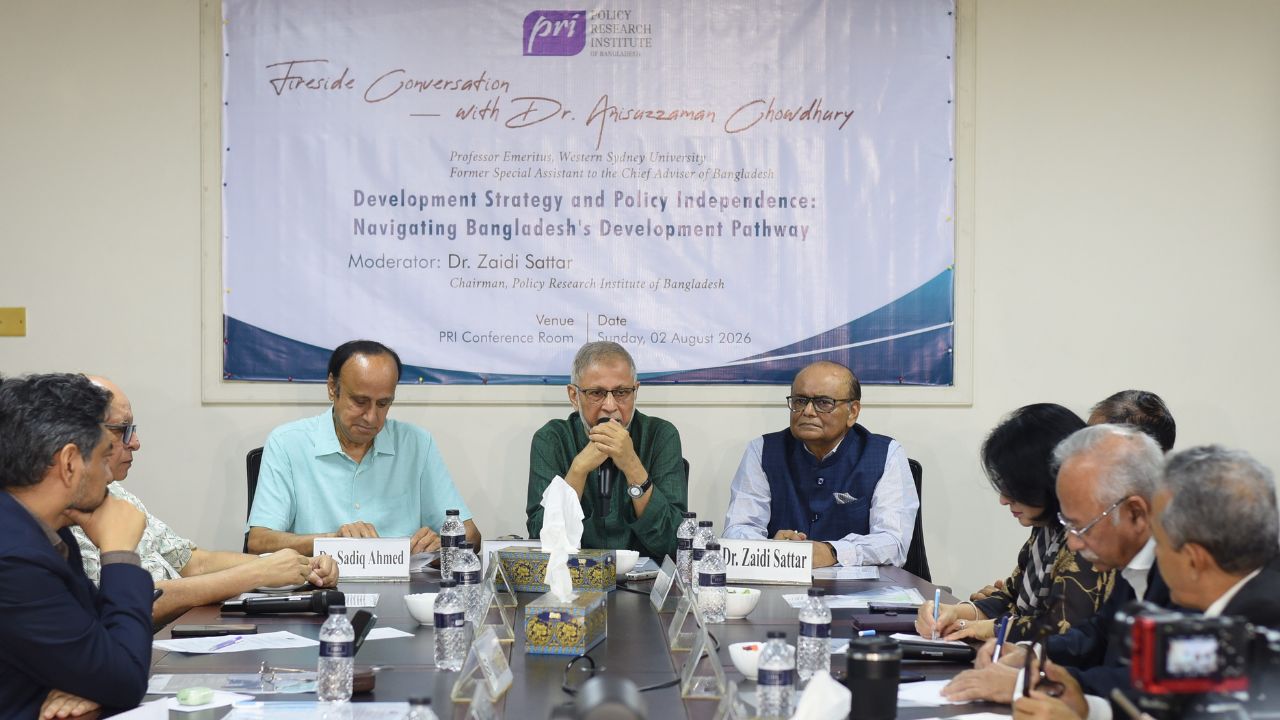
Bangladesh’s ability to design policies around domestic priorities while navigating external pressures will determine how effectively it manages its next growth phase, economists and business leaders said, calling for stronger institutions, reform ownership and consistent policymaking.
The issue was discussed at a Policy Research Institute of Bangladesh (PRI) dialogue in Dhaka on Sunday, where experts examined the country’s development path and the institutional capacity needed to sustain economic transformation.
Western Sydney University Professor Emeritus Anisuzzaman Chowdhury, former special assistant to the interim government chief adviser, said Bangladesh’s earlier economic progress was supported by policies that expanded private-sector participation, including privatisation initiatives during President Ziaur Rahman’s regime, the rise of the ready-made garments sector and agricultural integration.
However, he said policy autonomy has narrowed over time as reform agendas have increasingly reflected external pressures rather than domestic priorities.
Citing Vietnam and South Korea, Chowdhury said sustained economic transformation requires consistent policies and national ownership of reforms. Bangladesh should tailor international recommendations to its own economic realities instead of applying them without adjustment, he added.
Referring to Bangladesh Bank’s approach during the interim government period, he said the central bank did not fully implement some IMF recommendations, highlighting the importance of aligning reforms with local conditions.
Chowdhury also stressed the need for stronger social capital, an empowered civil society, reduced influence of vested interests and greater independence of public institutions, particularly educational institutions.
PRI Chairman Zaidi Sattar said Bangladesh’s economic policy direction changed after the 1990 crisis, when growth slowed, foreign exchange reserves declined to only a few weeks of import coverage and poverty remained high.
The 1991 reforms moved the economy from a state-controlled import substitution model towards a market-oriented framework through exchange rate flexibility, current account convertibility, trade liberalisation, privatisation and financial sector reforms.
Many of those reforms later lost momentum or remained incomplete, leaving institutional challenges unresolved, Sattar said.
He also highlighted Bangladesh’s changing reliance on foreign assistance. Foreign aid accounted for around 6 per cent of GDP in the 1970s but now represents less than 2 per cent. More than 90 per cent of public external debt was concessional as of 2021-22, with an average interest rate of 1.3 per cent and repayment period of around 23 years.
Metropolitan Chamber of Commerce and Industry President Kamran T Rahman questioned whether conditions attached to World Bank and IMF financing should be viewed only as external pressure or as commitments linked to governance and reform.
As Bangladesh approaches graduation from least developed country status, the focus should remain on long-term structural transformation rather than short-term policy adjustments, said Centre for Policy Dialogue Executive Director Fahmida Khatun.
She said Bangladesh’s negotiating capacity and policy voice have improved but warned that rising geopolitical tensions have weakened multilateral institutions. Meaningful policy independence requires resilience against both external pressures and domestic vested interests, she added.
Fiscal and financial sector vulnerabilities were also discussed. North South University School of Business and Economics Dean AKM Waresul Karim said slower public borrowing during the interim government was a positive development but warned that rising debt, higher interest costs, banking sector weaknesses and unemployment remain major risks.
He called for stronger fiscal discipline, banking sector reforms, improved project planning and greater reliance on lower-cost financing.
Development partners have increasingly moved towards country-specific engagement, said South Asian Network on Economic Modeling Executive Director Selim Raihan. However, Bangladesh’s ability to negotiate and align external support with national priorities will determine the benefits of such cooperation, he added.
Human capital challenges also featured in the discussion. Bangladesh Garment Manufacturers and Exporters Association Vice President Md Rezwan Selim highlighted weaknesses in education quality and the continuing challenge of brain drain.
BRAC Institute of Governance and Development Executive Director Imran Matin said Bangladesh’s strong community and social forces often shape policy implementation, making broader social consensus important for effective reforms.


