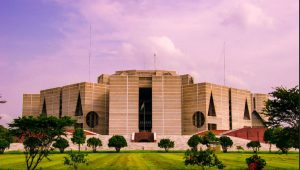
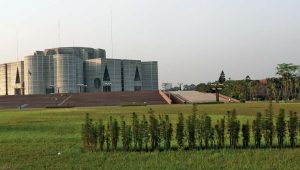
Over half a century since independence, the Bangladesh Parliament has remained a central yet contested institution in the country’s political life. Formally positioned as the cornerstone of representative democracy, it has operated under shifting constitutional arrangements, recurrent crises of legitimacy, and enduring tensions between law and power. Understanding this trajectory requires attention not only to legal design but also to political practice, institutional culture, and historical contingency.
Jashim Ali Chowdhury’s Fifty Years of Bangladesh Parliament: A Critical Evaluation (Brill/Nijhoff, 2025) offers a sustained and methodologically rigorous examination of this institutional history. Drawing on constitutional law, comparative parliamentary studies, and political theory, the book evaluates the Bangladesh Parliament from its inception in 1973 to the most recent disruptions of 2024. Rather than treating parliamentary weakness as an accidental failure, Chowdhury situates it within a broader pattern of constitutional borrowing, executive dominance, and what he terms ‘Eastminster deviations’.
A major strength of the book lies in its careful dissection of institutional relationships. Separate chapters analyse the Parliament’s interaction with the executive, judiciary, and electorate, revealing a legislature that is structurally constrained and politically subdued. The discussion of accountability mechanisms – parliamentary questions, debates, committees, and legislative scrutiny – demonstrates how formal procedures exist but are routinely hollowed out by party discipline, cartelised committees, and the constitutional rigidity of anti-defection provisions. The Parliament emerges less as an arena of deliberation than as a legitimising appendage of executive power.

Equally compelling is the book’s engagement with constitutional design. By revisiting the framers’ adoption of a Westminster model, Chowdhury challenges the claim that Bangladesh’s parliamentary failures stem from an alien or inappropriate template. Instead, he argues that the design was recognisably Westminster but selectively adapted in ways that prioritised stability and control over democratic contestation. This argument is developed through detailed comparisons with the United Kingdom and other postcolonial legislatures, lending the study strong comparative depth.




Beyond institutional mechanics, the book addresses the democratic consequences of parliamentary decline. Chapters on elections, public participation, and constituency representation portray a growing detachment between citizens and the legislature, compounded by repeated crises of electoral legitimacy. The analysis of reform efforts – military interventions, caretaker governments, and constitutional amendments – underscores the persistence of incremental change without structural transformation.
Dense yet lucid, this monograph makes a significant contribution to the study of constitutionalism and parliamentary democracy in South Asia. It will be of particular value to scholars of law, politics, and governance, as well as policymakers concerned with democratic reform. By combining doctrinal analysis with political realism, Fifty Years of Bangladesh Parliament provides a sobering account of institutional endurance amid democratic fragility.
The writer is a poet, translator, and cultural critic