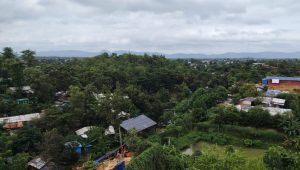
Over 2,000 people in six villages near the banks of the Mahananda River in Tetulia, a border district in Bangladesh, are enduring severe water shortages as groundwater levels continue to drop.
For the past few years, residents of these villages have faced constant hardship in accessing clean drinking water, with no end in sight to their crisis.
The only source of water for these villagers has been a single government tube-well, as local private tube-wells have dried up. People queue up from morning until evening to collect water, facing a daily struggle for this basic need.
According to the locals, for the past seven years, they have only had access to water from their private tube-wells for three to four months a year. For the remaining months, they have been solely reliant on the government tube-well near the riverbank. This limited resource is now stretched to its breaking point, with residents from five villages depending on it.

A visit to the area revealed long lines of people under the scorching sun, some rushing with buckets, while others stood in line for hours. Many were seen carrying containers on their shoulders to fetch water from the Mahananda River. The battle for water is not new, but it has become increasingly difficult with time.
Villages such as Siddiknagar, Mominpara, Sahebjot, Eidgabasti, and Puratan Bazar have all been affected. The continuous decline in groundwater levels has rendered local tube-wells useless, pushing the villagers to rely entirely on the government tube-well located at the Mahananda riverbank.



With limited access to drinking water and other daily needs, the situation has become dire, particularly for women and children who suffer the most from this water crisis.
Rabuil Islam, a resident of Siddiknagar, shared his frustrations: “We are facing immense hardship for water. We have repeatedly informed the administration, the chairman, and the members about our situation, but no action has been taken.”
Another local, Nur Nehar, echoed similar concerns: “Every household here has a tube-well, but due to the falling water levels, we are unable to get water. How much longer can we endure this? We want the government to take action to resolve this water shortage.”
Jahanara Begum, a housewife from the area, added: “The tube-well doesn’t produce water, and even installing a pump hasn’t worked. Some people who have installed deeper pumps are getting a little water, but we still have to face problems fetching water from their homes. We are not getting enough water.”
Mizanur Rahman, assistant engineer at the District Public Health Engineering Department, explained that the drop in the water table is a result of reduced river water levels, land excavation for stone extraction, and heavy irrigation pumps installed in agricultural fields.
He added that a proposal for community-based submersible pumps or Tara pumps has already been sent to the ministry for resolution.
Afroze Shaheen Khusru, the upazila nirbahi officer (UNO) of Tetulia, said, “We are treating the water crisis seriously. The request for submersible and Tara pumps has already been sent to the ministry.”
This water shortage crisis in Tetulia remains a pressing concern as local authorities work to address the situation.