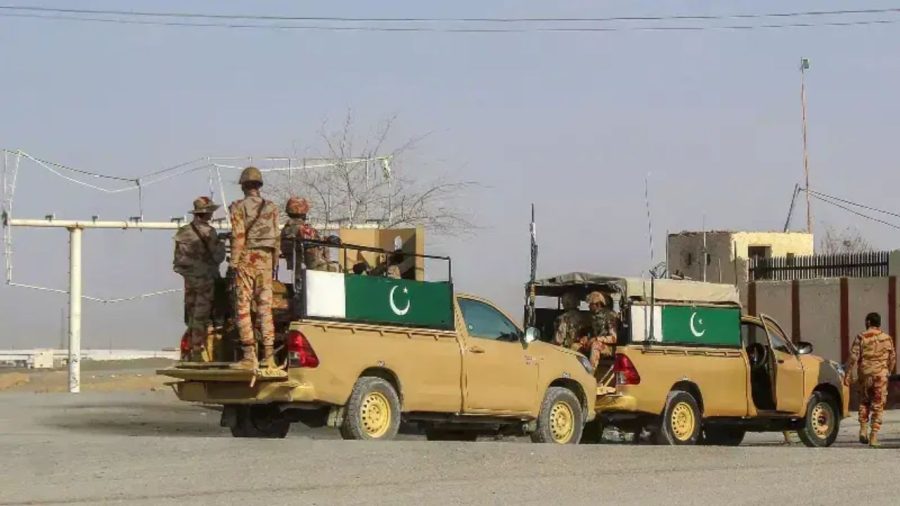

Pakistani security forces killed 11 suspected militants and seized 2.9 tonnes of explosives in two intelligence-based operations in Balochistan’s Kharan and Washuk districts, the military said Wednesday, amid a surge in violence in the restive southwestern province.
The military’s media wing, Inter-Services Public Relations (ISPR), said the operations were carried out on 6 and 7 September respectively, targeting militants it said belonged to “Fitna al-Hindustan” — a term Pakistan’s state uses to describe Balochistan-based armed groups it accuses India of sponsoring. Islamabad has repeatedly accused New Delhi of backing insurgents and destabilising the country, allegations India denies.
In Kharan, ISPR said militants attempted to set up a roadblock and disrupt traffic on Sunday before security forces intercepted and engaged them, killing eight. In Washuk, troops carried out what the military called a “deliberately planned” operation on Monday, dismantling a militant hideout after an intense exchange of fire that killed three fighters.

Forces recovered 2.9 tonnes of explosives believed to have been intended for improvised explosive devices, ISPR said, adding that “sanitisation” operations were continuing in the area to eliminate any remaining militants.
ISPR said the operations formed part of the ongoing counterterrorism campaign under Azm-i-Istehkam, a framework approved by the Federal Apex Committee under Pakistan’s National Action Plan, aimed at eliminating what it called foreign-sponsored terrorism.



President Asif Ali Zardari and Prime Minister Shehbaz Sharif both praised the security forces. Zardari said “the nefarious designs of terrorists who are active under Indian patronage will be thwarted at all costs” and vowed operations would continue “until the complete eradication of terrorists belonging to Fitna al-Hindustan network.”
Sharif commended the forces for foiling the Kharan roadblock attempt and destroying the Washuk hideout, reiterating the government’s commitment to eradicating what he described as terrorism conducted under Indian patronage. Interior Minister Mohsin Naqvi also praised the operations, saying in a statement carried by his ministry that security forces were determined to eliminate India-sponsored militants and calling them “a source of pride for the nation.”
The operations come amid a marked escalation in violence across Balochistan in recent weeks. On the night of August 31 into September 1, Tehreek-i-Taliban Pakistan fighters launched a coordinated assault on a Customs House along the N-50 highway in Pishin district; security forces killed 10 attackers, but six personnel, including two officers, were killed in the fighting.
Separately on August 31, forces killed 11 alleged Fitna al-Hindustan militants who had set up an illegal checkpoint for extortion on the N-40 Quetta-Taftan highway in Chagai’s Nokcha area.
On September 2, security forces killed 12 suspected militants in an operation in Kalat district, and ISPR said on September 4 that 36 more had been killed in a series of “high-tempo” operations across Mastung, Quetta, Kalat and Sibi districts, including the prevention of an attack on a police station in Sibi’s Bhag area.
According to a monthly assessment by the Pakistan Institute for Conflict and Security Studies, Balochistan remained the country’s most volatile region last month, with terrorist attacks rising seven percent from 83 in July to 89 in August.