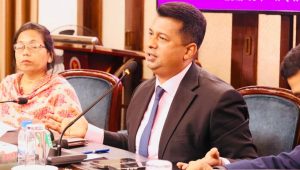
Water Resources Minister Md Shahiduddin Chowdhury Anee informed Parliament on Sunday that the proposed Padma Barrage Project has been approved following a comprehensive evaluation, marking the culmination of decades of technical scrutiny.
Speaking during a question-and-answer session, Anee described the project as a vital initiative for Bangladesh’s long-term water resource management, agriculture, and regional economic development.
In response to a question from M Nurul Islam, lawmaker for Chapainawabganj-3, the minister explained that the project is not a new concept and has been under consideration for many years. He noted that four international studies were conducted between 1960 and 2000 to identify suitable locations.
Subsequently, a 2002 pre-feasibility study by the Water Resources Planning Organisation (WARPO) recommended two potential sites near the Hardinge Bridge area – Thakurbari in Kushtia and Pangsha in Rajbari.

A full feasibility study, approved in 2005 and conducted by a consortium of four local and three international consulting firms, was completed in 2013.
Anee stated that the final design was reviewed by the Bangladesh Water Development Board (BWDB) and refined by high-level technical committees.




Technical viability has been further confirmed by satellite imagery from 2011 to 2025, which shows stable riverbanks, while data from the Joint Rivers Commission (JRC) between 1997 and 2025 indicates the barrage can supply water even under extreme conditions.
To manage the dynamic nature of the Padma River, the government has made provisions to appoint local and international consultants for continuous monitoring and design modifications. Additionally, a seven-member expert panel led by a specialist from the Bangladesh University of Engineering and Technology (BUET) will provide technical guidance.
Transboundary water diplomacy
Beyond domestic infrastructure, the minister highlighted a shift in strategic diplomacy.
Responding to a query from Abul Kalam, MP for Cumilla-9, Anee revealed that the government is currently reviewing all existing treaties and Memorandums of Understanding (MoUs) regarding transboundary water sharing.
He stated that the government is determined to ensure a fair share of water, a commitment prioritised in its election manifesto. Efforts are underway to strengthen JRC Bangladesh and establish basin-based integrated management involving India, Nepal, Bhutan, and China.
Anee acknowledged that upstream infrastructure has reduced dry-season water flow, a situation compounded by climate change and reduced water availability in upstream regions.
Canal excavation targets
The minister also detailed domestic water management efforts. Under a 180-day programme, 366 kilometres of canals are slated for excavation or re-excavation by June.
Furthermore, in response to a question from Fazle Huda, lawmaker for Naogaon-3, Anee announced a five-year plan to excavate or re-excavate 9,046 kilometres of canals and water bodies across the country to restore river systems and ensure sustainable water management.