More than half of online content analysed in Bangladesh contained false or misleading information, while more than one-fifth involved AI-manipulated media, exposing growing risks to public trust, social cohesion and informed decision-making in the rapidly expanding digital space.
The findings, presented in a UNDP Bangladesh analysis at a policy dialogue in Dhaka on Tuesday, prompted calls from the government, media, technology platforms and civil society for coordinated action to improve information integrity and strengthen digital accountability.
The dialogue, titled “Information Integrity and Social Cohesion in Bangladesh: Policy, Platform Accountability and Collective Action,” was organised by UNDP Bangladesh and partners with support from the Government of Germany.

Posts, Telecommunications and Information Technology Minister Faqir Mahbub Anam said Bangladesh’s digital transformation had expanded access to communication, education, business and public services, but the spread of unreliable information had created new challenges.
“Information integrity is not limited to combating misinformation and disinformation; it is also about strengthening public trust, social cohesion and meaningful citizen participation,” he said.



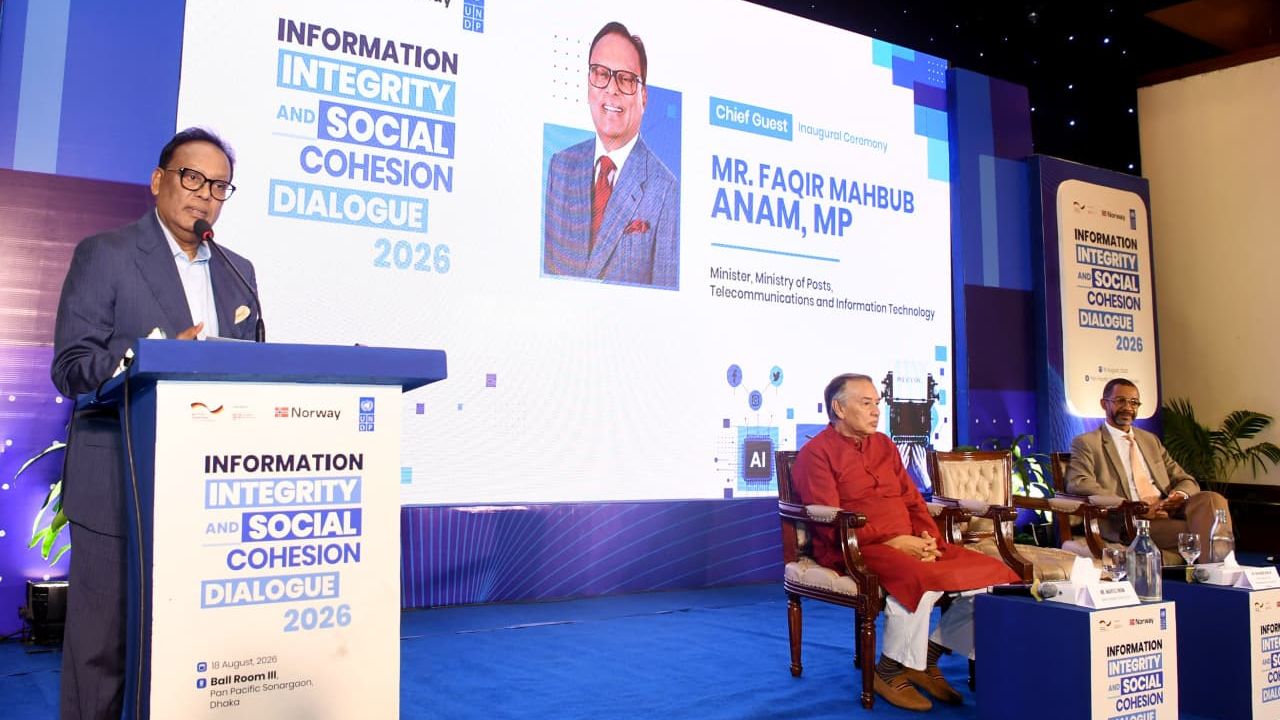
The minister warned that misinformation, disinformation and AI-generated content could have serious consequences, particularly for children and young people, by influencing public opinion and creating confusion in society.
He called for cooperation among government agencies, technology platforms, media organisations, civil society and citizens to build a safer and more trusted digital environment.
The Daily Star Editor and Publisher Mahfuz Anam said fact-checking and accuracy had become essential for maintaining public confidence as technology made information spread faster than ever.
He noted that while social media had expanded freedom of expression, it had also increased the risk of false information reaching large audiences quickly. “As journalists and institutions, our responsibility to verify facts before sharing them is now greater than ever,” he said.
Participants at the dialogue discussed the necessity for stronger policy frameworks, greater accountability for digital platforms, improved digital safety measures and wider media and information literacy to help citizens identify unreliable content.
The event was attended by representatives from the Bangladesh Computer Council, National Cyber Security Agency, Bangladesh Telecommunication Regulatory Commission, Bangladesh Police, Bangladesh Election Commission, UN agencies, development partners, media organisations and civil society.