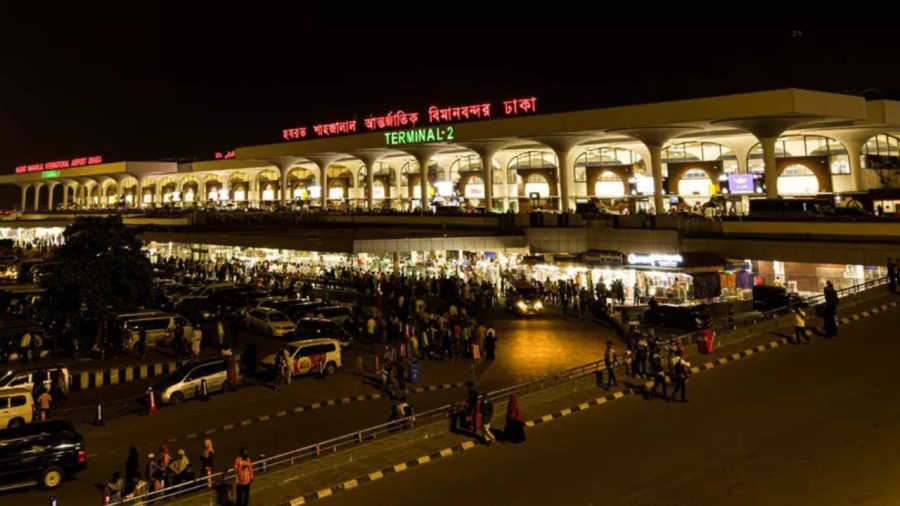



When Jewel Molla, a pizza chef working in Italy, landed at Dhaka’s Hazrat Shahjalal International Airport on Monday, an airport worker immediately approached him with an offer: pay Tk2000 to have his luggage collected quickly.
Jewel, a resident of Kaliganj in Jhenaidah who frequently travels home, rejected the proposition.
What followed was a frustrating ordeal through an airport grappling with acute trolley shortages, immigration bottlenecks, and severely overcrowded baggage halls.
“Finding a trolley was becoming increasingly difficult. There were simply too few for the volume of passengers, and everyone was scrambling to grab one,” Jewel told TIMES.
He ultimately spent nearly three and a half hours waiting for his luggage, a delay compounded by cramped conditions and a reliance on just eight conveyor belts.
Jewel’s experience reflects systemic dysfunctions at the country’s primary international gateway.
Passengers routinely complain of grueling immigration delays, lost or damaged luggage, aggressive demands for unofficial payments, and unprofessional conduct by staff.
During a seven-hour spot check on 5 October, TIMES interviewed dozens of arriving travellers.
Under standard international benchmarks, passengers should clear immigration, collect baggage, pass customs, and exit within 45 to 60 minutes.
At Shahjalal, travellers routinely report waiting between two and four hours.

Operational management at the facility has drawn renewed scrutiny following high-profile incidents, including allegations that three women were unlawfully barred from travelling abroad, as well as complaints of gross mismanagement raised after a 34-member Jamaat-e-Islami’s parliamentary delegation returned to the country.
Throughout the year, viral social media videos have documented luggage tampering, chronic delays, and official negligence.
Immigration officials defend their record, arguing that rigorous checks are essential due to security flags, widespread issues surrounding illegal overseas residency, and the need to intercept suspected fugitives.
Such scrutiny, they maintain, inevitably extends processing times.
Overcapacity and vanishing trolleys
Shahjalal International Airport was designed to handle eight million passengers annually.
However, throughput reached 12.7 million last year, severely exceeding its operational threshold.
Between 30,000 and 35,000 passengers pass through the terminal daily.



To serve this crowd, the airport maintains 3,920 luggage trolleys, though many are permanently out of service undergoing repairs.
When more than four wide-body flights land simultaneously, trolley supply collapses entirely.
Abdul Karim Molla, director of central procurement, engineering, and store at the Civil Aviation Authority of Bangladesh (Caab), acknowledged the deficit.
He said that procurement arrangements had been finalised to purchase 500 new trolleys from the Gazipur Machine Tools Factory.
“The initial consignment of 200 trolleys was scheduled for delivery this month, but the supplier failed to meet the deadline,” he explained.
Redundancy and unofficial scrutiny
For many, the ordeal extends far beyond securing a trolley. After waiting in a lengthy queue, Jewel was interrogated by an immigration officer about why he had returned to Bangladesh three times in a single year.
“Why should I have to justify visiting my own home country?” he asked.
The harassment continued after clearance. Near the baggage carousels, an individual in plain clothes demanded his passport, claiming a senior officer required a second review.
“What is the legal justification for re-checking my passport after official immigration clearance?” Jewel questioned.
When contacted, Immigration Special Superintendent Md Moniruzzaman claimed ignorance of plain-clothes checks in the baggage area.
Addressing wider public criticism, including a recent High Court writ petition filed by three women stopped from flying to Nepal on the grounds that they were unmarried, Moniruzzaman questioned the validity of such claims, asserting that “some individuals fabricate these complaints merely to go viral.”
White elephant e-gates and digital deficits
Automated e-gates were introduced under a multi-billion taka project launched in July 2018, installing 52 automated gates alongside 26 passport readers designed to process travellers in 18 seconds.
In reality, the departure e-gates remain largely inactive outside of occasional trial runs.
Crucially, passengers who do use the automated gates are routinely directed back into manual queues, nullifying the technology’s benefits entirely.
Aviation analyst Kazi Wahidul Alam delivered a scathing assessment: “The Tk4,000-crore project has completely failed to deliver on its objectives.”
The airport also lacks an integrated Border Management System. Unlike modern international hubs that sync passport details, visas, travel histories, and security alerts on a single screen, Shahjalal border personnel must manually cross-reference separate, unlinked databases, adding crucial minutes to every interaction.
Basic public services are poorly integrated; two free airport shuttle buses operating at a monthly cost of Tk900,000 remain virtually empty because passengers are never informed of their existence.
The airport’s operational data underscores these critical bottlenecks: while the terminal was originally designed for an annual capacity of 8.0 million passengers, actual throughput reached 12.7 million last year, resulting in an average daily volume of 30,000 to 35,000 travellers.
Consequently, whereas standard international exit processing times range between 45 and 60 minutes, arriving passengers at Shahjalal routinely experience delays of 2.0 to 4.0 hours, despite the installation of 52 automated e-gates, which remain largely inoperative.
Theft allegations and commercial exploiters
Persistent reports of luggage being slashed and items stolen, ranging from mobile phones and laptops to foreign currency, continue to tarnish the country’s international standing.
In response to a legal notice served by lawyer Md Mahmudul Hasan Mamun demanding real-time feeds of cargo handling, Caab member SM Lablur Rahman announced the installation of AI-enabled CCTV coverage.
“Passengers will soon be able to monitor baggage handling live on 56-inch terminal screens,” he assured.
Meanwhile, a lucrative gray market has emerged. Commercial “meet and greet” agencies charge between Tk500 and Tk1,500 for basic queue-jumping and luggage assistance, while unofficial touts aggressively solicit bribes from exhausted passengers.
Tanbin Islam, arriving from the UK, reported being mobbed by handlers demanding up to Tk3,000 to expedite her transit, before having personal confectionery confiscated by customs officials without a formal detention receipt.
Caab Deputy Director Mahmud Akhtar Hossain said he was unaware of any unauthorised solicitation within the terminal.
The disarray extends outside the arrival halls.
Driveways are clogged with illegally parked autorickshaws, street vendors, and loiterers, guarded by indifferent security personnel.
For frequent international travellers like Jewel, the contrast remains stark: “In Europe, facilities are structured and orderly. Here, total indiscipline reigns, and millions in investment have changed virtually nothing.”