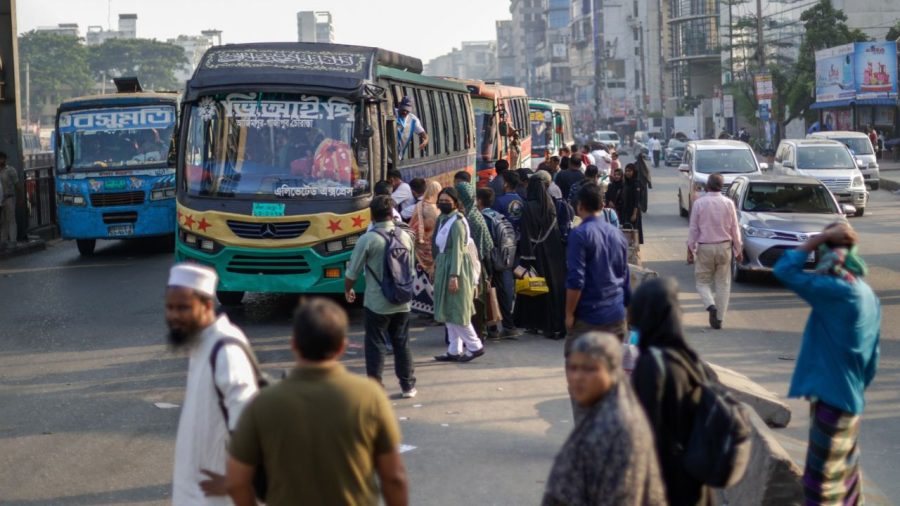



Under the ambitious banner of “One Route, One Bus,” Dhaka launched its new franchise-based bus service on Sunday, promising to sweep away decades of urban transit chaos.
Inaugurated at the capital’s Manik Mia Avenue by Pabna-5 lawmaker Shamsur Rahman Shimul Biswas, also chief coordinator of the Transport Owners-Workers Unity Council, the move promised a disciplined public transport system that would bolster national growth and GDP.
Yet, on the capital’s congested streets, commuters met the same old ordeal – repainted vintage buses, narrow doors, crammed seating, unauthorised fares, and chaotic stops.
Old vehicles, higher fares
At Farmgate, the gap between official promises and ground reality was immediately visible to Farid Islam, a Gazipur-bound passenger.
He told TIMES that his initial hopes for a comfortable journey on a modern bus were dashed when he discovered old, repainted vehicles operating in fewer numbers.
A similar disappointment was echoed by Yusra Khondokar, a zoo-bound passenger, said fares up to 50 percent above government rates were still being extracted, leaving her wondering what had actually changed.
For Nusrat Jahan, a student commuting on the Dhanmondi-Motijheel route, long waits of 20 to 30 minutes ended in boarding buses as overcrowded as local services, proving that passenger suffering had merely altered its form rather than disappearing.
The physical discomfort inside the vehicles added to the frustration.

Altaf Hossain, a regular commuter on the Azimpur-Gazipur route, described the long journey as agonising due to fragile buses featuring broken seats and stripped cushions that caused severe back pain during multi-hour traffic jams.
Meanwhile, Rokeya Begum, a regular commuter from Mirpur Zoo to Motijheel and Sadarghat, noted that travelling with children on the Zoo City Service was troublesome, as narrow central corridors and crammed seating made it impossible even to walk while carrying a bag.
Slashed fleets and operational hurdles
Behind the scenes, bus operators and crew admitted to significant compromises. On the Ghatarchar to Abdullahpur route via Bosila and Mirpur Technical, PPB City Service was formed by merging Prajapati, Paristhan, and Bikash Paribahan.
Md Akash, a driver for PPB City Service, told Times that repainted old buses were fielded because operators lacked funds for new vehicles.
He revealed that the combined fleet was slashed from about 300 buses to 150, with unpermitted buses forced off the road, while passenger ticket counters remained under construction.
On the Mirpur Zoo to Chunkutia route, Zoo City Paribahan unified Tanjil, Metrolink, and Dishari Paribahan to operate 133 buses.




Although Md Aslam, a driver, claimed the service would run on a “sitting service” model, standing passengers were seen crammed inside at Farmgate shortly afterwards, with no fare charts displayed.
Elsewhere, Rajnigandha Paribahan, which had plied the Farmgate route for 36 years, was renamed Three-Star City Paribahan and reassigned to Kanchpur.
Md Amir, a driver, explained that the route change created operational hurdles, prompting owners to apply for a resolution through the bus owners’ association.
Restructuring the route network
The pilot project currently spans six non-AC routes: Shivbari in Gazipur to Azimpur, Tongi to Azimpur, Mirpur Zoo to Chunchutia in Keraniganj, Ghatarchar in Mohammadpur to Demra Staff Quarter, Ghatarchar to Chittagong Road-Kanchpur, and Ghatarchar to Dhour in Abdullahpur.
On these routes, 18 previously competing companies have been consolidated under single corporate umbrellas. In addition, an air-conditioned circular route was launched between Mirpur-1 and Kakoli-Banani.
Detailing the rationale behind the overhaul, Mosleh Uddin Ahmed, commissioner of the Dhaka Metropolitan Police (DMP), noted that 98 bus lines previously operated under separate banners, triggering reckless competition, aggressive overtaking, and fatal accidents. To restore order, routes have been trimmed to 32, absorbing the various bus banners.
The commissioner pointed out that the prevailing contract-based system, which incentivises drivers and conductors to rush trips for higher income, remains the primary source of chaos.
To counter this, a proposal has been submitted to bus owners and worker bodies to employ drivers and crew on fixed monthly salaries.
Alongside the 32 main routes, 25 circular routes were designated for 27-seat AC minibuses, though delays in minibus deliveries meant only one circular route could be launched during the pilot phase.
Enforcement failures and expert warnings
That single operational circular route is managed by “Dhaka Chaka.”

Montu Mia, chairman of Dhaka Chaka, stressed that the habit of passengers boarding or alighting anywhere must be eliminated, warning that drivers take advantage if buses behave like local services, whereas a functional counter system would guarantee orderly operations.
To enforce discipline, the Dhaka Road Transport Owners Association laid down strict guidelines for the Bus Route Rationalisation model, mandating clean interiors, displayed stoppage lists, clean uniforms and courteous behaviour from staff, designated stops, and a ban on racing or excessive waiting.
Yet, violations of every condition were observed on day one.
Responding to allegations of overcharging, Saiful Alam, general secretary of the Dhaka Road Transport Owners Association, told TIMES that no new fares would be imposed and that vehicles must adhere to rates fixed by the Bangladesh Road Transport Authority (BRTA).
However, Ashis Kumar Dey, general secretary of the National Committee to Protect Shipping, Roads and Railways, said the launch was poorly organised, citing unposted fare charts and widespread overcharging up to 50 percent above official rates.
He added that painting a bus does not reduce its age, demanding fitness inspections through the BRTA.
Offering a broader critique, Moazzem Hossain, transport expert at the Bangladesh University of Engineering and Technology (BUET), warned that the revived franchise model has a slim chance of succeeding unless the government assumes total control.
He urged authorities to make the Bangladesh Road Transport Corporation (BRTC) the primary operator and bolster it with at least 2,000 new buses.
The struggle to establish a franchise-based bus system in Dhaka dates back to 2015.
It first materialised in December 2021 with the introduction of Dhaka Nagar Paribahan on the Ghatarchar-Kanchpur route, expanding in 2022 with two additional routes aimed at reducing over 400 chaotic routes into 42 organised corridors.
However, that effort collapsed when private operators pulled their buses following heavy financial losses – leaving commuters today questioning whether the latest attempt will suffer the same fate.