
The nation has observed Language Martyrs’ Day and International Mother Language Day with solemn tributes, emotional remembrance and widespread public participation, as thousands gathered at the Central Shaheed Minar and across the country to honour those who died for the right to speak their mother tongue.
The observance carried its familiar rituals — barefoot processions, wreath-laying ceremonies and mournful songs — but this year’s commemorations unfolded against a different political backdrop.
Following the return of an elected government in 2026, the scale of participation and official engagement reflected what many saw as a symbolic restoration of national continuity after years of political uncertainty.
The formal observances began shortly after midnight, when the president, prime minister, members of the cabinet and opposition leaders laid wreaths at the Central Shaheed Minar in Dhaka.
Soon after, the site was opened to the public. Within minutes, the altar was covered in flowers as people from all walks of life arrived to pay their respects.
The air filled with the familiar melody of “Amar Bhaiyer Rokte Rangano Ekushey February”, a song that has become inseparable from the nation’s collective memory of sacrifice and identity.
For many, the act of laying flowers was accompanied by silent reflection. Some offered prayers, others stood quietly with bowed heads. In those moments, silence itself became a form of tribute.
The day commemorates the events of 21 February 1952, when students and activists were killed to ensure the right to speak Bangla. Their deaths, including those of Salam, Barkat, Rafiq and Jabbar, became a defining moment in the country’s political and cultural history. The language movement laid the foundations for a broader struggle for national identity and self-determination.

Across the country, the day was marked by traditional observances, including dawn processions, black badges and flags flown at half-mast.
Government institutions, schools and cultural organisations organised discussions, art competitions, poetry recitals and documentary screenings, aimed in part at connecting younger generations with the historical significance of the movement.
The area around University of Dhaka, widely regarded as the birthplace of the language movement, remained a central gathering point throughout the day.
Crowds filled the campus and surrounding areas, including TSC and Palashi, with attendance swelling into what appeared at times to be a sea of people.
Students organised mural paintings, photography exhibitions and street theatre performances, reflecting renewed interest among younger Bangladeshis in the language movement and its legacy.




Observers said such activities demonstrated that the movement’s historical significance continues to resonate beyond textbooks, remaining a living part of national consciousness.
Visitors to the Shaheed Minar represented a cross-section of society.
Some came quietly, while others expressed their tribute through symbolic displays. One man arrived bare-chested, his body painted with the map of Bangladesh and the Shaheed Minar, carrying the national flag and wearing a tiger motif on his head.
Children were also among those paying tribute.
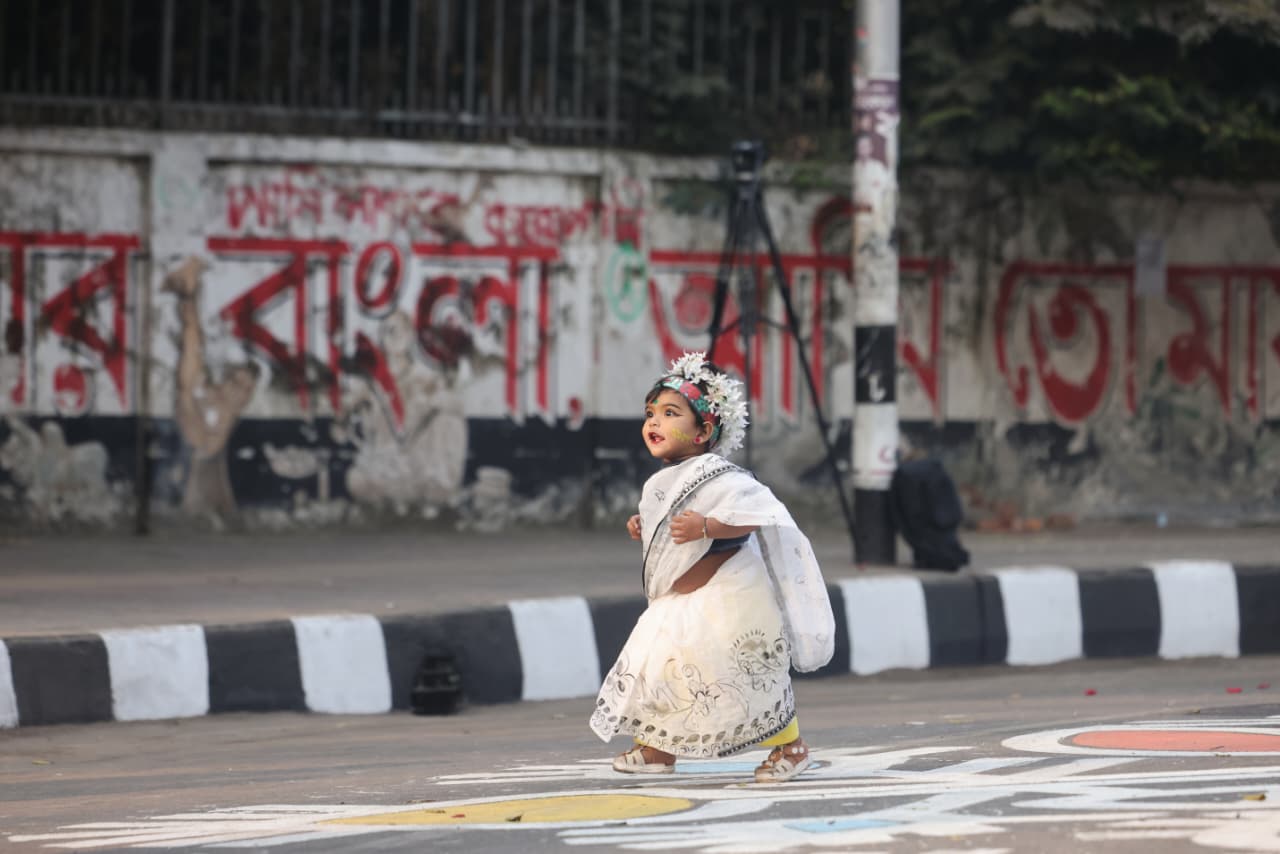
Four-year-old Afsana, who had travelled from Narayanganj with her father, had a drawing of the Shaheed Minar painted on her cheek. Her father said he wanted his daughter to understand the country’s history and remember the sacrifices made for its language.
Scenes like these underscored how the day serves not only as remembrance, but also as a means of passing historical memory to future generations.
From midnight onward, the steady stream of visitors grew into vast crowds by dawn.
Long queues stretched from Palashi to the Jagannath Hall intersection, as political parties, social organisations, educational institutions and professional bodies laid wreaths throughout the day.
Law enforcement personnel and volunteers worked to maintain order, ensuring people could pay their respects safely.
The observance extended beyond Bangladesh’s borders. Diplomatic missions and expatriate communities around the world also marked the occasion.
The day has had international recognition since 1999, when UNESCO designated 21 February as International Mother Language Day, highlighting the global importance of linguistic diversity and cultural preservation.
Despite the overall atmosphere of respect and unity, some incidents of tension were reported.
At the Central Shaheed Minar, the presence of Bangladesh Jamaat-e-Islami chief Shafiqur Rahman prompted exchanges of slogans and counter-slogans between supporters and protesters. Law enforcement officers intervened to prevent escalation.
Elsewhere, in Sarail in Brahmanbaria, newly elected MP Rumin Farhana was unable to lay a wreath following a dispute with local activists of BNP. The confrontation led to road blockades before the situation subsided.
Members of Jatiya Party also left the Shaheed Minar without laying wreaths after encountering obstruction.
While these incidents did not overshadow the broader commemorations, they highlighted lingering political tensions even on one of the country’s most solemn national days.
Despite the isolated disruptions, the day’s overall tone remained one of solemn remembrance and shared national identity.
The flower-covered monument, the sound of mourning songs and the quiet procession of barefoot citizens reaffirmed the enduring significance of the language movement.
More than seven decades after the events of 1952, 21 February remains not just a day of mourning, but a powerful symbol of the nation’s cultural identity, resilience and the enduring importance of linguistic freedom.