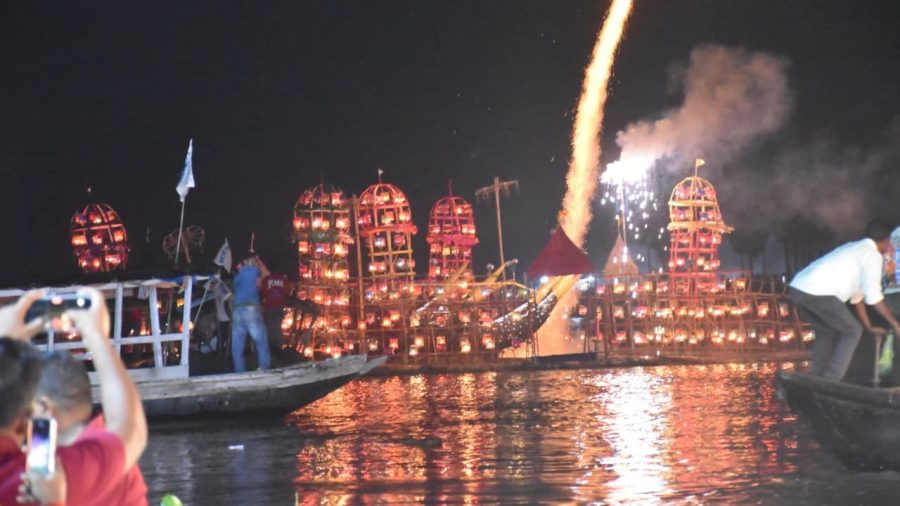

The historic city of Murshidabad in West Bengal came alive as the centuries-old Bera Bhasan Festival, believed to have been started 324 years ago by Nawab Murshid Quli Khan, was celebrated with traditional rituals, illuminated boats and a spectacular fireworks display on the Bhagirathi River.
Following the traditions of the Nawabi era, the ancient festival was observed on the last Thursday of the Bengali month of Bhadra with considerable grandeur and enthusiasm.
At around 8:30pm, boats featuring traditional designs, including elephant and crocodile-shaped fronts, were brought from the Imambara to Wasif Manzil. Members of the Nawab family, Syed Reza Ali Mirza and Syed Abbas Ali Mirza, performed the traditional Sehera ceremony on the boats.
Several public representatives and senior government officials, including minister Gaurishankar Ghosh, were present on the occasion.
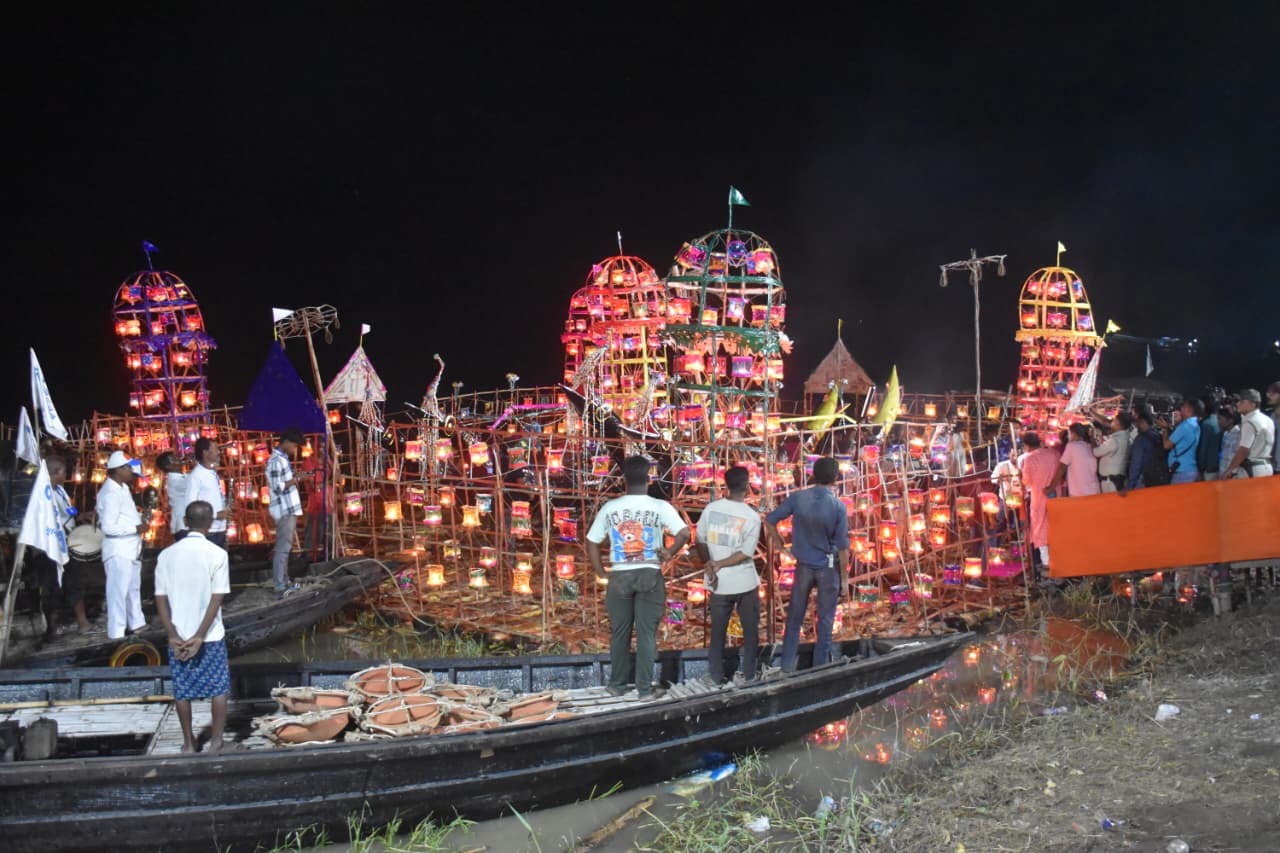
Immediately after the Sehera ceremony, a fireworks display was held. Following the fireworks, at Topkhana Ghat near the Imambara, the boats and traditional decorative objects known as Lauki, Tipai and Bera were arranged on a raft made of banana plants.

During the Nawabi period, the raft was reportedly decorated with numerous golden lamps. Today, the traditional arrangement includes one gold lamp, five silver lamps and Lauki or lamps made of bamboo and coloured paper.
At around 10pm, the festival formally began with the lighting of the golden lamp.
What is Bera Festival?
Historical accounts suggest that Bengal’s first independent Nawab, Murshid Quli Khan, introduced the Bera Bhasan Festival in 1703. At that time, the capital of Subah Bengal was Dhaka, and the festival was first organised there.




From the following year, 1704, the festival has been associated with Murshidabad and has continued there as an important part of the city’s cultural heritage.
There are different accounts regarding the origin of the festival. According to one tradition, Murshidabad was frequently affected by floods, and the festival was introduced to appease Khaja Khizr, the traditional guardian of water and rivers.
Another account links the festival to the Nawabs’ river journeys to Delhi to send revenue and valuable items to the Mughal emperor. It is believed that boats carrying gold, silver, diamonds and other precious articles were vulnerable to attacks by river pirates.
According to this version, the Nawab introduced the festival to seek the blessings and protection of the water deity during such journeys.
Whatever its precise historical origin, the Bera Bhasan Festival, introduced during the Nawabi era, has become an important cultural tradition of Murshidabad and attracts visitors from different parts of West Bengal and beyond.
Although the scale and splendour of the Nawabi period are no longer seen, public enthusiasm for the festival remains strong. In recent years, the festival has been organised by the Murshidabad Estate under the state’s judicial administration, rather than by the Nawab family.
Murshidabad Estate Manager Biplab Sarkar said, “The Bera festival begins with the lighting of the lamp at Topkhana Ghat. A stage was constructed at the ghat for the ceremony. The Bera Bhasan Festival could not be held from 2020 to 2024 due to Covid-19 and other reasons.
“It resumed last year following the ancient tradition. Thousands of visitors from Murshidabad as well as different parts of the state gather to witness the festival.”
A senior officer of the Lalbagh Sub-Divisional Police said extensive security arrangements were made across the town for the occasion. Special surveillance was also maintained along the river to prevent accidents, particularly the risk of people falling into the water during the celebrations.
The Bera Bhasan Festival thus continues to preserve a unique link between Murshidabad’s present-day cultural life and its rich Nawabi-era heritage.