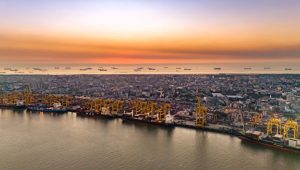
The recent pledge by the minister overseeing shipping, railways and road transport to introduce ‘radical changes’ at Mongla Port within 180 days has brought renewed attention to a long-standing national priority. But the real issue is larger than Mongla itself. It is about whether Bangladesh can reduce its overwhelming dependence on a single maritime gateway and build a more resilient, competitive trade system. Today, Bangladesh’s export economy relies heavily on Port of Chattogram. While this port has developed into a robust logistics ecosystem over decades, such concentration creates systemic risks. Congestion, rising logistics costs, and vulnerability to disruptions are no longer theoretical concerns – they are structural realities. In this context, developing Mongla Port as a credible second logistics gateway is not optional. It is a strategic necessity.
Mongla’s geographic position offers clear advantages. It serves the southwest, reduces inland transport distance for several districts, and holds potential to connect with Nepal, Bhutan and India’s northeastern states. The commissioning of the Padma Bridge has further strengthened this advantage by bringing Mongla significantly closer to Dhaka, cutting road distance by roughly 100 kilometres compared to Chattogram. In logistics terms, this translates directly into lower costs, shorter transit time, and reduced congestion exposure.
Over the past decade, investments in dredging, navigation, and cargo-handling equipment have improved operational readiness. Cargo volumes have grown steadily. Yet these improvements have not translated into a strong competitive position. The reason lies not in capacity, but in ecosystem depth. Globally competitive ports do not operate as isolated terminals. They function as integrated logistics clusters, supported by inland container depots, container freight stations, bonded warehouses, cold-chain infrastructure, and multimodal connectivity. These elements reduce transaction costs, improve reliability, and attract cargo flows.
This is precisely how Chattogram evolved. Over time, a dense network of off-dock depots, shipping agents, freight forwarders, clearing and forwarding agents, and transport operators developed around the port. This ecosystem is now one of its greatest strengths. Mongla, by contrast, has yet to build such an ecosystem. Even with improved facilities, the absence of supporting logistics infrastructure discourages shipping lines from committing regular services. For carriers and exporters, total supply-chain efficiency matters far more than berth availability.

Policy misalignment has compounded the problem. The 20-kilometre restriction on private inland container depots and container freight stations around seaports may have been justified in managing congestion in a dense urban environment like Chattogram. Applied uniformly to Mongla, however, it has discouraged logistics investment in precisely the area where it is most needed. Exporters are forced to rely on distant facilities, increasing inland transport costs and cargo dwell times.
Industry feedback reflects this concern. During a recent discussion organised by American Chamber of Commerce in Bangladesh in collaboration with the U.S. Embassy in Bangladesh, representatives from Maersk reportedly highlighted operational constraints at Mongla, particularly the absence of off-dock facilities comparable to those serving Chattogram. When global carriers raise such structural issues, policymakers should treat them as strategic signals. There are also physical constraints to consider. The existing jetties at Mongla operate under relatively shallow draft conditions, requiring continuous dredging. While dredging programmes have improved vessel access, they remain costly and recurring, creating uncertainty for long-term shipping operations.




Yet this limitation also reveals a strategic opportunity. The Joymonir Gol channel offers significantly better natural conditions, with a draft of around nine metres. Developing a multipurpose terminal at this location, comparable in scale to major national terminals, could reduce dredging requirements to a fraction of current levels while improving operational reliability. The case becomes even stronger with the planned bridge over Mongla Nala, which would enhance connectivity across the port area. A well-planned terminal at Joymonir Gol could combine deeper draft, improved access, and lower maintenance dependency – creating a structural advantage that existing facilities lack.
However, infrastructure alone will not make Mongla competitive. The deeper issue lies in spatial and ecosystem planning. Over decades, Mongla Port Authority has not implemented a comprehensive land-use strategy to support logistics development. Strategic land parcels have been allocated to various public and private entities, including economic zones and private investors. While individually justified, these decisions have collectively limited the port’s ability to develop integrated logistics infrastructure close to its core operations. Without control over surrounding land use, a port risks losing control over its own competitiveness.
If the government’s 180-day reform commitment is to deliver meaningful results, ecosystem development must become the central priority. One immediate step would be to invite Expressions of Interest from qualified domestic and international operators to develop an integrated off-dock logistics complex near Mongla under a public–private partnership framework. Such a facility should go beyond conventional cargo handling. It should integrate inland container depot operations, container freight services, bonded warehousing, and modern cold-chain logistics. Bangladesh’s export diversification increasingly depends on sectors such as agro-processing, fisheries, pharmaceuticals, and fresh produce – segments that require reliable temperature-controlled logistics.
Rail connectivity should be built into this vision from the outset. The ongoing development of the Khulna–Mongla railway line presents a critical opportunity. Extending a dedicated rail link into the logistics zone would transform it into a true multimodal hub, reducing dependence on road transport, lowering costs, and improving schedule reliability. Digital reform must accompany physical investment. Streamlined customs procedures, full implementation of single-window systems, and transparent documentation processes are essential. In modern supply chains, administrative predictability is as important as physical infrastructure.
As the country prepares for a more competitive global trade environment, efficiency, reliability, and resilience will determine its ability to sustain export growth. Overreliance on a single dominant port is no longer sustainable. Mongla does not lack strategic relevance or natural advantages. What it lacks is alignment between infrastructure, policy, and logistics planning. The minister’s pledge has created momentum. The real test is whether that momentum can translate into coordinated reforms: revisiting restrictive regulations, enabling private investment, developing an integrated logistics ecosystem, and aligning infrastructure with industrial strategy.
With the Padma Bridge already reshaping inland connectivity, the window for positioning Mongla as a true second logistics gateway is now open. If acted upon decisively, this moment could redefine Bangladesh’s maritime future. If not, it risks becoming another missed opportunity.
The writer is a Maritime, Logistics and Supply Chain Policy Analyst; Adjunct Faculty, Bangladesh Maritime University; Former Head of ICD Kamalapur & Pangaon ICT, CPA