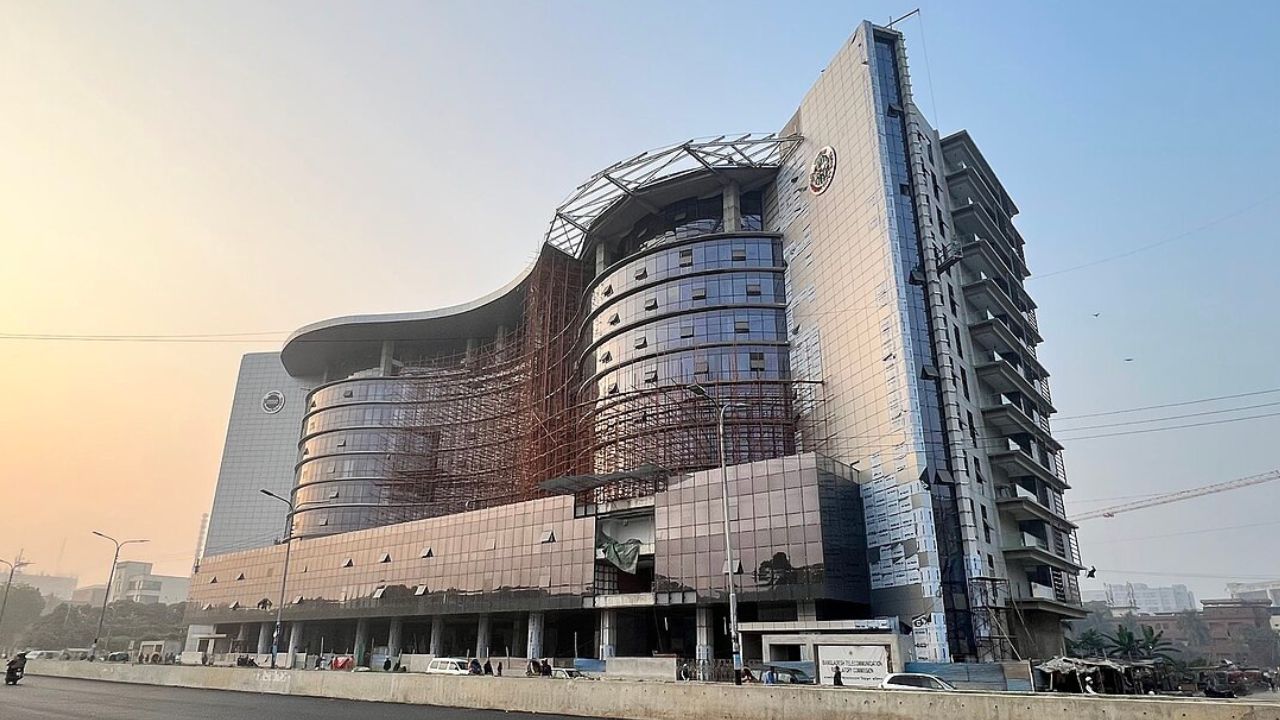

The Bangladesh Telecommunication Regulatory Commission (BTRC) office in Agargaon, Dhaka, was attacked and vandalised on Thursday afternoon by mobile phone traders protesting at the launch of the National Equipment Identity Register (NEIR).
As part of the mobile handset registration requirement, the NEIR was introduced on Thursday to curb the entry of illegal handsets into the country’s network.
The BTRC announced that the new system would block illegal handsets from joining the network.
Tejgaon Division Deputy Commissioner of Police, Ibne Mizan, told TIMES of Bangladesh, “A group of people suddenly launched an attack and caused extensive damage. They threw bricks and broke the glass windows. The police controlled the situation afterwards, and 26 people were arrested in joint operations by the police and army. A case will be filed.”

A BTRC official said that, after 4pm, some individuals broke the glass windows around the BTRC building’s boundary. A vehicle parked outside the building was also damaged. To control the situation, the police and army were deployed at the site.
Another official said, “The vandalism started suddenly after 4pm. Hundreds of protesters gathered on the street and threw bricks at the building, causing damage to various windows. No one could leave the premises even after office hours.”



Amid the sudden attack, BTRC officials were left frightened. The glass of the BTRC mosque was also shattered during the attack while staff members were praying. However, no injuries were reported in the incident.
Later in the evening, broken glass was seen in the BTRC building’s corridor. The widespread brick-throwing had also damaged the main building’s glass.
Several Ansar members stationed at the BTRC office said that mobile phone traders had been protesting since 2pm. Around 3pm, they began vandalising the building. The BTRC’s bus, parked in an adjacent lane, was also destroyed. By 6pm, army, police, and RAB personnel had been deployed to the building, and several people were seen being arrested and taken away in police and army vehicles.
The BTRC said that the NEIR was introduced to prevent the use of illegal handsets, block stolen phones, and eliminate chaos in the mobile market. Technically, NEIR works by verifying three elements: IMEI, SIM number, and IMSI (International Mobile Subscriber Identity). The system does not record calls, read messages, or monitor internet activity. It only ensures that illegal handsets entering the network are blocked.
Earlier, on 10 December, mobile phone sellers had protested at the Karwan Bazar intersection, demanding the closure of illegal handsets or ‘grey market’ phones. In response, the Ministry of Post and Telecommunications postponed the launch of the NEIR by three months. The deadline for submitting details of unsold or stock phones was extended until 31 December. That deadline has now passed.
In another briefing at the Foreign Service Academy in the afternoon, Press Secretary Shafiqul Alam announced that taxes on mobile phone imports and domestically produced phones had been reduced. The customs duty on imports has been cut from 25% to 10%, while the tax on domestically produced phones has been reduced from 10% to 5%.