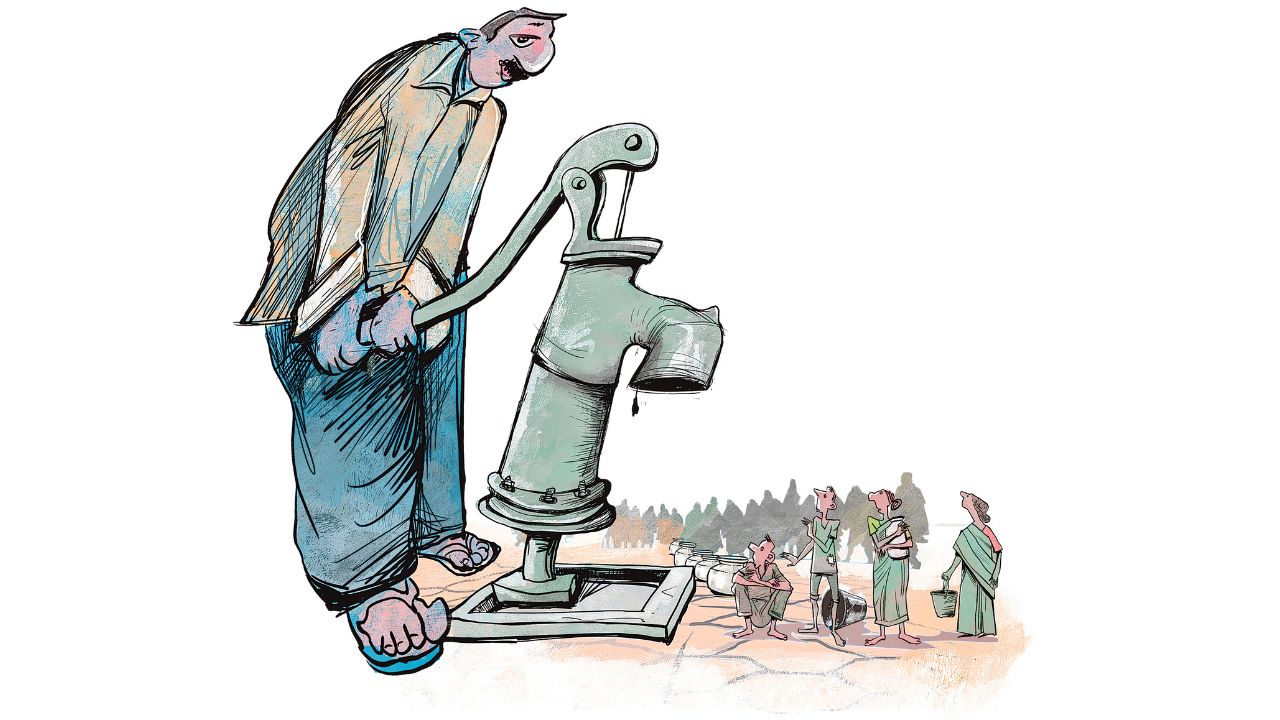



The Barind Tract is running out of water as groundwater sinks beyond reach, wells weaken and irrigation shrinks, leaving farms, drinking supplies and millions of lives increasingly exposed across the country’s drought-prone northwest.
Nearly one crore people are directly affected by the crisis. The government has declared 1,469 mouzas across 25 upazilas of Naogaon, Rajshahi and Chapainawabganj as facing an “extremely high water crisis”. Another 884 mouzas are classified as “high” and 1,240 mouzas as “moderate” crisis areas.
The situation is most severe in Niamatpur, Porsha, Patnitala, Dhamoirhat and Sapahar upazilas of Naogaon, where groundwater has fallen so sharply that adequate water is unavailable in some areas even after drilling between 300 and 1,400 feet.
Experts blame indiscriminate extraction, saying shallow and deep tube wells have been installed several times above approved levels, putting severe pressure on underground aquifers.
Chowdhury Sarwar Jahan, former pro-vice-chancellor of Rajshahi University and former professor of its Department of Geology and Mining, said there was no alternative to expanding surface-water use.

Canals, beels and ponds must be restored, rainwater conserved, farming shifted towards less water-intensive crops and privately owned tube wells strictly controlled, he said.
The impact is already visible in agriculture. A deep tube well that once irrigated 150 to 180 bighas can now supply only 90 to 110 bighas in many areas. Farmers are reducing Boro cultivation, shifting to less water-intensive crops or leaving land uncultivated. Costs are rising, while some residents must travel long distances for drinking water.
The decline has unfolded over decades. In parts of Niamatpur, Porsha, Sapahar and Dhamoirhat, groundwater was available around 90 feet below ground in 1992. Over time, wells had to be drilled deeper – first to 110 feet and later to 120 feet.
Recent statistics show groundwater levels falling from 29.09 metres in January 2023 to 31.04 metres in January 2025, with no significant replenishment in crisis-hit areas.




Saiful Islam, who operates a deep tube well at Shialdanga village in Porsha, has witnessed the change firsthand. His well initially drew water from 90 feet before successive drilling pushed the depth to 110 feet and then 120 feet.
“At the rate the water level is falling, it seems that after some time there will be no water left to draw,” he said.
The government has imposed 11 restrictions under the Bangladesh Water Act, declaring affected areas water-crisis zones for 10 years. New tube wells and groundwater extraction for non-drinking purposes have been prohibited, while authorities aim to reduce dependence on groundwater through crop diversification.
The crisis is reshaping farming patterns. Department of Agricultural Extension officials said rice cultivation in Naogaon declined from 1,98,465 hectares in 2015 to 1,92,050 hectares now. Meanwhile, mango cultivation has expanded to 30,310 hectares from about 6,000 hectares in 2016, while wheat cultivation has fallen from 26,000 hectares to 8,000 hectares.
The Barind Multipurpose Development Authority says around 1 lakh hectares of land are at risk, although it maintains that Boro production is not yet under threat.
Md Rezaul Islam, executive engineer of BMDA Region-1 in Naogaon, said irrigation was continuing and “the situation has not yet reached the stage where deep tube wells need to be shut down”.
Authorities are trying to increase surface-water use by excavating canals and bringing water from the Mahananda and Padma rivers. However, officials acknowledge that replacing groundwater dependence will not happen overnight.
The government is also working to secure drinking water supplies. Naogaon Deputy Commissioner Mohammad Saiful Islam said climate-resilient projects were being implemented to provide safe water and recharge groundwater. The district has 2,107 water storage points, each capable of holding 3,000 litres, while authorities are promoting community-based water use.
Development organisations are also pursuing alternatives. The Coca-Cola Foundation-funded DASCOH Foundation’s SAWAB project is working across 13 unions in Niamatpur and Gomostapur on safe water systems, pond re-excavation, rainwater harvesting and groundwater recharge.
Project Manager Jahangir Alam Khan said 34 community water systems, four school WASH blocks, facilities at two community clinics, 20 re-excavated ponds and 10 rainwater-harvesting systems had been established, benefiting around 38,970 people.
Environmentalists, however, warn that isolated measures will not be enough. Nice Parvin of Bangladesh Poribesh Andolon called for strict enforcement of restrictions, modern farming methods and planned management of water resources.
As wells are forced deeper, irrigation reaches less land and millions remain inside officially designated crisis zones, the struggle to secure the Barind’s future is becoming a race against disappearing groundwater.